Activity
Mon
Wed
Fri
Sun
Aug
Sep
Oct
Nov
Dec
Jan
Feb
Mar
Apr
May
Jun
Jul
What is this?
Less
More
Memberships
Syntropic Sunlands w/ Milan
178 members • Free
Food Forest Family (FREE)
3.7k members • Free
5 contributions to Syntropic Sunlands w/ Milan

Apr 17 •
Infestation Block of Acacias
After a year and a half of thinking about it -and after visiting Scott Hall on his farm, as well as the Permadynamics family in New Zealand - I finally took the leap and planted an infestation block of Acacia saligna. In this video, I am breaking down what Infestation actually means, and why it can be such a powerful lever - especially in brittle climates (Arid, Semi-arid or Mediterranean climates) Infestation isn’t a standalone method. It’s the first step in a broader framework called Successional Accumulation, a concept developed and coined by Scott Hall. The process unfolds in these three stages: - Infestation - Stabilisation - Succession We’ll dive deeper into each of these steps here on the platform as we go ! What I’ve found is that this approach is far more practical at scale than trying to plant everything all at once - especially when you’re limited in water, amendments, or access. And Scott covers his experience with it on his platform. It’s a way to work with constraints instead of fighting them, and it can significantly reduce costs while setting up a long-term resilience strategy. I’d really love to hear your thoughts. What species have you seen that could play a similar role in your climate ?

1 like • Apr 22
@Milan Marquis I'm not doing precisely the infestation move you are, but I'm trying sorghum as a placenta. Inspired by Gotsch suggesting that climate change means we should look to our neighboring climates for solutions, I'm guessing pulling this hardy arid-Africa annual into the Mediterranean context will make great ground cover, it can be chopped and dropped a few times (unlike sunflowers I believe?). Could be worth a shot in your infestation, sorghum is cheap.
1 like • Apr 22
@Milan Marquis I have seen Jerusalem Artichoke here and it grows aggressively and comes back every year. Good luck!
Apr 15 •
A Tip to Prevent Weeding - Video Filmed in February
The Fava Bean Trick ! Fava beans are great for smothering weeds, and they sprout easily with the first rains. In this video, I show how I use them - and how much easier they make the work. No need to get on your knees pulling grasses in the first year. You get 2 cuts with them, and each cut took me 20min/100m/1 person. It's really not that much work - about 2 and a half hours for these 3 rows of 240m each. By the time they phase out, it’s already Summer here in the Mediterranean, so there’s basically no need to weed anymore. Then when the rains return, your rows should be established enough that weeding becomes a minimal task. You might need a bit of weeding in year two if your trees haven’t grown enough - but in my experience, one more pass is usually enough - cutting them, not even uprooting them. After that, the trees outcompete the grasses and take over. What other plants do you think could do a similar job? I’m thinking artichokes or cardoons could work really well - but they’d need to be started as seedlings.
1 like • Apr 22
Yeah I've noticed stands of fava beans suppress grass really well, how do you prune them? At the base?
Mar 4 •
The Infestation - How to do syntropic ag amendments free
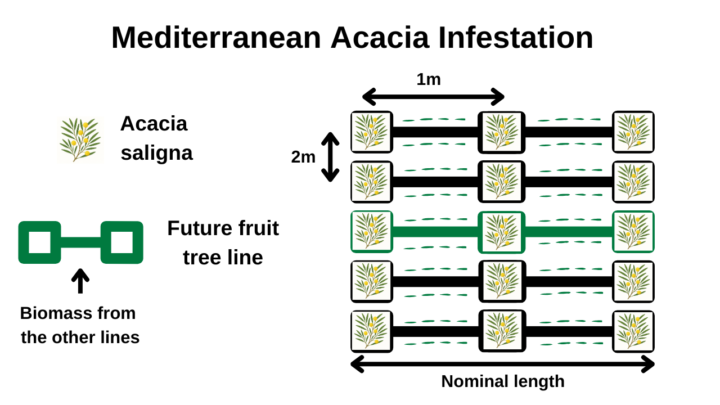
Hey everyone ! For the past two years I’ve been working toward something I’m finally beginning to implement: "the Infestation" a term coined by Scott Hall. Those of you on his platform will likely be familiar with it. Scott actually shared a design with me, and I’m currently in the middle of preparing the soil. - What is an infestation, and what’s the purpose? The concept of an infestation is simple—it’s essentially how nature most efficiently drives succession forward from bare or infertile soil. In natural ecosystems, a tough, fast-growing pioneer species colonizes poor ground because it’s the most adapted to those harsh conditions. It rapidly occupies space, outcompetes other plants, and establishes dominance so effectively that even grasses have little impact on its growth. After a few years, this often results in a dense hedge or stand of that species—you can clearly observe this along many roadsides. In my area, the species that naturally behaves this way is Acacia saligna. It self-seeds readily and is extremely resilient. Successional Accumulation Inspired by this natural process, Scott has been developing the concept of “Successional Accumulation.” The goal is to run syntropic agroforestry systems without external amendments by harnessing the initial growth and biomass production of the infestation phase. The system progresses through: - Infestation phase (pioneer dominance and biomass buildup) - Stabilisation phase - Succession phase - The end goal is the same abundance we seek in syntropic ag - but achieved only through plant power rather than external inputs. I won’t dive too deep into each phase here, but I’m happy to discuss further. Why acacias in the Mediterranean? Scott and I have discussed extensively how to adapt this to Mediterranean climates. We both see Acacia species as particularly promising pioneers (e.g., Acacia saligna, Acacia dealbata, Acacia pycnantha, etc.).
2 likes • Mar 6
@Milan Marquis As far as conditions go we're fairly blessed with no freezing, good sediment composition and relatively good soil conditions (obviously still not as good as a forest floor but we're working on it)
2 likes • Mar 6
@Martin Quach In Valencia ours is Leucaena but if you have the dreaded mimosa "weed" I'm sure acacia dealbata would do the job enthusiastically. I like Nitrogen fixers :)
Jan 21 •
Powerhouse Plants for the Mediterranean Climate
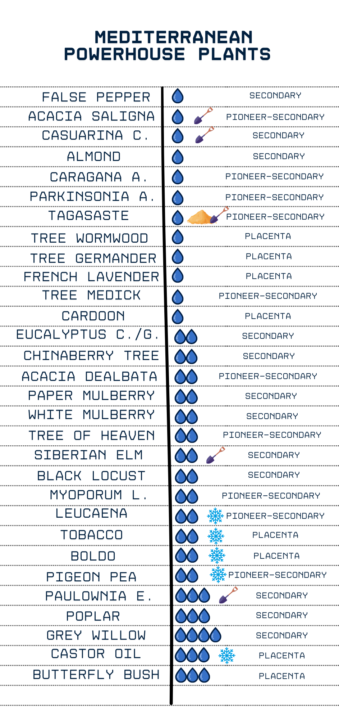
Electing your plant species for your syntropic system is a very difficult process for many. It's this typical overwhelming process where you don't know which plants to choose, that's why I aimed at making it much easier for you; condensing it down to 30 plants that grow very fast. Bear with me, it doesn't include later succession species, but don't worry, it's much more important to elect the right species entering into the secondary phase of a forest rather than thinking too much about which species will come later, as you can plant these later anyway. Most important advice here, don't overthink it, use whatever species grows fastest in your context to establish your system ASAP. I've separated the low water needs plants from the moderate water needs from the high water needs plants - symbolized by the water droplets. To be clear this is about water requirements at establishment, many plants in the moderate water needs will become tough as nails over time but if not watered enough at establishment, they will die. As well, the pile of sand (only tagasaste) symbolizes the need of the plant to be in loose or sandy soil. The shovel means these plants require good decompaction to get a good headstart - meaning breaking down the hardpan in a clay compacted soil - ex: using a subsoiler. Also, the snowflake means that these plants are frost sensitive, typically when temperatures go lower than 2 degrees they can exhibit damage. these plants are truly meant for a mild Mediterranean climate - especially mild winters. Lastly, the successional role of these plants is added at the end : - Placenta : Short-lived - Usually about 5 years maximum within a Mediterranean syntropic system. They can reach maturity within 6 months to a year and provide the fastest growth at establishment of your system. - Pioneer - Secondary : Plants that consolidate the transition from scrubland to forest. They are fast-growing too - but not as much as the placenta plants, usually reaching maturity around year 2 or 3. They create these conditions for the secondary forest to take place by providing high amounts of biomass and shade for the secondary seedlings below.
1 like • Feb 16
Curious if you found cardoon to be better than artichoke? Or are they similar as placenta species?
Feb 2 •
We're in for one of the wettest winters - What do we do about it ?
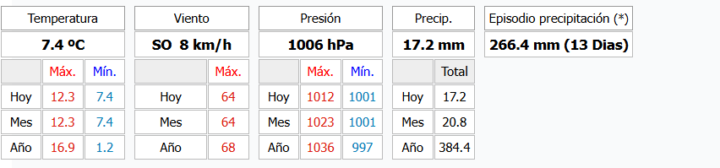
I’ve never seen such a wet January — it’s often the driest winter month here in Andalucía. Here’s a screenshot of the meteorological records for my area for January alone — nearly 400 mm! That’s almost what we usually get in a whole year, since the annual average is around 450–500 mm. If we add the rainfall since Autumn 2025, we’re probably already over 600 mm. It looks like we’re in the middle of a La Niña influence. I’m no meteorologist, but here’s what my gut tells me: - The last two years, aquifers have been able to recharge more than during the previous drought years. - We seem to have perfect conditions for larger-scale plantings, thanks to the rainfall. This is one of the reasons why, after seeing the heavy autumn 2024 rains, and the total rainfall of 2025 we went ahead with a large syntropic planting (~6000 m²). Doing this is especially important when water is limited - mind you, we’re on a hill where wells dry up faster than in the lowlands. So why is this the right time to plant? El Niño and La Niña cycles don’t happen from one year to the next. Each phase usually lasts 2–7 years, because ocean and atmospheric systems take time to shift. This creates clusters of wet or dry years, rather than a perfect alternating pattern. For planting, this is crucial: if we’re at the end of a wet phase, it’s a great opportunity to plant. The soil still has moisture, the aquifers are recharged, and there’s a high chance of more rain during the rest of winter and spring, maybe even into early June if we’re lucky. Let the trees and the soil soak up that rainfall, we'll end up with deeply taprooted trees that will grow more vigorously than in drought years, it's the perfect opportunity - the timing couldn't be better !
1 like • Feb 9
In Valencia with a bit better typical rainfall than you guys down further south, but yeah, this has been a wet winter with consistent rainfall. Lucky me to be planting a system right now!
1-5 of 5

@blake-selph-1202
Long time tree-hugger, community gardener with Xarxa Alimenta in Valencia, aspiring agroforestry consultant and designer
Active 66d ago
Joined Feb 5, 2026
La punta, Valencia, spain