Activity
Mon
Wed
Fri
Sun
Mar
Apr
May
Jun
Jul
Aug
Sep
Oct
Nov
Dec
Jan
Feb
What is this?
Less
More
Memberships
Women Build AI
1.6k members • Free
Customer Funded Founders
424 members • Free
AI Automation (A-Z)
131.4k members • Free
Women in Tech Power Network
61 members • $53/m
Grow Your Skool
5k members • Free
WavyWorld
45.1k members • Free
Skoolers
191.2k members • Free
Google Ads Foundations
1.6k members • Free
AI Automation Society
257k members • Free
27 contributions to AI Automation Society

23d •
FREE Book - Mobile Dev: React Native Notes for Professionals
Hey everyone! I'm giving away a copy of "React Native Notes for Professionals" — completely free. It's attached below. No email required. No catch. Why React Native? It's one of the fastest ways to build real mobile apps for both iOS and Android using a single codebase. Whether you're breaking into mobile development for the first time or expanding your skillset — this is a great place to start. What's inside: → Setup guides for Mac, Windows & Linux → Props, State & Component patterns → Styling with Flexbox (with visual examples) → Navigation best practices → HTTP requests & API integration → Push notifications setup → Firebase authentication → How to create a shareable APK → Unit testing with Jest → And much more... Who this is for: ✅ You're curious about mobile app development ✅ You're new to React Native and want a solid reference ✅ You've been building apps but want to level up ✅ You learn best from real code examples What makes this book different: It's compiled from Stack Overflow documentation. That means it's written by developers who actually solved these problems — not theory, but real solutions. 80+ pages. 32 chapters. Zero fluff. Happy building! 🚀

2 likes • 22d
Nice one @Max Gibson thanks

Oct '25 •
Stop Marketing Before You Know Who You Are (Copy These 2 Brand Prompts)
I see this all the time. People jumping straight into content calendars, posting schedules, and marketing tactics before they've answered the most important question: Who are we? Not what do we sell. Not what features do we have. But who ARE we as a brand? What do we stand for? How should people feel when they interact with us? And here's what happens when you skip this step. Your messaging feels inconsistent. Your content doesn't land. You're copying what other people do because you're not sure what YOU should be doing. Every post feels like you're throwing spaghetti at the wall. I've been there. It's exhausting. But here's the thing. You don't need a $10,000 brand strategy consultant to figure this out. You need the right questions and a framework to think through your answers. That's what these two prompts do. The first one helps you discover your brand identity—who you are, what you stand for, and how your product or service expresses that. The second one takes that identity and turns it into an actual marketing strategy and brand narrative you can use. These work together as a system. And honestly? This is some of the most valuable brand work you can do. Why This Matters Most marketing advice starts with tactics. Post three times a day. Use these hashtags. Try this trend. But tactics without identity just create noise. When you're clear on who you are, everything gets easier. You know what to say. You know how to say it. You know which opportunities to say yes to and which ones aren't aligned. Your content becomes consistent. Your voice becomes recognizable. People start to get what you're about. That's what these prompts help you build. PROMPT #1: Brand & Product Identity Discovery This is where you start. Copy and paste this into ChatGPT or Claude and let it guide you through defining your brand foundation. --- BEGIN PROMPT --- You are a Brand Identity Strategist and Product Definition Coach with deep expertise in emotional branding, market positioning, and authentic storytelling.
5 likes • Oct '25
Thanks Titus @Titus Blair useful for many I suspect.

🔥
Oct '25 •
🚨 Massive Global AWS Outage – Huge Impact on Digital Services
👋 Hey teammates, Today, Monday, October 20, 2025, the US-EAST-1 region of Amazon Web Services (AWS) experienced a major outage starting at 8:40 AM, disrupting hundreds of websites, apps, and platforms worldwide. 🌐 Some of the affected services include: - 🛒 Amazon.com - 🎬 Prime Video - 🎙️ Alexa - 🔎 Perplexity - 🎮 Fortnite, Roblox - 📸 Snapchat - 🦉 Duolingo - 💻 Zoom, Canva - 💳 BBVA, CaixaBank, Santander ⚙️ What’s happening:AWS reported a spike in errors and latency across multiple systems.Although engineers are working to restore services, the exact cause and estimated recovery time remain unknown. 💥 Consequences: - Millions of users and companies unable to access critical tools - Online payments, communication, and productivity platforms down - Issues with navigation, image loading, and overall web performance 💡 Takeaway:This incident shows how heavily the digital world depends on AWS, and highlights the need for cloud resilience and redundancy strategies. 💬 What about you? 👉 Did today’s outage affect your tools or projects? 👉 What steps should businesses take to prepare for these situations? Let’s discuss it below 👇

1 like • Oct '25
Thanks just seen that and it explains a big aws related service problem had over the weekend! Thanks @Joan Marquez

🔥
Oct '25 •
👀 Fears over AI bubble bursting grow in Silicon Valley
Key Takeaway: A surge of intertwined megadeals, cross-investments, and “vendor financing” is fueling AI’s meteoric rise, stoking fears that valuations outrun real demand and could trigger a painful, economy-wide unwind. More Insights: - Sam Altman admits “bubbly” pockets but says OpenAI’s growth is real—even as it remains unprofitable. - Big warnings (BoE, IMF, Jamie Dimon); AI names drove ~80% of U.S. market gains; Gartner pegs AI spend near $1.5T by end-2025. - OpenAI’s web: $100B with Nvidia, plans to buy billions from AMD, deep ties with Microsoft and Oracle; Nvidia also backs CoreWeave, an OpenAI supplier. - Critics call this “circular/vendor financing” (Nortel déjà vu); Nvidia’s Jensen Huang says no exclusivity or spending strings attached. - Signs of froth: splashy plans without secured capital, retail rush into chip stocks, massive 10-GW data-center builds—and environmental concerns—though some argue overbuild could still seed future innovation. Why it matters: If AI demand is being propped up by circular money rather than durable economics, the eventual comedown could hit chips, cloud, and startups simultaneously—leaving stranded megaprojects and exposing how concentrated the funding power has become—so transparency, stress-testing, and true unit-economics discipline are critical right now. Article
1 like • Oct '25
Hardly a surprise these valuation’s unsustainable when will Open AI have more than 4% paying customers? The scale is a concern and no wonder so aligned with US administration. But what price those pieces of silver?
Oct '25 •
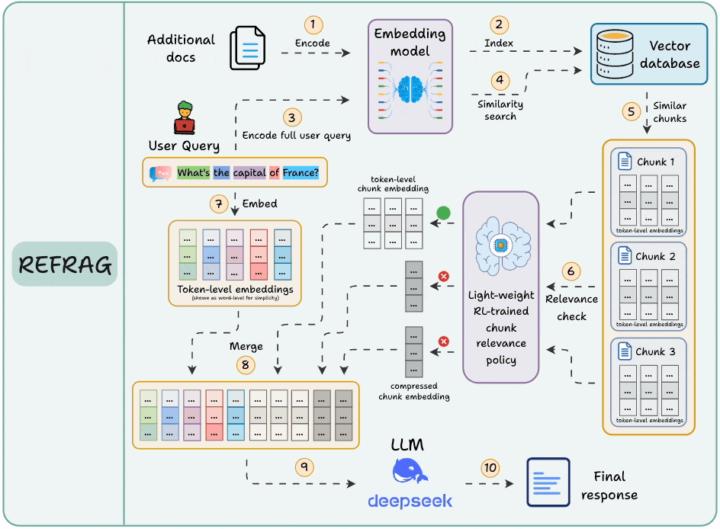
You're Burning Money with RAG, REFRAG instead! Meta Just Fixed It (30x Faster, 16x More Context)
If you built a RAG system, you made a crucial mistake. Not your fault—everyone did. You're feeding your LLM massive amounts of text it doesn't need. Paying to process tokens that don't matter. Waiting for responses while the model reads through garbage. And getting slower, more expensive results than necessary. Meta AI just released research that proves something most people building RAG systems don't realize: most of what you retrieve never actually helps the LLM generate better answers. You're retrieving 10 chunks. Maybe 2 are useful. The other 8? Dead weight. But your LLM is processing all of them. Reading every word. Burning through your token budget. Adding latency to every response. This is the hidden cost of RAG that nobody talks about. And it's getting worse as you scale. But here's what just changed. Meta's new method REFRAG doesn't just retrieve better. It fundamentally rethinks what information actually reaches the LLM. The results? 30.85x faster time-to-first-token. 16x larger context windows. Uses 2 to 4 times fewer tokens. Zero accuracy loss. Let me show you exactly what's happening and how to implement this approach right now. The Problem With Every RAG System You've Built Traditional RAG works like this. Query comes in. You encode it into a vector. Fetch the most similar chunks from your vector database. Dump everything into the LLM's context. Sounds good. Works okay. But it's brutally inefficient. Think about what's actually happening. You retrieve 10 document chunks because they're similar to the query. But similar doesn't mean useful. Some chunks are redundant—saying the same thing different ways. Some are tangentially related but don't answer the question. Some are just noise. But your LLM reads all of it. Every single token. It's like making someone read 10 articles when only 2 are relevant, and you're paying by the word. The costs compound fast. More tokens means higher API bills. Longer processing time means slower responses. Bigger context means you hit limits faster. And none of it improves your answer quality.
3 likes • Oct '25
There is a lot to be achieved with Graph combined as well and also hypergraphing which eventually leads to no RAG at all. Will tag some references in here.
1-10 of 27

@amanda-moore-7701
Wings4Mind - AI BI Data Business Solutions Architect/Consultant with 30+ years experience and loving the era of AI. Cofounder BeAIVisible.ai
Active 2h ago
Joined Jun 24, 2025
UK
Powered by