Activity
Mon
Wed
Fri
Sun
Apr
May
Jun
Jul
Aug
Sep
Oct
Nov
Dec
Jan
Feb
What is this?
Less
More
Memberships
Hey Systems
36 members • $47/m
Kingdom AI Learning Lab
267 members • Free
The Paid Up Club
273 members • Free
Coaches Blue Ocean
681 members • $49/month
Empowering Women in Business
41 members • Free
23 contributions to The Paid Up Club

4d •
Sales and Marketing made easy with AI Tools - Research Help please
This is the topic of a keynote I will be giving in a few weeks - in the words of AI 'In this fast paced world ...'. I would love to get a picture of what AI tools you have started to use and how are you using them to support your business - specifically in Sales and Marketing? I know there are so many options that it can be overwhelming - are you still taking tentative steps and asking AI to help with your writing, content creation, social captions? Are you using GPT's? Writing your own GPT's? Setting up workflows specific for your business? Or something else altogether? There is no right or wrong answer - we are all in this together and AI is not going away - so how are you making it work for you ... and your business? Thanks so much for your help - happy for you to message me direct if you are not sure how to articulate your answer here.
1 like • 3d
@Rachel Groves love this Rachel. Thanks for sharing. Are you finding nuanced differences between Claude and Chat in their output? Your final comment - it’s like having a personal assistant- YES! Exactly that.
1 like • 56m
@Val Ross Hi Val - dip your toe into the water - you will find it to be warm! It will blow your mind a bit.
5d •
The Opening Line I've Used for 30+ Years (And Why It Still Works)
"I don't have all the answers." That's how I start every presentation. Have done for 30 + years. Here's the backstory: When I did my first seminar after selling my business, I noticed something: too many speakers had an "I know it all" style. Great content. But the delivery felt... off. So I thought: How can I be strong but also disarming? I landed on this opening: "Hello, my name's Peter Thomson. I'm delighted to share tried and tested ideas with you today. But before we start, there's one thing I need to tell you: I don't have all the answers." People told me it made them relax. It felt honest. Authentic. Years later, I learned WHY it worked: Professor Robert Cialdini (Influence: Science and Practice) identified it as a persuasion principle: admit a failing. The idea: Tell people what you CAN'T do before you tell them what you CAN do. Not weakness. Authenticity + authority. Your challenge: Think about your next presentation, pitch, or client conversation. What's ONE thing you could admit upfront that would make you more relatable? Drop it in the comments
1 like • 4d
I have used this opener a few times - and I am certainly planning on using it in a few weeks time when I am speaking at a conference on 'Sales and Marketing made easy with AI tools'! How is this topic even possible to speak about when it changes so much? I have jested that my talk could be fit for the Comedy Store and then I pull myself out of the pit of Imposter and know that whilst I don't know everything, I don't have all the answers - I know something and that something in the way that I deliver it will give someone comfort and a feeling of ease to carry on and be curious. It is certainly an interesting time preparing for this 'in this fast paced world', 'in this ever changing world' ... got to love AI - always brings a smile to my face and gets things done far quicker.
26d •
What's Your Unique Value Proposition? (And Why It Matters)
Over my many years in business, I've come to realise that one of the most powerful tools we can have is our Unique Value Proposition, our UVP. It's not just a fancy marketing term. It's the very essence of what we bring to our clients and to the marketplace. The problem? Most people get this wrong. They create something bland. Something that could apply to almost anyone in their field. In this video, I walk you through my 5-step formula for creating a UVP that actually attracts those "love to work with" high-paying clients. Have a watch and let me know what you think. And if you're open to. it, drop your current UVP below. Let's see if we can sharpen it together. 👇

1 like • 11d
I have been working on my MVP over the last few weeks having had a bit of a change of direction this year in who I want to work with. Still not totally there yet - my key pieces are: I work with midlife professional services people such as Doctors, Dentists, Pharmacists, Lawyers, Vets and business owners who want to retire from their current role and take up a new one to have a legacy and significance and to make an impact or give back in a way that is fully satisfying and at ease. I could further nuance this by adding in that most of my clients have been men and are of the Christian faith - or of other faiths. As I say - a WIP. Any thoughts appreciated @Peter Thomson
0 likes • 8d
@Peter Thomson Oh Peter you are so right - to be fair I don't like the phrase but it is one of those that is used so much and people understand it - I'm going to change it - I didn't take anything and the people that I will be working with will have given so much already - its part of their DNA - so that part of them is not going to change. ... to make an impact and to happily give with ease and satisfaction. Not quite right but better for using 'happily give'.
11d •
The Small Detail That Doubles Client Loyalty
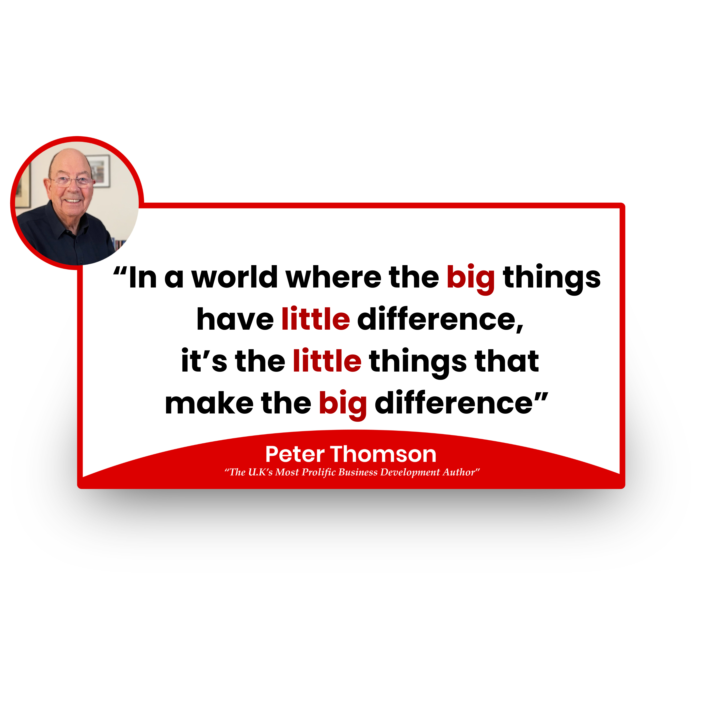
You know what really fascinates me? It's not the grand gestures or the flashy promises that win clients over. It's the small stuff. The details. The things that most people overlook. Think about it this way... When you turn up to a client meeting and they've misspelt your name on the parking sign, what does that tell you? Or when they forget a preference you shared last time you spoke? These moments speak volumes about how much they truly value the relationship. Here's the thing most professionals miss: your clients aren't just buying your product or service. They're buying an experience. They're investing in a relationship with someone who remembers them, values them, and shows up consistently with that same level of care. I learned this the hard way over my 30+ years in business. I've seen advisors lose high-value clients not because their technical expertise wasn't up to scratch, but because they forgot the client's daughter's name. Or didn't follow through on sending that book they mentioned in passing. The relational client, the one who stays, pays, and refers you to others is looking for more than competence. They're looking for someone who makes them feel seen. Heard. Valued. That happens in those tiny moments. The personalised thank-you card that arrives in the post. The book you order and send to their office because it came up in conversation. The detailed notes you keep from every meeting so you never have to ask them the same question twice. These aren't add-ons. They're fundamentals. And here's what's brilliant about this approach: whilst your competitors are competing on price and chasing transactional customers, you're building a business filled with loyal clients who wouldn't dream of going elsewhere, regardless of what you charge. Because in a world where the big things have little difference, it's the little things that make the big difference. So here's my question for you: What's one small detail you could add to your client experience this week that would make them feel truly valued?
2 likes • 11d
I love everything about this post @Peter Thomson - it's something I also endeavour to do. I struggled for a few years with forgetting things - I was so good at relying on my memory but then my memory started to let me down. Now it's a notebook in a meeting - a voice note into Notion or to my phone reminders. You made a great impression on me when I joined one of your workshops and you gave everyone a copy of Ayn Rands book Atlas Shrugged. The ability to give gifts (not just the physical box to unwrap - most important gift in this economy is listening), is life changing.
19d •
☕ The Starbucks Lesson: What Do You REALLY Sell?
I was having a coffee with my wife Sharon at Starbucks, and we got talking about Howard Schultz, the CEO. He said something in a memo to Starbucks partners that I absolutely love: "We're not in the coffee business serving people. We're in the people business serving coffee." Wow. Just think about that for a moment. What Do You Really Sell? This got me thinking about our businesses. Not what we DO, but what we really SELL. Consider these examples: Holiday Company → Not hotel beds → Really sells: DREAMS Bookseller → Not words → Really sells: ESCAPES Restaurant → Not food → Really sells: MEMORIES Wouldn't it change the way you market if you thought this way? The Hidden Benefit Ted Nicholas once told me about what he called "the hidden benefit" the second-level benefit that's deeper than first imagined. This isn't just about features and benefits. It goes much deeper than that. I wrote in my notes: "The idea is far more stretching than just features and benefits. It's like a twirling, swirling whirlpool, deeper than first imagined." My Example Part of my business is: I help people write, create and market informational products, grow their fees, and get properly rewarded for the positive difference they make. But what do I really sell? Significance. That might seem strange. But when I know I sell significance, doesn't it change the way I market it? Real World Application When I was doing some work in Hong Kong, I was advised by Chinese people living there that perhaps the second-level benefit for that audience was RESPECT. So I wrote the copy focusing on respect, not on the amount of money somebody might make. It worked brilliantly. Your Challenge Take some time, some precious, precious time, to think about your business. What is it that you really do? Not the WHAT... but the deeper WHAT. What hidden benefit do your clients actually buy? Share your thoughts below 👇 What do YOU really sell?
1 like • 11d
There are times I realise I sell 'permission'. There are conversations I have with people who have not shared the information with anyone else - they share it with me - I prod and delve a bit deeper, they come up with more insights and suggestions - ultimately we agree on next steps and they end the conversation by saying - thank you for giving me permission to do xyz. I found it quite odd to start off with - I didn't literally give them permission but that is what they gained. Not sure how I use that in marketing - any thoughts @Peter Thomson
1-10 of 23
@julie-stevens-4643
Christian Coach & Mentor giving people of faith tools to discover their 'What's next?' after a successful career as a Doctor, Dentist, Vet, Barrister.
Online now
Joined Dec 12, 2025
Rochester, Kent, UK
Powered by