Activity
Mon
Wed
Fri
Sun
Jul
Aug
Sep
Oct
Nov
Dec
Jan
Feb
Mar
Apr
May
Jun
What is this?
Less
More
Owned by David
Master DeFi from beginner to advanced. Security-first curriculum, live mentorship, gamified learning. Join us and build DeFi expertise safely.
Memberships
424 contributions to DeFi University

9d •
Polymarket drama
Anyone have thoughts on the latest Polymarket resolution drama? There seems to be a pattern of behavior here, can they continue to be successful with all these issues?

1 like • 9d
thats a good point @Carlos Kessler so i asked Gemini 3.5 a few questions about it and here's what I learned: The resolution drama is getting harder to ignore, and it’s exposing a massive structural flaw in how "decentralized" prediction markets actually operate. If you look at the recent MicroStrategy ($MSTR) Bitcoin sale fiasco (where they sold BTC, but the market resolved "NO" on a filing technicality) or the $345M Iran peace deal semantic standoff, a really concerning pattern emerges. Here is why this is a massive deal for DeFi, and whether they can actually survive it: 1. The "Decentralized" Oracle is Broke Polymarket relies on UMA to resolve disputes. In theory, it's decentralized. In practice, it's a whale game. Recent data shows that just 9 wallets control over 50% of the UMA voting power, and over 60% of active UMA voters also trade on Polymarket. Because UMA penalizes voters who end up in the minority, voters are financially incentivized to vote with the "expected majority" rather than objective truth. If a whale has a $10M position on Polymarket, they can literally buy up UMA tokens, vote in their own favor, and protect their bet. That's not a market; that's a consensus exploit. 2. From "Predicting" to "Lawyering" We’re seeing a shift where winning a bet isn't about predicting the future anymore—it’s about predicting how Polymarket will interpret its own fine print. When platforms issue retroactive rule clarifications after millions are pooled, it destroys user trust. Users feel like they are playing against a house that can shift the goalposts mid-game. 3. The Insider Trading Problem The recent indictments (like the U.S. soldier betting on the Venezuela raid using classified intel, or IDF members betting on flight schedules) prove that these markets are being warped by asymmetric information. It changes the narrative from the "wisdom of the crowd" to "who has the best classified leak." Can they continue to be successful?
Jul '25 •
Welcome to DeFi U!
Hello everyone and welcome. As we begin building out DeFi University together, please know that any ideas you may have for a new tool, a new live call, a new course, anything that you'd like to build or incorporate in to add more value for us, the community members, that is 100% a yes here. This community is AI first, which simply means that we learn together how to use AI tools to build what will generate more value for us, the community members. We hope to foster an environment of learning and growth in many different areas of life within our DeFi University community, and now with these new AI tools any suggestion that any member has which will add value can quickly be built out and incorporated in. It's a very exciting and transformative time that we live in. To foster a sense of community spirit, please introduce yourself in the general chat as you join, and share a bit about yourself so that we can all get to know one another better. Live calls in the community take place every day Monday through Friday and they are open to all members. See you on the next live call and in the DeFi U chats! -David
0 likes • 18d
@Chi Won funding rate arb... maybe depends on the details
0 likes • 16d
@Chi Won each perps dex has a different way of calculating funding. Usually its about balance of OI

May 20 •
Independent AI agent?
Hello team, Have you guys seen this? An AI agent doing your investing for you? Alex Walch from UIG fame created an ai bot that does independent market and chart analysis and manages it's own portfolio, that generated over 10% profits in fees in two weeks, while suffering only mild IL? What do you guys think? https://youtu.be/HjuYTKK_9zw?is=1Sr9CUvKrfLUqJcw
0 likes • 22d
@Balazs G yes, unfortunately their protocol is not real. There is no edge for liquidity provision. Their performance numbers are fake and their marketing is dishonest and misleading. It preys upon the lack of knowledge of most people when it comes to liquidity provision.
0 likes • 20d
He told me he does it because he has a family and needs to pay the bills. Sad. Very sad.
24d •
🧠 Why NEAR’s Cross-Chain Architecture Crushes the Competition
Most blockchains force you to choose between massive hardware barriers or security risks. NEAR takes a different approach: it swaps heavy hardware for mathematically rigorous, dynamic cryptographic security. By securing a high-throughput internal state, NEAR unlocks the ultimate application layer: autonomous, cross-chain commerce. Here is exactly how it works, why it's a game-changer, and why it absolutely beats competitors like ThorChain and ICP. ⚡ The Power of "Intents" Instead of forcing users to execute a rigid, sequential path across bridges, NEAR relies on intents. What is an intent? A user signs an off-chain cryptographic instruction specifying a desired outcome (e.g., "Exchange exactly 100 USDC for 99 USDT"), rather than the exact technical route to get there. These intents are managed by the Intents.Near verifier contract, which acts as a trustless internal ledger. This allows cross-chain outcomes to settle without relying on centralized bridge custodians. 🔄 The 3-Phase Execution Flow By settling trades entirely within the internal state of a highly scalable ledger, users completely bypass the latency, security risks, and exorbitant gas fees of live cross-chain trading. The process breaks down into three distinct phases: 1. The Deposit Phase: Users lock supported assets into the verifier contract, which registers those balances onto its internal state ledger. The user's intent is then broadcast off-chain to a message bus. 2. The Atomic Execution Phase: Independent market makers (known as solvers) compete to provide the most efficient route and exchange rate. Once a match is found, the verifier contract validates signatures, ensures inputs/outputs match perfectly, and executes the trade atomically within its own internal state. 3. The Withdrawal Phase: The internal ledger balance is burned. The contract triggers a cross-contract call to a token bridge, delivering the native assets directly to the user on their destination chain. 🛠️ The Core Primitive: Additive Key Derivation + MPC

1 like • 23d
NEAR intents are built for agentic cross chain atomic swaps. Imagine an agent that can operate natively on any chain. Thats pretty cool
0 likes • 23d
The tokenomics still kinda suck for NEAR tho. Great tech, tokenomics need work.

0 likes • Apr 17
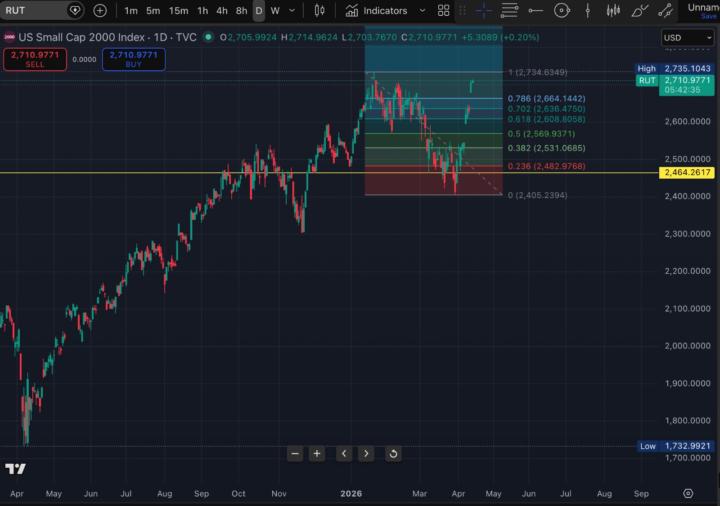
I don't think so, this looks like a nice mid-term year bear market rally to me. Hasn't the breadth of the rally been fairly concentrated in just a few of the large cap tech names?
1-10 of 424

@david-zimmerman-7358
Professional DeFi Trader and Founder of DeFi University. Bought my first BTC in 2012.
Active 21h ago
Joined May 22, 2025
Powered by