
Write something

May 8 •
Have you tried Cycle Syncing Ladies?
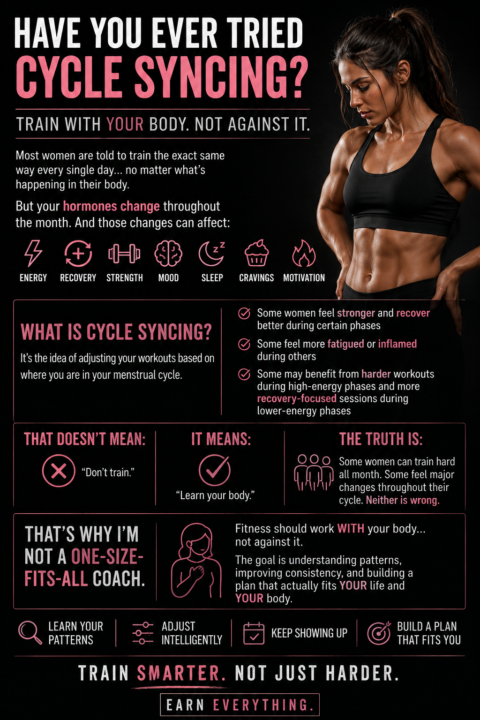
Have you ever tried Cycle Syncing? Most women are told to train the exact same way every single day…no matter what’s happening in their body. But your hormones change throughout the month.And those hormonal shifts can affect:• Energy• Recovery• Strength• Mood• Sleep• Cravings• Motivation Cycle syncing is the idea of adjusting your workouts based on where you are in your menstrual cycle. For example:• Some women feel stronger and recover better during certain phases• Some feel more fatigued or inflamed during others• Some may benefit from harder workouts during high-energy phases and more recovery-focused sessions during lower-energy phases That DOESN’T mean:“Don’t train.” It means:“Learn your body.” Because not every woman responds the same way.And that’s something the fitness industry doesn’t talk about enough. Some women can train hard all month.Some feel major changes throughout their cycle.Neither is wrong. That’s why I’m not a one-size-fits-all coach. Fitness should work WITH your body…not against it. The goal is understanding patterns, improving consistency, and building a plan that actually fits YOUR life and YOUR body. Train smarter.Not just harder. Earn Everything.
May 8 •
Example of Cycle Syncing (Women)
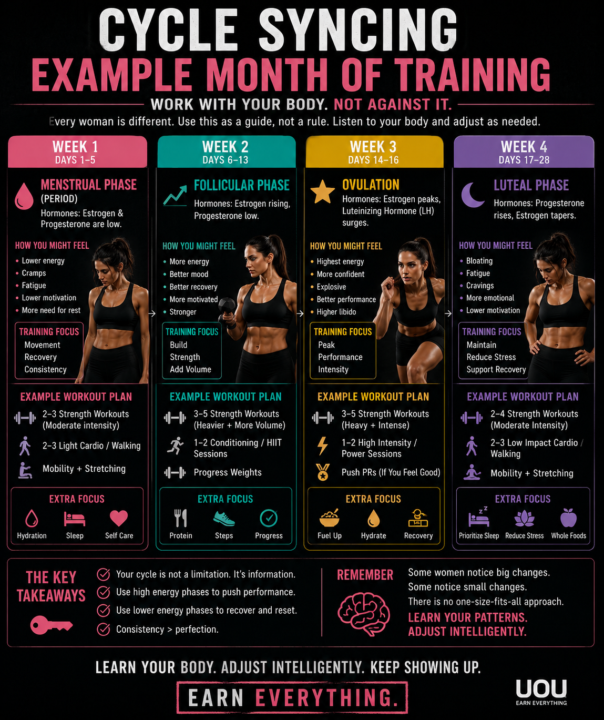
What could Cycle Syncing actually look like in a workout program? Here’s a SIMPLE example: 🩸 WEEK 1 — Menstrual Phase (Period)Goal: Movement + Recovery + Consistency • Walking• Mobility work• Moderate strength training• Lower intensity workouts if energy is low• Focus on showing up — not crushing yourself Example:2-3 strength workoutsLight cardioExtra sleep & hydration — ⚡ WEEK 2 — Follicular PhaseGoal: Push Performance This is where many women feel:• Higher energy• Better recovery• Stronger in the gym• More motivated Example:• Heavier lifting• More volume• Faster-paced workouts• Sprint work or conditioning• Progress weights This is often the “GO” week. — 🔥 WEEK 3 — OvulationGoal: High Performance + Intensity Many women feel explosive here. Example:• Personal record attempts• Higher intensity strength work• Athletic training• Hard conditioning• More challenging workouts IF the body feels good — take advantage of it. — 🌙 WEEK 4 — Luteal PhaseGoal: Reduce Stress + Maintain Momentum This is where some women experience:• Fatigue• Bloating• Cravings• Poor sleep• Lower motivation Example:• Moderate lifting• Slightly lower volume• Walking• Longer rest periods• Focus on recovery and consistency This isn’t about doing less because you’re weak. It’s about understanding your body and training intelligently. The truth is:Some women notice huge changes during their cycle.Some notice very little. That’s why there is NO one-size-fits-all approach. The best workout plan is the one that works WITH your body and keeps you consistent long term. Learn your patterns.Adjust intelligently.Keep showing up. Earn Everything.
2
0
May 5 •
The Metabolic Syndrome of Menopause (Full Breakdown)
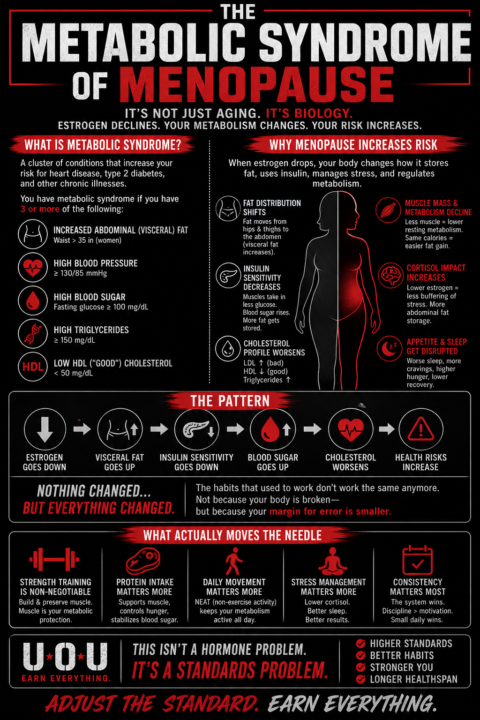
This isn’t one single disease. It’s a cluster of changes that happen in the body as estrogen declines—especially during perimenopause and menopause. And those changes increase the risk of what’s known as metabolic syndrome. Metabolic syndrome is defined by having multiple of the following: • Increased abdominal (visceral) fat • Higher blood pressure • Elevated blood sugar • Higher triglycerides • Lower HDL (“good”) cholesterol When these show up together, your risk for heart disease and Type 2 Diabetes goes up significantly. Now here’s where menopause comes in. As estrogen levels drop, your body starts to change how it functions—not just hormonally, but metabolically. First, fat distribution shifts. Before menopause, estrogen helps store fat in the hips and thighs (subcutaneous fat). After menopause, that same fat is more likely to be stored in the abdominal region—around your organs. This is called visceral fat, and it’s more metabolically active and more dangerous. Second, insulin sensitivity decreases. Your muscles become less efficient at pulling glucose out of the bloodstream. That means more circulating blood sugar, which over time gets stored as fat—especially in the abdomen. Third, your cholesterol profile changes. LDL (bad cholesterol) tends to increase. HDL (good cholesterol) often decreases. Triglycerides can rise. This combination increases cardiovascular risk. Fourth, muscle mass tends to decline. Less muscle means a lower resting metabolism. So even if your eating habits stay the same, your body burns fewer calories. That leads to easier fat gain over time. Fifth, cortisol (your stress hormone) has a stronger impact. Estrogen used to help regulate stress response. Now, cortisol is more likely to drive fat storage—especially in the abdominal area. Sixth, appetite and sleep can become less stable. Sleep disruptions (like night sweats or waking up frequently) affect recovery, hunger hormones, and energy levels.
1
0
May 5 •
Estrogen Education
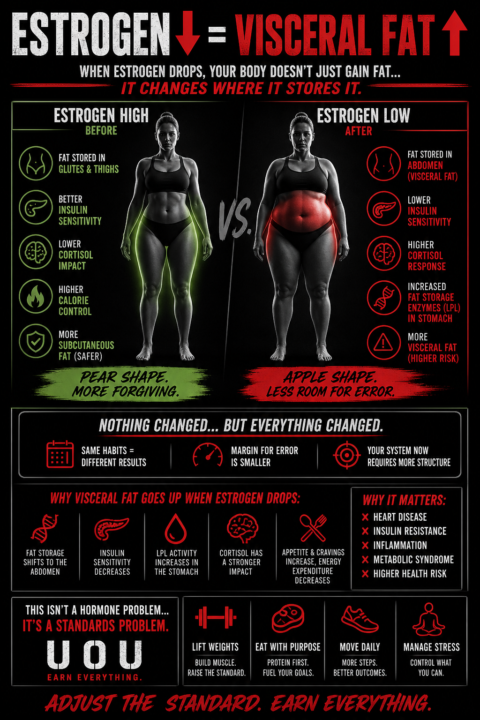
Estrogen ↓ = Visceral Fat ↑ (Here’s the Truth) When estrogen levels drop (especially during perimenopause and menopause), your body doesn’t just gain fat… It changes where it stores it. Before: • Fat is stored in the hips and thighs • Better insulin sensitivity • Lower stress impact • More “forgiving” metabolism After: • Fat shifts to the abdomen (visceral fat) • Insulin sensitivity decreases • Cortisol (stress hormone) has a bigger impact • More fat is stored around your organs This isn’t random — it’s physiological. Your body increases fat storage in the stomach because: • Fat storage enzymes (LPL) become more active there • Estrogen no longer helps regulate distribution • Blood sugar control isn’t as efficient • Stress responses hit harder So what does that mean? 👉 The same habits that used to work… stop working. That’s why so many people say: “I didn’t change anything, but I’m gaining weight.” You didn’t… But your body did. Now here’s the part most people avoid: This doesn’t mean you’re stuck. It means your margin for error is smaller. Which means: • Strength training is non-negotiable • Protein intake matters more • Daily movement matters more • Stress management matters more Most people don’t have a hormone problem… They have a lifestyle that no longer matches their biology. Adjust the standard. Earn Everything.
1
0
Apr 23 •
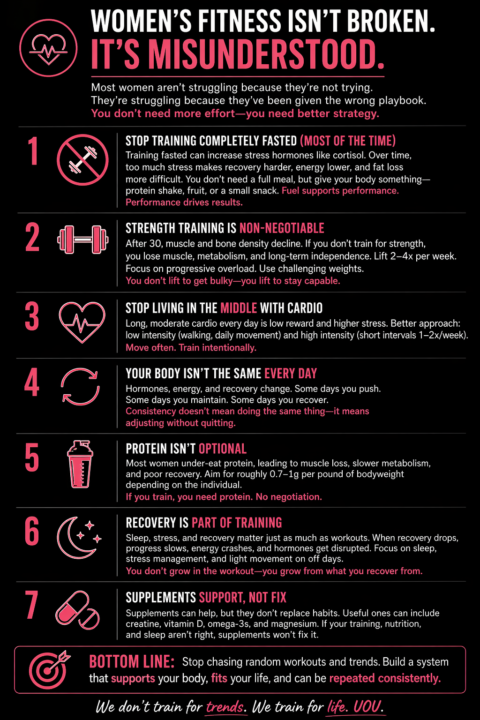
WOMEN’S FITNESS ISN’T BROKEN. IT’S MISUNDERSTOOD
Most women aren’t struggling because they’re not trying. They’re struggling because they’ve been given the wrong playbook. You don’t need more effort—you need better strategy. 1. Stop training completely fasted (most of the time)Training fasted can increase stress hormones like cortisol. Over time, too much stress makes recovery harder, energy lower, and fat loss more difficult. You don’t need a full meal, but give your body something—protein shake, fruit, or a small snack. Fuel supports performance. Performance drives results. 2. Strength training is non-negotiableAfter 30, muscle and bone density decline. If you don’t train for strength, you lose muscle, metabolism, and long-term independence. Lift 2–4x per week. Focus on progressive overload. Use challenging weights. You don’t lift to get bulky—you lift to stay capable. 3. Stop living in the middle with cardioLong, moderate cardio every day is low reward and higher stress. Better approach: low intensity (walking, daily movement) and high intensity (short intervals 1–2x/week). Move often. Train intentionally. 4. Your body isn’t the same every dayHormones, energy, and recovery change. Some days you push. Some days you maintain. Some days you recover. Consistency doesn’t mean doing the same thing—it means adjusting without quitting. 5. Protein isn’t optionalMost women under-eat protein, leading to muscle loss, slower metabolism, and poor recovery. Aim for roughly 0.7–1g per pound of bodyweight depending on the individual. If you train, you need protein. No negotiation. 6. Recovery is part of trainingSleep, stress, and recovery matter just as much as workouts. When recovery drops, progress slows, energy crashes, and hormones get disrupted. Focus on sleep, stress management, and light movement on off days. You don’t grow in the workout—you grow from what you recover from. 7. Supplements support, not fixSupplements can help, but they don’t replace habits. Useful ones can include creatine, vitamin D, omega-3s, and magnesium. If your training, nutrition, and sleep aren’t right, supplements won’t fix it.
1-9 of 9

skool.com/uou-the-standard-5428
Follow the plan. Earn everything. Strength, discipline, and accountability—no shortcuts.
Powered by