User
Write something
Piano and Theory Q&A Hotline is happening in 35 hours
🏗️ February Challenge: The Pre-Lesson Report
This month, I want to share with you a resource that's been on my mind for a while, and I've been workshopping it with my students today (thank you, Seamus and Thomas!). It's called: The Pre-Lesson Report (dun, dun, dunnnnnn). It's designed to: - Focus your practice - Help you progress by yourself - Help us use lesson time more efficiently It's a natural progression of the Practice Journal (see previous posts for info about that). Here's how it works: Before every lesson, for each piece, create a table. At the top of the table, next to the title, write your target speed. Make sure you include "crotchet equals" or "quaver equals" etc.--not just a random bpm! Now for the table itself. From left to right, the columns are: - Section (you can write specific bar numbers, line numbers, rehearsal markings, etc.) - Hands separately/hands together - Safe speed (the speed at which you'll be able to play this section perfectly with a metronome in the lesson. Make sure you include "crotchet equals" or "quaver equals" etc.--not just a random bpm!) - Notes (any specific questions about the section, or any additional details) Then, under each piece, write 1-3 questions. Each question must start with "How do I...". Here's an online template so you can see how it works: https://docs.google.com/spreadsheets/d/1OAXYmEU-T4K5IqRsTxk-iNiYgVwPAwoWs4KfoiIhDyk/edit?usp=sharing Repeat this for every piece you want to look at in the lesson. If you're not sure what you want to look at in the lesson, do it for all your pieces! Your challenge is this: for every lesson this month, submit your Pre-Lesson Report the day before or on the day of your lesson. This will be much easier if you keep a robust practice journal! If you don't manage to do it sometimes, don't worry; we may do it together at the beginning of your lesson as an exercise to improve your practice skills.
Atomic Habits
A tip I got from the above book was to build a system that over time will make change, rather than aim for a goal (often without a system to reach it). I realised I was just WISHING to practice the piano but always told myself I never had time. After listening to the above advice I decided to start a routine in which I would practice the piano after all chores etc done in the evening, for only 5 mins (if I do more, great, but no pressure). This way, even on the hardest, busiest days, I can still maintain my routine. Herbie Hancock said that you don’t need to be good straight away, you just need to be better than yesterday. So I have been doing this every evening for about two weeks now and loving it, and feeling like I am better than yesterday. Never done less than half hour cause I get so into it but I love knowing that if I can’t, 5 mins is also fine. Hope this helps someone!
How not to practice
Has your practice ever sounded like this…?
3
0
Moving Beyond the Blues Scale: A Clear Roadmap for the Next Level
It is a common milestone in the self-taught journey for jazz pianists: reaching a point where the blues scale and a good ear have taken things as far as possible. Eventually, a plateau often appears where improvisation starts to feel like "running scales" rather than playing authentic, idiomatic jazz. To bridge the gap between "intuitive foundations" and "intentional jazz," I recommend a structured path using two specific "bibles" of the genre. These resources remove the guesswork by providing clear, page-by-page drills and the specific theory behind every note choice. The Core Resources 1. The Jazz Piano Book (Mark Levine). This is the industry standard for piano-specific textures and "the sound." For anyone wanting to move from basic chords to the sophisticated voicings of Oscar Peterson or the unique rhythmic "lag" of Erroll Garner, this is the resource. It focuses heavily on the actual "how-to" of sitting at the keys. 2. The Berklee Book of Jazz Harmony (Nettles/Graf). While Levine provides the "sound," Berklee provides the "map." This book is essential for mastering chord-scale theory. It explains exactly which scales to use over specific chords based on their function in a song. It turns jazz theory into a clear, logical system. Why Use Both? Using just one can often lead to gaps. Levine’s book is brilliant but can be anecdotal; the Berklee book is mathematical and rigorous. Combining them helps a pianist to: - Move Beyond Scales: Stop just running up and down modes and start using "bebop" vocabulary, chromatic enclosures, and arpeggios from the 3rd. - Master Functional Harmony: Understand exactly when to use a Dorian, Mixolydian, or Altered scale based on the chord progression. - Build Professional Textures: Transition from simple left-hand chords to "shell voicings," stride foundations, and advanced rhythmic displacement. By following the specific chapters and exercises in these two texts, the transition from "playing by ear" to "playing with intent" becomes a clear, manageable process.
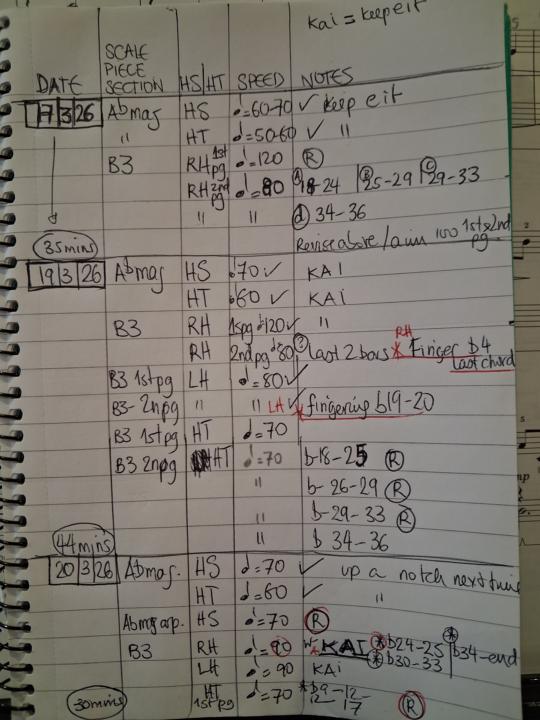
Practice routine, log and recordings
This is the first time I've kept a record of my practice and it has really helped me manage my expectations and pace. I usually try to only tackle a small section at at time but writing it down with the speed has also helped me make progress. I had recorded myself playing this piece 2 weeks ago and it was slow and disjointed. The difference after more targeted practice is noticeably improved. I am encouraged to try a new piece alongside this one now. I do my practice each morning for 30 minutes before work but didn't have as much time this week because I was away so am really pleased with the progress. Does anyone else keep a log or record themselves?
Practice routine, log and recordings
1-26 of 26
powered by
The Independent Pianist Circle
skool.com/the-self-taught-pianist-circle-7074
A calm, member-led space for adult pianists to connect, share progress, and maintain steady growth together. Support without pressure.
Build your own community
Bring people together around your passion and get paid.
Powered by