
Write something
Pinned

4h •
Community Norms
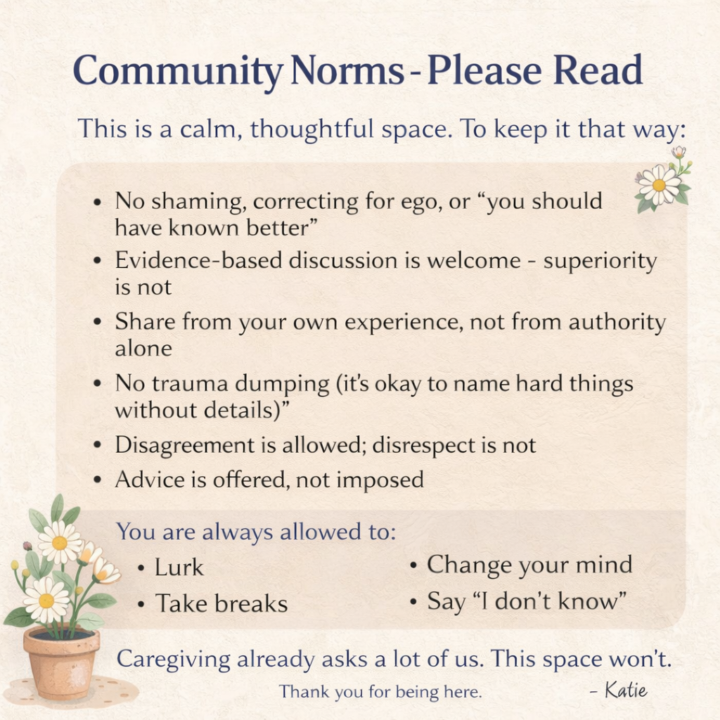
Community Norms - Please Read This is a calm, thoughtful space. To keep it that way: - No shaming, correcting for ego, or "you should have known better" - Evidence-based discussion is welcome - superiority is not - Share from your own experience, not from authority alone - No trauma dumping (it's okay to name hard things without details) - Disagreement is allowed; disrespect is not - Advice is offered, not imposed You are always allowed to: - Lurk - Take breaks - Change your mind - Say "I don't know" Caregiving already asks a lot of us. This space won't. Thank you for being here. — Katie
0
0
Pinned
22h •
Welcome Post - I changed the name after everything was made, eek!
Welcome to “Caring for the Caregiver” If you're here, you likely care deeply - about your patients, your clients, animals, your work, and doing things the right way. You might also be tired, overstimulated, or quietly questioning whether it's supposed to feel this hard. This space exists because caregiving is real work, not a personality trait, and "just be resilient" is not a plan. Here's what this community is (and isn't): What we do here: - Talk honestly about real-world caregiving - Share practical knowledge grounded in evidence - Explore ethical and emotional challenges without judgment - Learn how nervous systems work under chronic care stress - Use gentle, hands-on creative practices to to regulate - not perform What this is not: - Toxic positivity - Hustle culture - "Fix yourself" nonsense - A place where you have to prove how hard you work. You do not need to be productive here. You do not need to have the right words. You are allowed to be thoughtful, sensitive, and tired… all at once! Please feel free to introduce yourself in the Introductions section if you'd like. Or don't. Both are okay. I'm really glad you're here. — Katie
0
0

22h •
Why being sensitive is not a flaw in care work
In caregiving, sensitivity is often framed as a weakness. We’re told to be “thick skinned,” “detached,” or “resilient enough” to handle anything. But I’ve learned in 13 years as a PSW, and now as a nursing student, that sensitivity is actually a strength. It allows you to notice subtle changes in a patient, respond with empathy, and anticipate needs before they become crises. It makes your care more thoughtful, ethical, and humane. The challenge isn’t sensitivity itself, it’s learning how to regulate it so it doesn’t lead to burnout. Sensitivity without self-care can overwhelm us, but sensitivity with boundaries, nervous-system awareness, and practical strategies is what makes us truly effective caregivers. I’d love to hear from you: How has your sensitivity helped you in your caregiving work?
4h •
Finding Balance Between Science and Creativity
After spending the week studying for Anatomy & Physiology tests, I like to unwind by doing something creative - the opposite of scientific focus for me. I decompress through painting, sculpting, wire-wrapping jewelry, or simply drawing. Creativity gives my brain space to breathe and helps me reset. Here’s a fun little activity, to make wire wrapped dragonfly earrings. I love these so much! https://youtu.be/ZVa-OmMUEN8?si=7z1ubLVEWT2EcKD8
0
0
4h •
What drains you the most right now?
Care work can be draining in different ways, and it's not always the obvious things. Sometimes it's: - Emotional labour - Family dynamics - Time pressure - Sensory overload - Moral distress - Or the feeling of never quite being "off" You don't need to explain or justify anything here. If you want to share, just answer simply: What drains you the most right now? (Responding to other's is optional.)
0
0
1-8 of 8
powered by
skool.com/the-regulated-caregiver-2510
Real world caregiving, honest support, and creative ways to stay grounded for people who care deeply.
Suggested communities
Powered by