
Write something

Jun 18 •
Hey Michael Colin, The Lean OCD Factory Method 🚀
Hey Michael Colin 👋 Just checked out The Lean OCD Factory Method. You're still early enough to structure the community properly before growth starts kicking in — which honestly is the best possible timing. We're currently helping new Skool owners turn empty/basic communities into launch-ready ecosystems completely free. Examples + full breakdown here: 👉 Community Launch Before vs after examples below 👇


May 30 •
If you could meet a person you admire, to give a major hug to
and have an hour long conversation with, who would it be? I was thinking, King Solomon, (For his mind) Mother Teresa, (For her heart) Charlie Kirk, (for his courage) Michael Jackon, (for his creativity) #inspiration #life #love #leadership #humanity
0
0
May 29 •
Do we suffer more in imagination?
Can we learn to "react" better, to "bad" things and thoughts that happen to us? What do you think?
0
0

May 28 •
"Value Added vs. Non-Value Added activities
In Lean management, "Waste" is anything that takes up time and energy without producing a value added result. Originally developed by Taiichi Ohno at Toyota, this system identifies 8 Wastes that should be removed or reduced to find true efficiency. We can categorize every action you take into two groups: 1. Value-Added activities These are actions that serve your goals and values. They are done "right the first time." In a competitive market, the "customer" (your healthy self, your Peace Of Mind) only wants to pay the lowest price in time, energy and effort. If a task takes you an hour because of rituals, but should only take five minutes, you are “overpaying" with your time. For example, If I “turn off my stove” when cooking is complete, I am doing a (Value Added) activity. If I leave the room and come back again, just to check and make sure, because I don't “trust” the first |data point", or the first time I did it, and that I did it “right” the first time, it would be a complete waste in time and energy. Now if I keep doing that ten times, I am suffering. The goal is to reach a state of Peace Of Mind (POM) at the least amount of time. 2. Non-Value Added activities (The Wastes) What are some of your Value Added activites that bring you comfort, pleasure, and peace of mind? What do you assume are your "Neccassary but Non Value Activities", and what are your "Non Value Activities"? For example'; "Transportation", is an activity we can usually define as Non Value Added, but neccassary to get from point A to B. The question then becomes.. well, can we shorten the trip?
0
0
May 28 •
Why Your Brain Feels Like a Broken Assembly Line (And How to Fix It)
If you are dealing with OCD, your brain isn't broken, it’s just running a highly inefficient, chaotic factory floor. Think about it: An intrusive thought pops onto your mental conveyor belt, your internal fire alarm goes off, and suddenly you are spending three hours doing mental "rework" just to prove you aren't a terrible person. As an engineer, I look at that and see a massive operational bottleneck. You are wasting "time" from your limited daily battery power, responding to a false alarm. If a machine on a real manufacturing floor glitched and threw a fake error message, you wouldn't stand there arguing with the machine for two hours. You’d mark it as a "defect", leave it alone, and keep the assembly line moving. Let’s look at a classic example: The Kitchen Stove. You turn it off. That's a normal, (Value-Added) activity. But as you walk away, the brain sensor fires: "Did you really turn it off? What if the house burns down?" If you turn back around and check it five times, you just fell for a Defect Loop. You are paying for a temporary dose of "Peace of Mind" using the most expensive currency you have: your actual lifetime and energy. The secret isn't fighting the thought; it’s treating the thought like a piece of factory waste. You label it, you refuse to do the unpaid manual labor of re-checking, and you keep walking. Quick Q&A Q: If I ignore the alarm and don't check the stove, won't my brain completely short-circuit? Oh, yes. For about ten minutes, you’re going to feel like the entire factory is burning down. That's just the glitchy hardware doing its thing. But here's the science: your brain is a machine that learns from data. If you ignore the alarm and go eat dinner anyway, the brain eventually realizes, "Oh, wait... we didn't explode." The next time that alarm goes off, the signal gets weaker. Refusing the rework is how you rewrite the brain's software. Q: How do I actually track this, or am I just guessing? A: We don't guess; we use metrics. As the Plant Manager of your own mind, you need to track your Cycle Time (how long you spend stuck in a single loop) and your Lead Time (the total hours it takes to get back to actual peace of mind). If you used to spend 4 hours a day spinning your wheels, and this week you brought it down to 2, you just optimized your mental factory by 50% and gained your life back. That is a massive operational win.
0
0
1-7 of 7
powered by
skool.com/the-lean-ocd-factory-method-8586
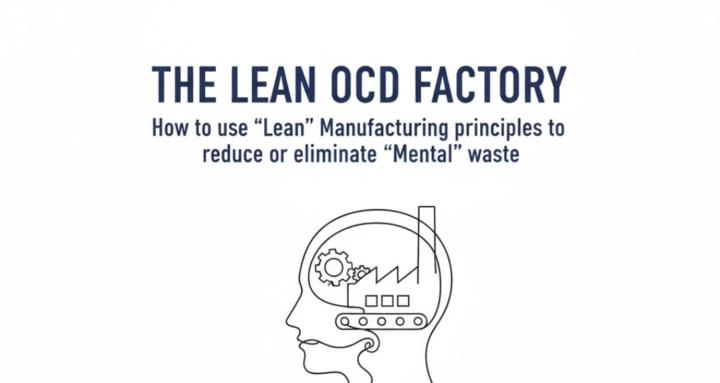
A community for improving and managing OCD (Obsessive Compulsive Disrorder), from an efficiency point of view.
Suggested communities
Powered by