

Jun 1 •
Decode Your Four-Letter Type: Two People Can Share Letters and Run Opposite Cognitive Sequences
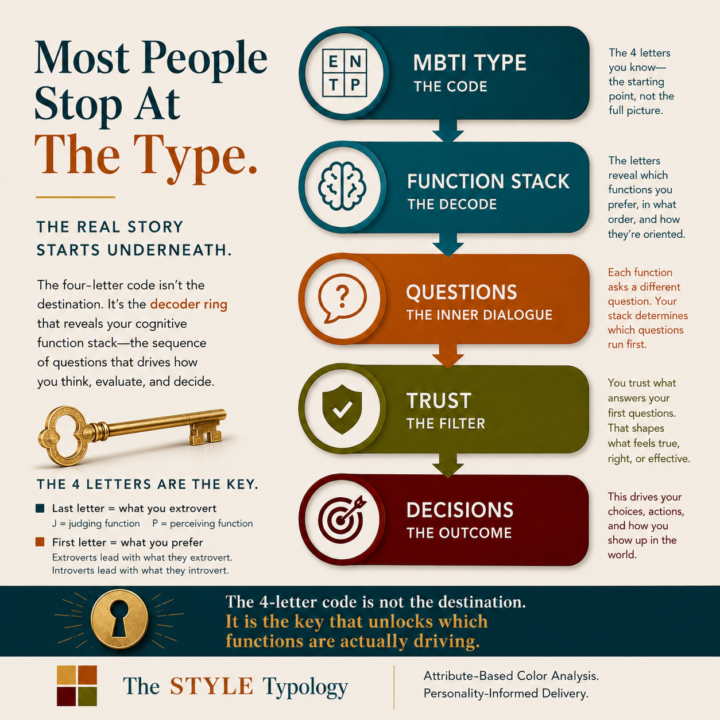
The four-letter Myers-Briggs type is not the destination. It is a decoder ring. What is it decoding? Your cognitive function stack. The letters exist to reveal which functions you prefer, in which order, and how they are oriented. The stack is where the actual substance lives. The last letter tells you which function is extroverted. J types extrovert their judging function. P types extrovert their perceiving function. The first letter tells you which function is preferred. Extroverts lead with the function they extrovert. Introverts lead with the function they introvert. Take ENTP and INTJ. Both NT types. Same temperament group. In practice, they are running almost opposite cognitive sequences. The ENTP leads with Extroverted Intuition. The driver question: what possibilities am I not seeing yet, and where could this go? The co-pilot is Introverted Thinking. The second question: does this actually hold together on its own terms? The INTJ leads with Introverted Intuition. The driver question: what is the pattern beneath all of this, and where is it heading? The co-pilot is Extroverted Thinking. The second question: does this work, and can it be made to work better? Same two middle letters. Completely different direction of energy. Completely different criteria for trust. If you know your current best-fit type and want me to map out your cognitive function stack, drop it below.
May 23 •
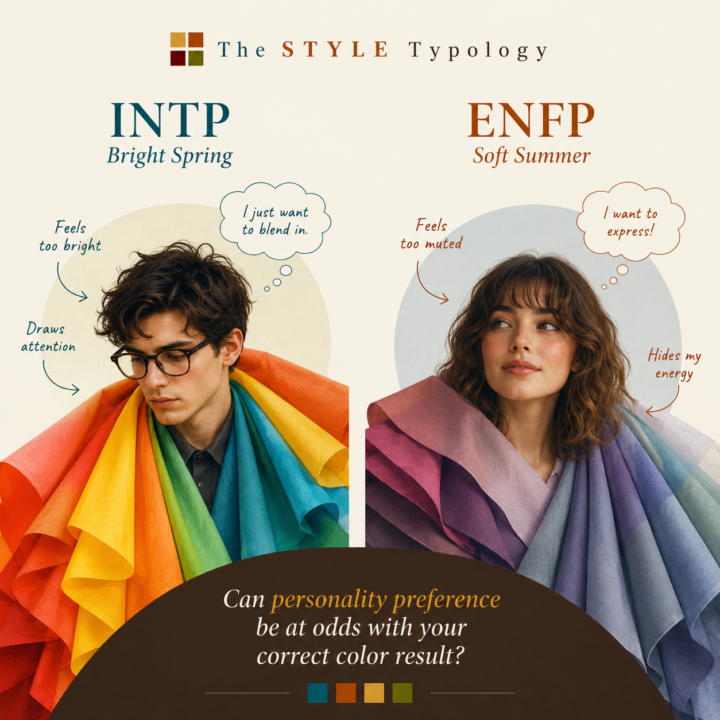
Can your personality preference be at odds with your correct color result (or vice versa)?
A question came up in conversation recently that is a perfect topic for this group. The argument, roughly: certain personality types will struggle to wear their correct color result, even if the determination is objectively right for their coloring. An INTP who is a Bright Spring will resist it because bright and warm reads as drawing attention, and drawing attention is not the goal. The flip side also came up: an extroverted, expressive type stuck with a muted, cool result may find it just as hard to embrace. It's a genuinely interesting claim. Where do you land on it? Also — we have some new members who joined this week. Welcome to everyone who just found their way here. Drop your type and color result in the data thread (https://www.skool.com/the-color-typology-lab-7535/personality-type-color-season-building-the-data-set?p=4adeff77) if you haven't already, and jump in wherever something catches your attention.
May 15 •
Did you know...your MBTI type isn't actually decided by the test
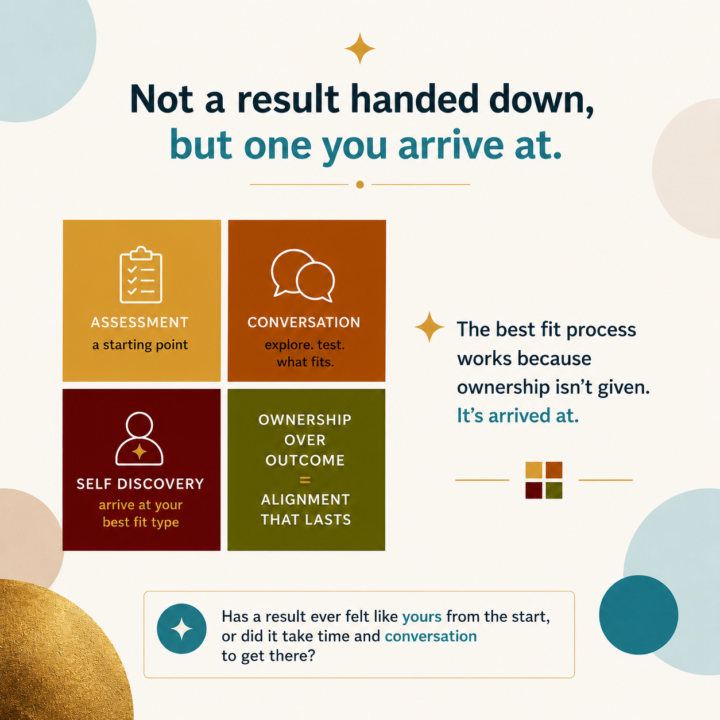
I did my first practice MBTI assessment session this afternoon. I've been working my way through the MBTI training long enough to understand the framework. The score from the assessment is a starting point. What follows is a conversation where the practitioner walks through each of the four preference pairs with the client, using real examples, testing what actually fits. The client lands on their best fit type. Which may or may not match what the test reported. And that final answer belongs to them, not the instrument. What I wasn't prepared for was watching it happen in real time and feeling genuinely energized by it. Because what I watched today wasn't a practitioner delivering a result. It was a person working through their own patterns and arriving somewhere that was theirs. That's what I'm trying to build on the color side. Not a determination handed down, but one the client can actually claim. The best fit process works because ownership isn't given. It's arrived at. Has a result ever felt like yours from the start, or did it take time and conversation to get there?
May 14 •
An ESTJ and an INFP walk into a color analysis...
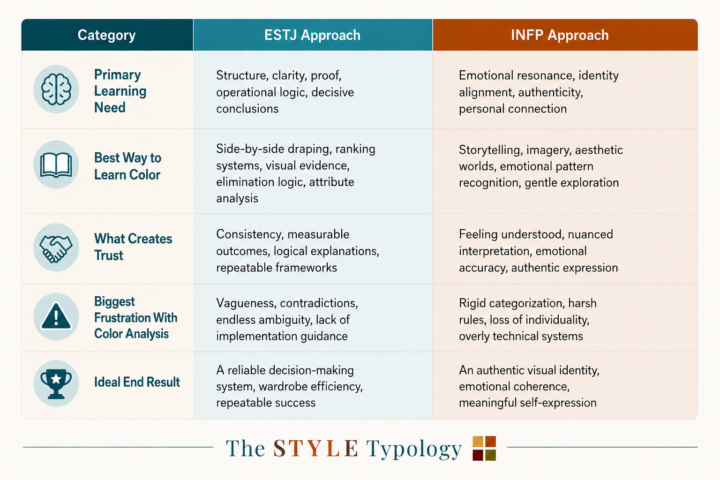
Two people can attend the exact same color analysis and walk away with completely different experiences. One feels relieved by the structure. Another feels constrained by it. One wants definitive answers. Another wants interpretive space. The result isn't the variable. The delivery is. An ESTJ and an INFP might arrive at equally accurate color conclusions, but the path that gets them there successfully may look completely different. The comparison image breaks down exactly where those differences show up. And interestingly, some analysts and systems naturally align more strongly with different personality preferences and learning styles. ESTJs often gravitate toward analysts or systems that: - explain the "why" - compare visually - provide operational guidance - reduce ambiguity - create clear implementation systems Possible examples: - John Kitchener - David Zyla - attribute-based systems - highly structured draping approaches INFPs often gravitate toward analysts or systems that: - use emotionally resonant language - connect identity and aesthetics - encourage exploration - create visual storytelling - leave room for nuance and individuality Possible examples: - Rita's Style Key - artistic style frameworks - more interpretive color approaches Neither approach is "better." They're just different pathways to trust, understanding, and implementation. The more I study both personality systems and color analysis, the more convinced I become that successful implementation is not just about accuracy. It's also about whether the information was delivered in a way your brain naturally absorbs. Which side do you relate to more in how you learn color?
May 4 •
Turns out being a difficult case is actually good data
I've had my colors analyzed more than once. And I'm probably what you'd call a difficult case — in more ways than one. My actual color attributes are genuinely ambiguous. And my personality? I ask a lot of questions. I want to understand exactly why something works, where the edges are, and how to apply it consistently. At some point I realized I had essentially built a personal operating system for color. Not because I'm obsessive, because that's how I process information. I systematize. It's the only way results actually stick for me. Getting to something that held didn't come from a single result. It came from testing, refining, and understanding where the framework broke down. So I'm curious. Have you been able to actually use your color results consistently? Or does it still feel like something you have to keep reinterpreting every time?
1-6 of 6
powered by
skool.com/the-color-typology-lab-7535
Exploring personality type and the implementation of personal color analysis results. MBTI, Enneagram, OCEAN, and color frameworks.
Suggested communities
Powered by