Activity
Mon
Wed
Fri
Sun
Aug
Sep
Oct
Nov
Dec
Jan
Feb
Mar
Apr
May
Jun
Jul
What is this?
Less
More
Owned by Virginia
Exploring personality type and the implementation of personal color analysis results. MBTI, Enneagram, OCEAN, and color frameworks.
A community for solo, service-based business owners to pressure-test growth decisions before committing significant time, money, or resources.
Memberships
MicroBranded
31 members • Free
Template Skool
3.7k members • Free
Synthesizer Scaling
284 members • $1,950/month
Grow With Evelyn
3.4k members • $7/month
EverAds
663 members • Free
Skoolers
167.1k members • Free
Her Money System Community
99 members • Free
Free To Paid Buyer Journey
399 members • Free
The Owner's AI Room
718 members • Free
35 contributions to The Color Typology Lab

6d •
What the MBTI x color season data set is starting to show (and what it isn't, yet)
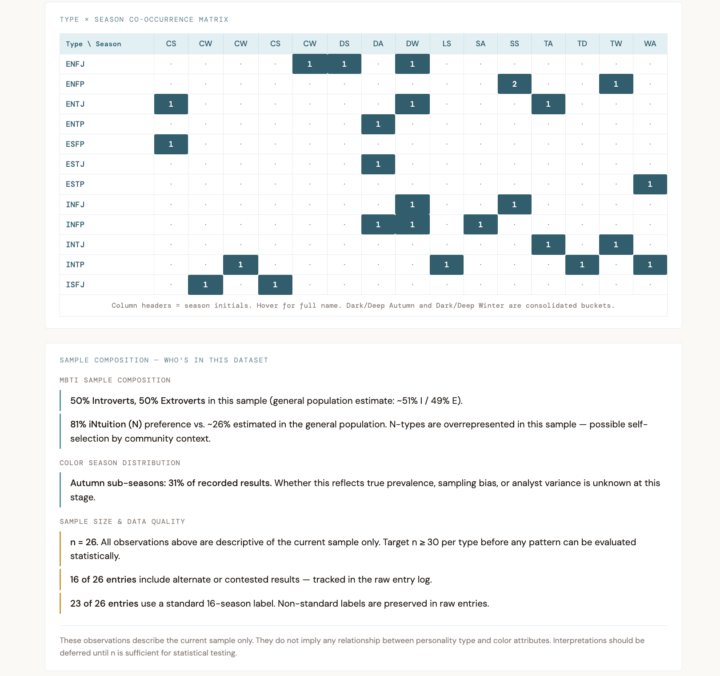
The MBTI x color season tracker has 26 entries now, and one number jumped out enough that I want to flag it for the group. N-types are 81% of this sample. The general population estimate is around 26%. That is not a small skew, that's most of the group running on a preference held by roughly a quarter of people (which, if you've ever wondered why "just trust the process" lands so badly in here, this might be part of the answer). What's NOT showing a skew anymore: Introvert/Extrovert is sitting at 50/50, almost exactly matching the general population estimate. So whatever is pulling people into a research-flavored color and personality group, it's an N thing, not an I thing. I'd have guessed both going in, so that one's worth sitting with. It tracks with how N and S types tend to approach learning a color system in the first place. An N wants the underlying framework before they trust a single recommendation (why does this hue read as warm, what's the mechanism behind clarity, how does this rule generalize). An S wants the concrete result and a way to check it against something real (this top works, does the new one match it). Neither is more rigorous than the other, they're just different entry points. But a group built around dissecting the framework itself is going to read as home base to N types in a way it won't for S types looking for a direct answer. That's probably at least part of what's showing up in the data. Two honest caveats before anyone runs with this: n=26 isn't enough to call this a settled finding (the target is 30+ per type before I'd trust anything statistically), and this only tells us who self-selects into a group like this one. It says nothing yet about whether N correlates with anything on the color side. Two different questions, and I want to keep them separate. So, curious for the room: does the N-skew track with why you joined, or is it just a coincidence of who ended up here? And if you haven't dropped your entry in the MBTI x color season tracker yet, now's a good time. Every entry makes the next pattern more trustworthy.
1 like • 1d
@Becki Zingg lol....that could be very true! And the E in me is happy you (and all the Is) are here with me
1 like • 12h
@Ashley Lluay I'm an S too and just love getting my hands on the data and sharing back insights with you all!👩🎓
2d •
One of the Most Interesting Ways I've Seen Color Taught (The Colour Room)
One of the things I've really enjoyed about spending time in different color communities is seeing the completely different ways people teach the same concepts. Lately I've been exploring The Colour Room, created by Tracy Holmes, and I thought some of you might enjoy it too. What I find particularly interesting is her approach to teaching color itself. Rather than starting with seasonal systems or "what colors should I wear," she builds your ability to see color through observation and hands-on practice. One of her core tools is a monthly Color Tracker that has you working with color gradients and relationships. It sounds simple, but it's a surprisingly effective way to train your eye. I've especially enjoyed how it builds an intuitive understanding of how hue, value, and chroma interact. Watching pure colors evolve through carefully constructed gradients makes abstract color theory feel much more tangible. It's a very different perspective from the work we're doing here in Color Typology Lab, which is why I enjoy it. I think the more ways we have to understand color, the stronger our overall foundation becomes. If you're someone who enjoys digging into the mechanics of color and building your visual vocabulary, I think it's worth checking out. https://www.skool.com/the-colour-room/about?ref=e59d1900d8994c8ba25a1b44e0ff1fa9 Have any of you found other color educators whose teaching style has really expanded how you see color? I'm always interested in learning from people who approach the subject differently.
1 like • 12h
@Ashley Lluay I think in those cases they would move over into the Bright or Pastels. I think, in her system, it would be the soft summer and soft autumns which would look "okay" in the Pale Tones. Here is what she said the color genres fell out for me. I do disagree about the Jewel Tones...those are some of my favorite to wear for special occasions. With that all being said, I think this is a great way to look at it...she just understated my chroma level.
1 like • 12h
@Ashley Lluay TOTALLY agree! Like so so much. [in response to this one: I really do think chroma is hard to sport virtually! That was probably part of why Ikept getting typed as Soft Autumn rather than Light Summer which is actually medium chroma :)]
4d •
What's your swatch situation? (no..not the watch brand)
I hope everyone in the Midwest or Eastern seaboard in the US is staying cool. My son is at overnight camp this week with no AC, which means I've had unusual stretches of uninterrupted thinking time. One thing I've been turning over: how much people actually rely on physical swatch tools as part of color implementation, and whether that changes over time. Did you use a swatch book or fan heavily after your analysis in check for harmony or attribute matching? A few hypotheses I'm sitting with: -S types may hold onto physical references longer because a concrete comparison point is more reliable than an abstract rule. N types often internalize the framework earlier and drop the swatch sooner, which isn't always a sign of mastery. Sometimes it's just pattern-matching confidence running ahead of actual accuracy. -Si-dominant and Si-auxiliary types (ISxJ and ESxJ) may be the most likely to actually collect multiple swatches and fans, not just use them occasionally. Si builds detailed internal sensory libraries, and a physical reference collection is a very natural extension of that. -And then there's a completely different behavior I'm curious about: the person who decided the existing fans weren't quite right and built their own out of paint swatches. (You know who you are.) My guess is that's lprobably more of an NT one: the system has gaps, the available tools don't fully solve the problem, so obviously the answer is to make a better one from scratch. What's your type, and what's your swatch situation?

0 likes • 3d
@Becki Zingg Talbot red! Lol… I like that you tested colors in real life that influenced where you landed with your own unique personal palette. You were given the roadmap and then collected additional data to make it work for you.
2 likes • 12h
@Ashley Lluay it definitely seems like a lot of us used the swatches as a tool until we were confident in our own abilities.
3d •
The Different Ways People Build Confidence After a Color Analysis
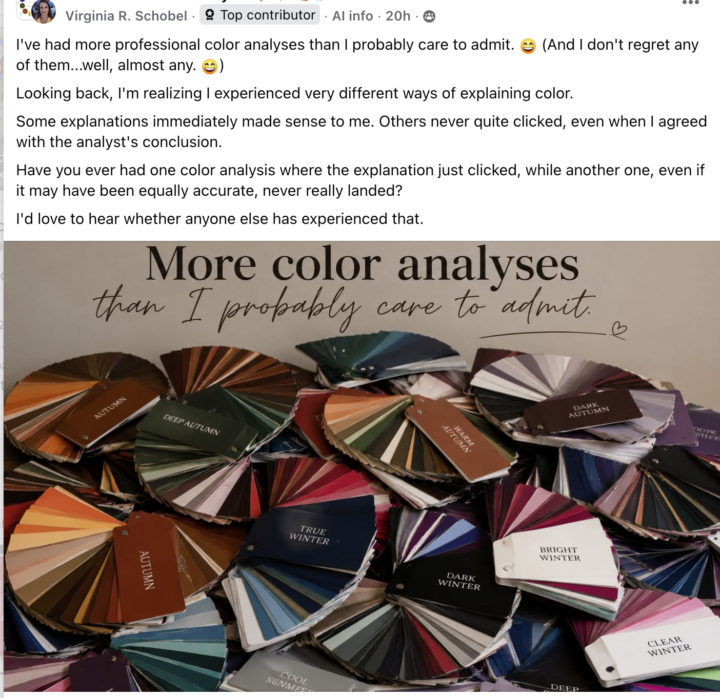
This week I started a thread in a Facebook color analysis group with a simple question: Have you ever had one analysis where the explanation just clicked, while another one, even if it may have been equally accurate, never really landed? The different seasons people received weren't what caught my attention. It was what happened afterward. As I read through the comments, three patterns kept surfacing. 👇 1. Some people didn't fully trust their result until they could actually see what the analyst was seeing. The in-person draping experience mattered not just as a method, but as a communication tool. Watching the colors work in real time made the reasoning visible in a way a written summary couldn't replicate. 👇 2. Several people talked about combining insights from multiple analyses. Rather than asking, "Which analyst was right?" they asked, "What does each result add to my understanding of my own coloring?" One commenter described wearing jewel tones from a neighboring season for formal occasions while defaulting to her primary palette day to day. She wasn't confused. She was intentionally using both sets of information. 👇 3. One comment from a fellow analyst really stayed with me. A color consultant wrote: "It's much more satisfying when a client really gets it, rather than just taking my word." She later added: "If she can't really see it, it's probably not going to have much impact on her life in the long run." That's the usability problem stated plainly, from the analyst's side of the table. And I think it's significant that it came from a practitioner, not a client. Reading through the discussion, I realized there are really two separate challenges in color analysis: 1. How do we arrive at the most accurate assessment possible? 2. How do we help someone understand that assessment well enough to confidently use it long after the appointment ends? The industry spends a tremendous amount of time discussing the first question. The second one seems to receive much less attention.
1 like • 14h
@Ashley Lluay I absolutely agree that supporting the assessment using the individual attributes is so helpful for helping the why really stick for actual implementation. I wonder if the other two analyst who assessed you as a soft Autumn had provided the attributes if you were a more quickly realized it was the warm attribute that was off?
1 like • 14h
@Ashley Lluay I just added to the comment above. What do you think about my second question?
15h •
Help Create a Color Analyst Consultant/Companies Database
I'm working on a research project (Color Analyst × Preference Appeal Index) and could use your help. When you think of personal color analysis, which analysts or companies come to mind? Don't overthink it. Just list everyone you can remember, whether you've worked with them or simply know of them. I'm curious to see which names come up most often.
0 likes • 15h
I'll start! 😊 Off the top of my head, here's my list: Alchemy of Color and Style, Andrea Pflaumer, Beauty and Soul Studio, Bella Figura Style, Belle and Bonnet, Carol Brailey, Colour Analysis Studio, Coloured Confident, Created Colorful, Curate Your Style, David Zyla, Dream Wardrobe, Ellie-Jean Royden, Emy C., European Fashion School (StyleMe), Francesca Cairns, Frump Fighters, Heather N Co, HER Style, House of Colour, Imogen Lamport, International Image Institute, John Kitchener, Kibbe and Colors, Laia Melga, Lana Schwartz, Luminary, Our Fashion Garden, Pamela Croxford, Poeticize Your Presence, Pretty Your World, Rachel Nachmias, Radiantly Dressed, Sasset Sheldon, Style by Color, Style Refinement, The Concept Wardrobe, Truth Is Beauty, Victoria Maria, Your Color Style, Season of Colors (TCI), and Gabrielle Arruda. I'm sure I'm still forgetting some, so keep them coming!
1 like • 15h
@Ashley Lluay absolutely! Guess I should’ve added The Style Typology myself
1-10 of 35

@virginia-schobel-7810
20+ Years Pharma Market Insights Professional | Founder, The Style Typology | Triple-Certified Personal Color Analyst | MBTI Certified Practitioner
Active 7h ago
Joined May 1, 2026
ESTJ
19406