
Write something

4d •
Got a question? Shoot!
If you have a question about the nervous system, fascia, qi… health, metaphysics, quantum physics, light… anything adjacent to these topics or topics covered here, in The Body Space, post it here! Perhaps the collective wisdom of the group or your humble host can provide answers.
8d •
Poll: What self-healing practice(s) if any, do you already do?
I’m curious!
Poll
4 members have voted
4d •
When the body says “no”.
There’s something I don’t think gets said enough in the nervous system regulation space. Neither by practitioners or experts. Even when you understand the nervous system, even when you have the tools… there are days where it still overrides you. Yesterday was one of those days for me. I woke up already exhausted from deep crying the day before and with a deep knot in my gut. I had my usual Thursday bookings, so I told myself that going to work would make me feel better and so I pushed through. But the feeling only intensified. I’d also just heard that an aunt in Italy is in hospital, struggling with ongoing complications from her battle with cancer. That and other ‘Life challenges’ I’m facing, added up and sat heavy in my system, whether I wanted it to or not. I got ready as usual, fighting back tears, got in my car and started driving. “Get your shit together” I told myself over and over. But the pressure got stronger. It rose from my gut, into my chest and up to my throat. It felt like something needed to be spoken. I called my mum and as soon as I said it out loud, the floodgates opened. “Mum, I can’t do this. I have a feeling of dread”. I had to pull over. I was nowhere near my first client, barely a couple of kilometres away from home; and by now, my first booking was meant to start in a few minutes. I had to make the decision to cancel. Sending those text messages to my clients was really hard. Part of me felt relief once I’d done it. Part of me felt worse. Like I’d let my most important clients and myself down. Like I was unreliable. Like I was a failure. And the familiar thought came up: “how can I support others to regulate their nervous systems when mine is all over the place?” But my system had hit capacity. The old pattern would’ve been to push through, smile, perform, turn my attention outward to my clients and try to override what was happening. And it would’ve leaked out anyway. I’m lucky that I have a good relationship with my Thursday clients, who know me as a human being with struggles and problems and not as a clinical, impersonal practitioner.
5d •
Vagus Nerve Diagnostics & Basic Reset
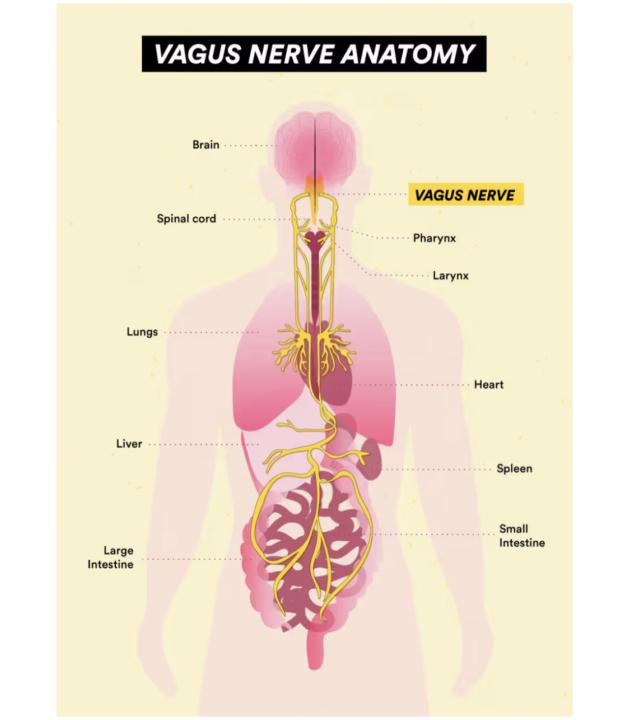
The Vagus nerve is the body’s great regulator - a wandering pathway that links the brain to the heart, lungs and digestive organs, while overseeing the rhythms that keep us alive. Its name comes from the the Latin “Vagus”, literally meaning “wandering” - a reflection of its far-reaching, meandering path through the body. It plays a central role in the parasympathetic nervous system, guiding the body into states of rest, repair and restoration. When the Vagus nerve is toned and responsive, the body can shift out of stress and back into safety with greater ease - slowing the heart, deepening the breath, supporting digestion and allowing healing processes to unfold. In many ways, it is the bridge between survival and self-healing, translating a sense of safety into physiological harmony. Vagal Diagnostics: Listening to the Body These gentle movements assess the tone of your Vagus nerve and cranial alignment, giving you a snapshot of your current state. You don’t need to memorise the anatomy and there is no right or wrong. Just feel, witness your system as it is. Basic Sensory Diagnostics (Feel - Based) 1. Head turn test - Stand or sit upright but comfortably. Slowly turn your head to the left. Come back to centre and turn your head to the right. You can repeat these movements a few times to get a good feel for what’s happening in your neck and base of your skull. Notice: Do both sides turn freely, evenly and smoothly? Or is the movement a bit limited, stiff, crackly or jagged on one side? 2. Ocular tracking - Hold a finger up in front of your face. Without moving your head and using only your eyes, move the finger to the left, come back to centre and move your finger to the right and back to centre again. You can do this a few times to get a feel for your eye movements. Notice: Do your eyes follow smoothly left and right? Or is the movement of your eyes a bit jagged, jumpy, or rigid? 3. Swallow test - (You can have a sip of water for this diagnostic.) Swallow.
8d •
Why I Created SomaKey Protocol
The SomaKey Protocol didn’t come from a certification, a trend, or a single modality. It came from observation, of my own body and of the bodies I’ve worked with hands-on. It came from over a decade of self managing my Multiple Sclerosis without pharmaceuticals. Over the past couple of years, I kept noticing the same pattern. People were doing “all the right things” like breathwork, meditation, supplements, treatments, diet and nervous system tools… and still not getting lasting results. Not because those tools don’t work, but because they were being applied at the wrong time, in the wrong state. If your body is in Fight, Flight, Freeze or Fawn, it doesn’t matter how advanced the technique is. The body won’t receive it. It can’t. And the thing about the nervous system (and the fascia) is, it is constantly on the lookout for possible threats - it’s designed to keep you Safe, first and foremost, so it’s extremely sensitive and just about anything in the modern age can trigger it into Fight/Flight. A bill you didn’t expect, too much caffeine, a meal that didn’t agree with you, an argument with a loved one, driving in peak-hour. That’s the missing piece I kept seeing again and again. So I started simplifying everything. Stripping it back to what actually creates change in the body, not just in theory, but in real time, on my treatment table, in sessions and in myself. What SomaKey Protocol Is: SomaKey Protocol is a sequence. A specific order that works with the body instead of against it. 1. Recognise the state of your nervous system 2. Reset it out of survival mode 3. Turn your proprioception inward and change your internal chemistry through breath 4. Open the body through fascia 5. Move energy (qi) through that open system and directly to points where it is needed Each step builds on the last. When you follow the sequence, things start to land and the body becomes receptive, change becomes easier. Why It Works: Because it meets the body where it is.
1
0
1-7 of 7
powered by
skool.com/the-body-space-4482
This is not a passive content community. It is a practice community focused on consciously activating the body’s self-healing mechanisms and more.
Suggested communities
Powered by