
Write something
Pinned

4h •
🧩 The AI Use Case Inventory: The Smallest Governance Move With the Biggest Payoff
Most organizations do not struggle with AI because they lack tools. They struggle because they lack visibility. When we cannot clearly see where AI is being used, what data it touches, and what decisions it influences, we cannot scale adoption confidently. We either freeze, or we let shadow usage spread until trust breaks. An AI use case inventory sounds unglamorous, but it is one of the highest leverage moves we can make. It turns AI from scattered experimentation into a managed capability. ------------- Context: Why AI Gets Messy Fast ------------- AI adoption often begins with good intentions. A team tests a tool for summarizing meetings. Another team uses AI to draft marketing copy. A leader asks for faster reporting. Someone finds an AI feature in an existing platform and switches it on. None of this feels risky in isolation. Then, a few months later, the organization is surprised. People cannot answer basic questions. Which teams are using AI. What tools are in play. Are we putting customer data into third-party systems. Are we relying on AI outputs in decisions that affect customers. Which workflows are automated. Who owns them. The problem is not that AI is uniquely chaotic. The problem is that AI is easy to adopt without coordination. It spreads through convenience. It hides inside everyday tools. It slips into workflows because it saves time, and then it becomes normal before anyone has defined standards. When that happens, leadership tends to react in one of two ways. We either clamp down and restrict everything, which kills momentum and creates resentment, or we ignore it and hope for the best, which creates silent risk. An inventory is the middle path. It does not require perfect policy. It requires honesty. It starts with one simple act: seeing reality clearly. ------------- Insight 1: You Cannot Govern What You Cannot See ------------- Governance often fails because it is built on assumptions. We write rules based on what we think is happening, not what is actually happening. AI makes this worse because usage is distributed and often informal.

Pinned

7h •
The Difference Between Grinding… and Living on Purpose
I was up at 4:35am this morning… on a Sunday… diving head first into work. And the truth is — it didn’t feel like grinding at all. Because when you love what you’re building, when you know it’s stretching you as a man, when it’s tied to being in service to your family and making a real impact… the work hits different. It stops feeling like pressure. It starts feeling like purpose. I don’t get excited about being busy. I get excited about growing. About becoming more disciplined. More focused. More capable than I was yesterday. That’s what fuels me. Not the hours. Not the grind. The progress. So if you’re in a season where you’re putting in the reps — don’t just ask yourself how hard you’re working. Ask yourself who the work is helping you become. Because when the mission is bigger than you…even a 4:35am Sunday start feels like a privilege.
Pinned
2d •
Claude Interactive Responses, ChatGPT Ads Explained & More AI News You Can Use
This week, I show you how to use Claude's new Interactive Reponses, breaks down AI ads at the Superb Owl and how ads in ChatGPT work (for now), reviews our testing results comparing GPT-5.3-codex and Claude Opus 4.6, and way more. Enjoy!

1d •
New here
Hi I am new to the community and I excited to learn more about AI and it's functions and I am very grateful to be apart of a community. I am hoping to meet new friends on my journey.🥰 Thank you for accepting me.

11d •
Support needed…
I tend to think that I can figure everything out myself, I don’t like to ask for help, and I definitely do not like to be vulnerable and say i don’t know what I am doing .I don’t have it figured out and I’m running on empty. I put way to much stress on myself and I cave and tend to give up and that is the last thing i truly want so if anyone can guide me on my journey I definitely want to help others , I also need to start generating income. I feel like I’m on a hamster wheel repeatedly doing the same things knowing the results. Insanity

1-30 of 11,437
skool.com/the-ai-advantage
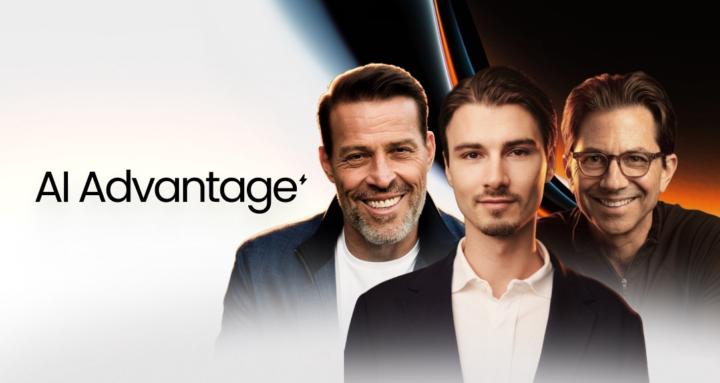
Founded by Tony Robbins, Dean Graziosi & Igor Pogany - AI Advantage is your go-to hub to simplify AI and confidently unlock real & repeatable results
Leaderboard (30-day)
1

+175
2

+165
3

+148
4

+140
5

🔥
+111
Powered by