
Write something
Pinned

⭐
2d •
🔥 Welcome to the Private AI Advantage Community!
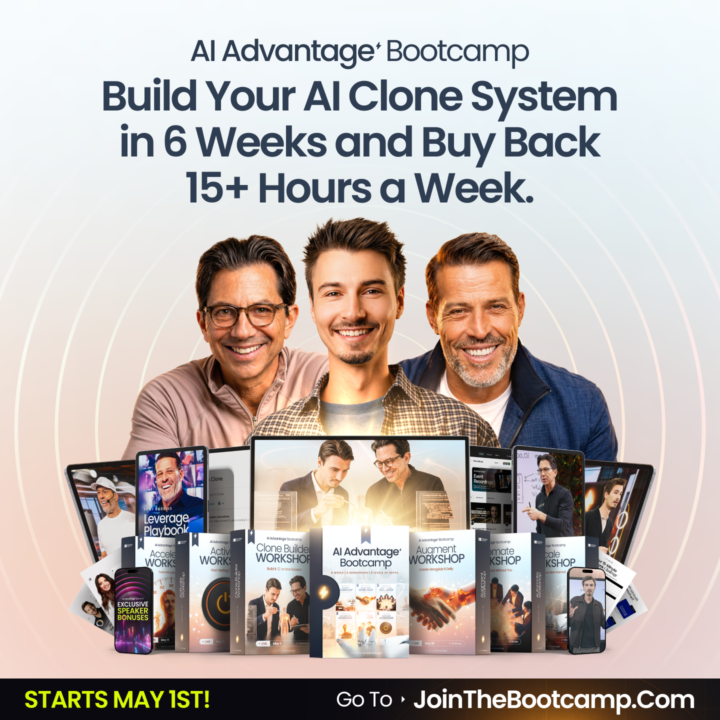
First and foremost, so glad you’re here. The 2026 AI Advantage Summit just wrapped, and the energy was incredible. If you joined us live, you already know what this community is about. And if you’re just finding your way here now, perfect timing. The doors to the AI Advantage Bootcamp are officially open. This is where the real work begins. Over the course of the Bootcamp, you’ll build your own AI clone, create AI agents that work for you around the clock, and put together a setup designed to save you 15 hours every week. Not 15 hours of busywork. Fifteen hours of the stuff that drains you, distracts you, and keeps you from the work that actually moves the needle. Whether you’re brand new to AI or you’ve been experimenting for a while, this is the right next step. The Bootcamp is practical and step-by-step. You don’t need a tech background. You just need to show up and do the work. JOIN THE BOOTCAMP HERE And while you’re getting settled, introduce yourself in the General Discussion section. Let us know where you’re from, what you do, and what you’re most hoping to change. We’re glad you made it. Let’s get to work.
Pinned
⭐
5h •
🔥 Quick Clarification: The Difference Between Our 3 AI Advantage Communities
Hey everyone, we’ve received a few questions in the customer service inbox, so we wanted to take a moment to clearly explain the difference between the groups and experiences inside the AI Advantage ecosystem. --------------------------------------------------------------------------------------------------- 1. This Skool Community (Free) This group right here is our free community. It’s where Igor Pogany, our team, and the community continue to share value, insights, resources, conversations, and support. Inside here you can expect: - Free trainings and resources inside the Classroom - Ongoing conversations - Community support - Updates of the latest AI News - Updates and announcements for AIA - Valuable insights to help you grow with AI This group is completely free and we fully encourage you to stay engaged, ask questions, connect, and use everything available here. And just because the Summit is over, doesn’t meant mean this group is going anywhere! --------------------------------------------------------------------------------------------------- 2. AI Advantage Club (Paid Membership) The AI Advantage Club is our premium membership for those who want to go deeper and continue building their AI skillset consistently. Depending on how you joined: - VIP members received a 30-day trial - Bootcamp members receive 3 months included And if you took the VIP upgrade AND joined the Bootcamp, you would have 4 months free inside the Club. Inside the Club, the experience goes deeper with things like: - Advanced trainings - Step-by-step guides and our “Hacks of the Week” - AI workflows - Prompt libraries you can copy - Business use cases - Time-saving systems - Ongoing implementation support - New resources added regularly - A Technical Support Team who can answer questions if you hit roadblocks trying to implement an AI tool Think of this as your AI gym membership. It’s the place where you will train those AI muscles and really focus on implementing AI into your life and business.
Pinned

24h •
What an incredible few days
I just wanted to take a moment and sincerely thank you for showing up for the AI Advantage Summit. Thank you for investing your time. Thank you for being open. Thank you for being willing to learn, grow, and prepare for what’s next. In a world full of distractions, noise, and reasons to wait… you made a decision to be here and we don't take that lightly. And as Tony said during the event, your decisions shape your day, your future, and ultimately your reality. That’s why this doesn’t end when the summit ends. Now you get to decide what comes next. Decide to stay plugged in. Decide to keep learning. Decide to take action on what you discovered here. Decide that your future matters enough to keep moving forward. If you are joining us for the Bootcamp, we cannot wait to see you Friday and go even deeper with you. If you grabbed the VIP upgrade and unlocked access to the AI Advantage Club, our team is already pouring insane value into that community every single week and we’re excited to support you there. And if now isn’t the right time for anything more, that’s okay too. This free community is staying open. We’ll keep showing up. We’ll keep adding value. We’ll keep giving you tools, insights, and support to help you grow. No matter where you are in your journey, there is a place for you here. From my heart, thank you for trusting us, for spending these days with us, and for being part of something special. Excited to build alongside you!

5d •
🧩 AI Design Tools Are Expanding Fast: The New Time Win Is Faster Visual Thinking, Not Just Faster Writing
A lot of AI productivity conversation still begins with text. Faster drafts, better summaries, cleaner emails, quicker outlines. Those gains matter, but they can make it easy to overlook another major shift happening right now. AI is moving deeper into visual work. Prototypes, mockups, slide concepts, layout ideas, one-pagers, and branded assets are becoming easier to generate and refine. That matters because visual work is often where teams lose a surprising amount of time before alignment ever begins. The real opportunity here is not only faster design output. It is faster visual thinking. When teams can turn ideas into something visible sooner, they reduce the time spent describing, translating, and debating abstractly. In many cases, that shortens the path to feedback, decision, and momentum far more than another faster paragraph ever could. ------------- Context ------------- A lot of work gets delayed because people are trying to align around something they cannot yet see. A concept sounds promising in conversation, but until it is visualized, everyone fills in the gaps differently. One person imagines a clean layout. Another imagines a detailed dashboard. Someone else is still thinking in terms of a slide, not a prototype. The discussion continues, but the team is not actually converging. This is where visual thinking becomes a time issue. Teams often assume they are discussing the same thing when in reality they are carrying different mental pictures. That mismatch creates extra meetings, repeated clarification, and slow feedback cycles. The work is not blocked by lack of effort. It is blocked by the absence of a shared object to react to. AI design tools change that dynamic. They make it easier to move from concept to visual draft quickly enough that people can respond to something concrete. A rough interface, an early one-pager, a draft layout, or a visual storyboard may not be final, but it creates a common reference point. And once a team has that, the conversation becomes far more efficient.


21m •
Prompt Categories
Hello AI Advantagists, I was born too early. We didn't have computers available to the masses when I went to college; if they had I think (looking back on my life) I would have majored in Library Science (my HD is a mess!). Our peers are undoubtedly going to be sharing countless prompts they've created. I wonder if there is a list of general categories we might utilize that will make it easier for us to save and FIND those we deem useful. BTW, thanks in advance for all the insight that get shared in this group.
1-30 of 18,216
skool.com/the-ai-advantage
Founded by Tony Robbins, Dean Graziosi & Igor Pogany - AI Advantage is your go-to hub to simplify AI and confidently unlock real & repeatable results
Leaderboard (30-day)
1

+1693
2

+1245
3

+689
4

+584
5

+543
Powered by