

Nov '25 •
He got 7 qualified techs to respond in ONE day (steal the exact ad inside)
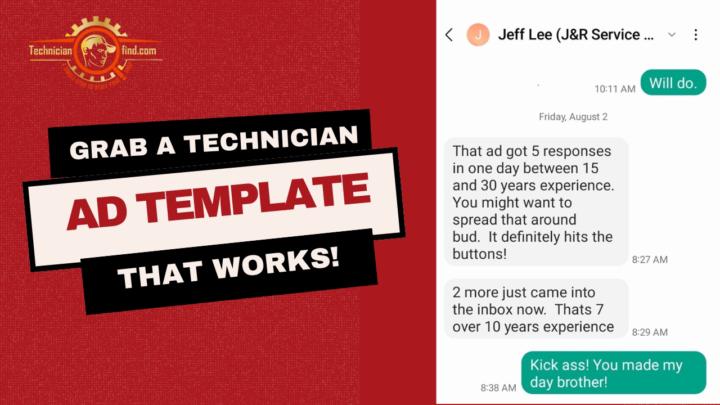
Let me tell you a quick story. A few months back, I got a text from Jeff Lee. He and his wife Amy own J&R Service Center—three shops, including a motorsports division. His message? "That ad got five responses in one day. Between 15 and 30 years of experience. You might wanna spread that around, bud. It definitely hits the buttons." Two minutes later, another text: "Two more just came into the inbox. That's seven. Over 10 years experience." Now look—that doesn't happen every day. That's an outlier for sure. But here's what's NOT an outlier: Ads that stand out get responses. Ads that look like everyone else's get ignored. Go search Indeed right now. Type in "automotive technician in [your city]" You'll see 380+ jobs that all look EXACTLY THE SAME. Same boring headlines. Same "requirements first" structure. Same invisible, forgettable copy. Meanwhile, the techs you actually want? They're scrolling past all of it. So I put together something special for you. Inside the classroom, you'll find: → A 16-minute video walkthrough showing you exactly how the ad that got those 7 responses was built—section by section → The actual swipe-and-deploy template you can customize for your shop → A custom AI tool (Mini Travel Brochure) that writes the relocation section if you're open to hiring outside your area → Another AI tool (Tech Ad Tuner) that diagnoses what's wrong with your current ad and shows you exactly how to fix it Your ad is usually the first impression a technician has of your shop. It's the highest-leverage thing you can work on if you're serious about attracting real talent. Go grab these tools and write something that makes a tech stop scrolling. 📍 Find it all in the classroom under "Grab a technician ad template that works!" Remember—techs aren't reading every word. They're scanning. They're deciding in seconds whether you're worth their time.
17d •
Don't ever forget this...
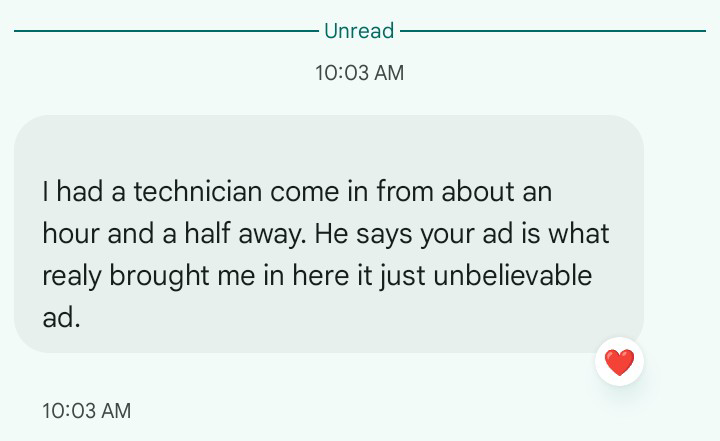
I'm about to hop on a plane after two amazing shop visits in Washington and I got this text from a shop owner in Iowa. Just a reminder of the power of a well-written ad.
24d •
Your ad says "experienced." Techs are reading "entry-level."
"I had three real conversations out of five calls. Every one was bottom-floor, no experience. Two of them said they thought the job was entry-level." That's a message a shop owner forwarded me this morning. He's hunting for a tech who can actually diag a BMW. He's getting oil-changers who think they hit the jackpot. He doesn't have a bad-applicant problem. He has a translation problem. His ad says one thing in English and something completely different in tech. Your ad doesn't broadcast what you wrote. It broadcasts what the reader can verify against their own life. You read your ad and see "European-focused, experienced tech wanted." A seasoned tech reads the same ad and sees three things: the pay, the requirements, and how easy it is to reach out. The first two tell him what level the job is. The third tells him whether you're worth the effort. Together they decide everything. Not your headline. So when the qualified guys scroll past and the entry-level guys think they qualify, it's not a mystery. You think the words say experienced. The market is reading the coordinates. And the coordinates say entry. In a previous post I covered adding a "Not a Fit" block to your ad. That helps. But if qualified techs are still reading the job as entry-level, the leak is upstream of the copy. Here's how to find it. FIRST: don't troubleshoot anything yet. Before you touch the ad, before you blame the applicants, answer one question. How long has the ad been running? If it's under 7 days — stop. You don't have an ad problem. You have a patience problem. When you run on Meta, the algorithm spends the first week in a learning phase. Those early applicants aren't a real sample — they're the system casting a wide net while it figures out who to show your ad to. Judging your ad on day three is like judging a tech on his first oil change in a new shop when he doesn't know where anything is yet.
4
0

May 29 •
The hire-winning line was hiding in the benefits.
"We're a faith-based shop. A conservative little shop." He led with it on the onboarding call. How do you write an ad that finds that person — without writing a single word you're legally not allowed to? Every shop has a culture it can't say out loud. Maybe it's faith. Maybe it's politics. Maybe it's the quiet sense that you're a certain kind of place — and people either fit or they don't. So you strip it out. You post a clean, careful, generic ad — the same one the shop down the road is running. And you get a clean, careful, generic stack of résumés. The one thing that would filter for fit is the one thing you deleted. So you hire on skills instead. Because skills you're allowed to ask about. You land the top performer. Great hands, great numbers, week one. Gone by day 90. Or worse — still there on day 90, quietly turning the crew against each other. A skills gap, you close in a quarter. A values gap, you're cleaning up for a year. And the better the tech, the more damage a bad fit does. A weak one who doesn't fit gets ignored. A great one gets followed. Skill is a megaphone. Point it at the wrong values and the whole shop hears it. None of that makes him a bad tech. A great tech in the wrong shop is still a great tech. Wrong shop, right tech. So the fix was never about filtering people harder. It's about putting a clearer signal in the ad. You can't always screen for culture. You can't filter applicants by faith, politics, anything protected — that door is closed, and it should stay closed. But nothing stops you from signaling. From describing your real culture, your real calendar, your real benefits — so specifically that the right person reads one line and thinks, they're talking about me. Screening keeps people out. Signaling invites the right people in. One gets you sued. The other is good writing. The ad turns no one away. Anyone can still apply. You've lit a porch light the right person was already looking for. Back to the conservative little shop.
4
0
May 13 •
Pausing your hiring ads mid-hire is more expensive than running them.
Most shops treat their Facebook ads like a faucet. Off when budget feels tight. On when the panic kicks back in. That model is wrong — and it's costing you the candidates you can't see. In this post: - The difference between pausing to save money and turning ads off after a hire - What Facebook is actually doing in the first week you don't see - The relearning tax — the invoice line nobody charges you for, but you still pay - Why some shops who spend less hire faster than shops who spend more - The decision frame that changes everything: let it learn, or pay to learn it again 3-minute read. Watch the video on the run if you're short on time. _______________________________________________________________ "Can we just shut it down for a couple weeks and see what flies?" Just about every shop owner I talk to has asked me some version of this — usually during an active campaign, when the spend feels heavy and the right tech hasn't surfaced yet. It feels frugal. It feels smart. It's neither. Your Facebook ads aren't a faucet. They're a trained dog. Stop the training mid-search and the dog forgets. Here's what's actually happening on the back end of your campaign — and why pausing mid-hire costs you more than you think. For the first week or so of any new Facebook campaign, the platform isn't fully sourcing leads for you. It's learning. Meta's official threshold is around 50 conversions inside a 7-day window before a campaign exits what they call the learning phase. In practice — for shop owners running specialty hiring ads — that usually takes anywhere from five days to two weeks depending on your budget and your area. During that window, Facebook is figuring out who to show your ad to. Which technicians. Which zip codes. Which times of day pull the right scrollers. Which version of your ad pulls A-techs and which one pulls guys who saw the salary and clicked apply on everything. Every click. Every scroll-past. Every application. Every bounce. All of it teaches the platform something about who's actually open to a move right now.

1-30 of 32

skool.com/technicianfind
Proven templates, strategies, training and top-level networking to help independent auto repair shops hire quality staff faster.
Leaderboard (30-day)
1

+3
2

+3
3

+2
4

+2
5

+1
Powered by