
Apr 17 •
How To Simply Create a Multisensory Learning Experience at Home
Teaching reading at home does not have to feel complicated. One simple way to make practice more effective is to make it a multi-sensory experience. That just means your child is not only looking at words on a page. They are hearing sounds, saying them out loud, touching, tapping, writing, and moving while they learn. This can be very easy to do at home. You might: - have your child trace a letter or word while saying the sounds - tap out sounds on their fingers - build simple words with letter tiles, magnets, or even scraps of paper - write words on a whiteboard, in sand, or in shaving cream - clap syllables in longer words - practice reading a word, then spelling the same word right after - These little things can make learning feel more natural and less frustrating because they give the brain more than one way to remember. You do not need fancy materials. You can do a lot with your voice, your hands, and a few simple supplies you already have at home. Sometimes the smallest changes make reading practice click a little faster.
0
0
Mar 5 •
Fun and Engaging Ways to Build Reading Fluency
From Partner Reading to Reader’s Theater For many developing readers, the journey from sounding out individual words to reading sentences with ease can feel like a monumental leap. This transition is the heart of reading fluency—the ability to read with accuracy, at an appropriate speed, and with suitable expression, or what experts call prosody. Reading fluency is often described as the essential bridge connecting the skill of decoding words to the ultimate goal of understanding them. When a child reads fluently, their mind is freed from the mechanics of reading and can focus on the story, the characters, and the meaning of the text. However, for students with dyslexia, achieving fluency can be a significant hurdle. Their challenges with decoding and recognizing words quickly mean that reading can be a slow and laborious process. This is not due to a lack of effort, but rather a need for extensive, targeted, and engaging practice. The great news is that building fluency doesn't have to be a chore. With creative and research-supported strategies, parents and educators can make this practice both fun and highly effective. Drawing from the evidence-based approaches in Dyslexia Interventions and Recommendations (Mather et al., 2024), here are some engaging ways to help students build their reading fluency. 1. Team Up with Partner Reading Partner reading, also known as paired reading, is a simple yet powerful strategy that involves a more proficient reader and a developing reader reading a text together. This collaborative approach provides a live model of fluent reading, complete with proper pacing and expression. The supportive nature of reading with a partner can also reduce the anxiety that many struggling readers feel when asked to read aloud on their own. How to Do It: 1. Choose a Text: Select a book or passage that is at the student's instructional level, typically one they can read with about 90–95% accuracy. 2. Read in Unison: Sit side-by-side and begin reading the text aloud together. The more fluent reader sets a comfortable, natural pace.
Feb 24 •
Do you have a student with a chronic word guessing, omitting, or substituting problem?
Here's a game I play with my private students to quickly stop those bad habits. The more competitive the child is, the faster it works!
Jan 28 •
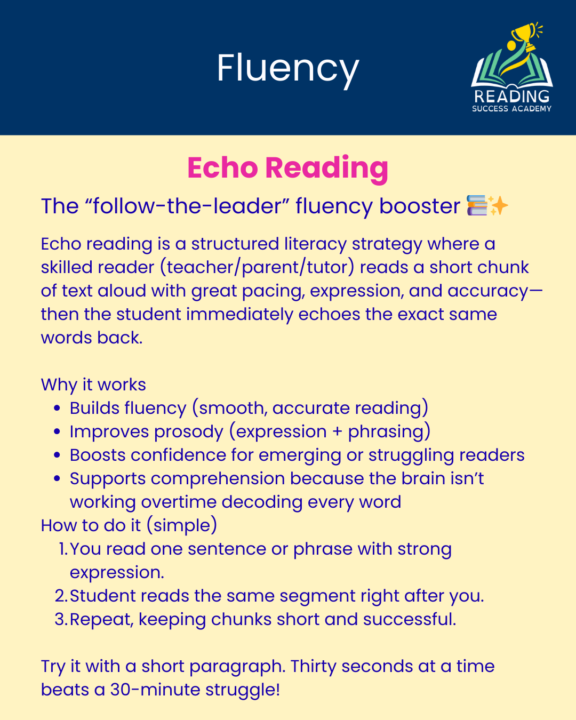
Have you tried "echo reading" for building fluency?
Echo reading is a structured literacy strategy where a skilled reader (teacher/parent/tutor) reads a short chunk of text aloud with great pacing, expression, and accuracy—then the student immediately echoes the exact same words back. Why it works - Builds fluency (smooth, accurate reading) - Improves prosody (expression + phrasing) - Boosts confidence for emerging or struggling readers - Supports comprehension because the brain isn’t working overtime decoding every word How to do it (simple) - You read one sentence or phrase with strong expression. - Student reads the same segment right after you. - Repeat, keeping chunks short and successful. Try it with a short paragraph. Thirty seconds at a time beats a 30-minute struggle!
Jan 13 •
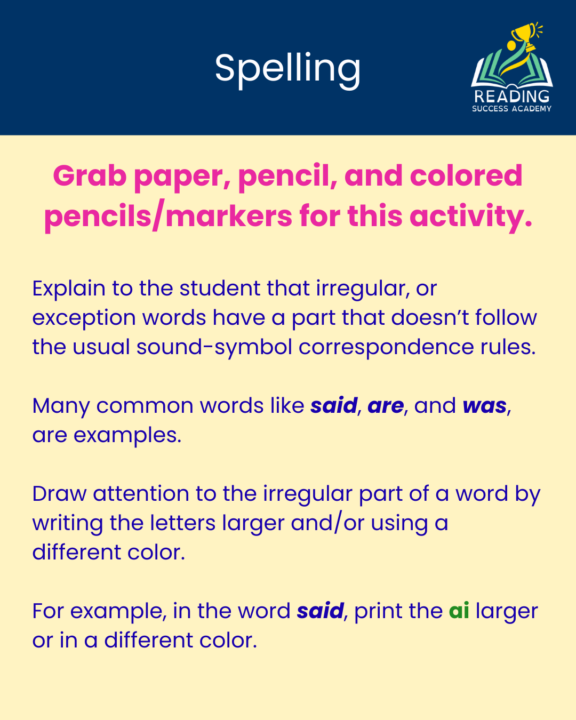
Spelling Irregular Words
Here's an intervention for spellers who are frustrated with words that don't follow the rules. I usually add one or two of these to each week's spelling list as "bonus words" or "challenge words". Explain to the student that irregular, or exception words have a part that doesn’t follow the usual sound-symbol correspondence rules. Many common words like said, are, and was, are examples. Draw attention to the irregular part of a word by writing the letters larger and/or using a different color. For example, in the word said, print the ai larger or in a different color.
1-17 of 17
powered by
skool.com/reading-success-academy-4045
A supportive community helping parents & teachers guide struggling readers and kids with dyslexia to success. Free lessons, courses, and live events.
Suggested communities
Powered by