

3d •
Magic for floating
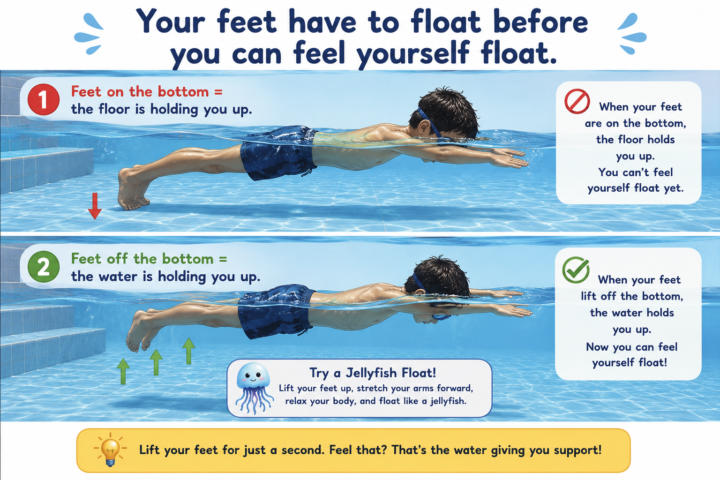
I often call this magic when I speak to my students but it is science: “Your feet have to float before you can feel yourself float.” What happens: When a child’s feet are planted on the pool floor, the floor is supporting their weight. They can’t really experience buoyancy because they’re still relying on the ground. When you let their feet lift off the bottom—even for a second—the water becomes the thing supporting them. The science - The floor is holding you up. - Once your feet leave the floor, the water holds you up. - Your body begins to discover its natural floating position. Kid version “The floor is helping you stand. Let’s see if the water can help instead.” or “Lift your feet for just a second. Feel that? That’s the water holding you- you float in water.”

13d •
adult beginners
I'm looking for any suggestions for building confidence in an adult beginner swimmer. I have managed to get her to do a very nervous back float, and she has done a little streamline with a bit of a kick, but she struggles to return to vertical and just her confidence in general is not there. so, I'm looking for exercises we can do to build some confidence and get her more comfortable in the water. Any suggestions would be appreciated and if you have a video link even better. her next lesson in a day or two and I am just drawing a blank for new stuff to try.
Apr 16 •
Highly recommend
After having YMCA of the USA Parent Child and preschool aquatic- which I highly recommend. And Adult and Child. Then being a Red Cross WSI I highly- highly recommend this certification. I got this after two participants in my WSI class recommended it. And I feel it is great! https://worldwideswimschool.com/swim-teachers/join/

26d •
I don’t usually get stumped in swim lessons.
Stuck? Yes.Paused? Absolutely.But stumped? Not often. Today, I had one of those lessons that made me stop, reflect, and really think through what was happening underneath the behavior. A young swimmer came to class with fear. Not refusal. Not defiance. Fear. He could stand on the steps.He could move along the wall.He could climb out. But the moment we left the steps, his body changed. That lesson reminded me that sometimes the skill is not the first thing we need to teach. Sometimes we need to ask: What is the child’s body telling us?Where does fear begin?Where does safety return?How do we help the swimmer recover without removing the challenge completely? I turned this lesson into a training resource for swim instructors because these are the moments where we grow. If you are creating staff training or need an in-service opportunity for your team, this is a strong one: Understanding the Fearful SwimmerA practical look at fear, regulation, safe zones, and what children communicate before they have the words to explain it.
22d •
Otterball
Really enjoyed watching Ron show the children at the city of Brunswick and the City of Savannah how OtterBall is played!

1-30 of 151
powered by

skool.com/navigating-neva-5481
Exploring the psychology, safety, and soul of aquatics—where leadership, learning, and emotional intelligence meet.
Suggested communities
Powered by