

6d •
Let’s spill the psychology secrets 👀
What’s the best trading psychology advice you’ve heard, and actually trade by? For me it’s understanding that my job isn’t to make money today, it’s to stay aligned with reality and protect the quality of my decisions. Emotional regulation has helped me a lot with this. The more regulated I am, the more present I become the less I project fear, hope or urgency when trading and the easier it is to simply trade what’s actually there and not what i hope to be there, or feeling unresolved tension in my body. For me, good trading is more about staying clear enough not to distort or project your desires into the market. What’s your thoughts on this and what did you have to overcome to become a better trader? 😁
10d •
Backtest vs live
I’m curious, lately I’ve realised that my biggest challenge isn’t understanding my strategy. It’s fully trusting it when real money is on the line and sitting in uncertainty. I know what I’m looking for, but executing with the same confidence I have in backtesting is a completely different skill. So I’m wondering, what was the single biggest shift that took you from knowing your strategy to actually trusting it live? Not a technical tweak, but the mental shift. I’d genuinely love to hear everyone’s experience because I have a feeling this is where a lot of traders quietly struggle.

Jun 18 •
📌 Why I Re-entered The Trade
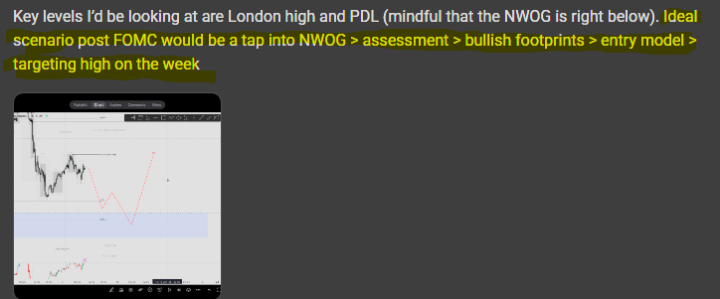
I didn’t want to send the third entry here without first having the time to write a full explanation for you all. As mentioned yesterday, the most likely scenario was a tap into the NWOG followed by a reversal. You saw me enter twice already, and both trades ended at break-even. For many traders, this is where they close the charts, become frustrated, and reassess the following day. In many cases, that’s actually the sensible thing to do. However, trading is not an exact science, and sometimes it takes more than a simple tap into a POI to trigger the move you’re anticipating. In this particular case, I still believed the probabilities heavily favoured a reversal. If price needed a deeper retracement into the NWOG before moving, I was willing to allow that to happen. These are the moments where I don’t need every single confluence to align. I don’t need every FVG to invert, every OB to be respected, or CVD to print a perfect divergence. When you have a clear narrative and the odds are stacked in your favour, it’s worth putting risk on the table without waiting for the perfect entry. This is what I want you all to understand, and why I believe discretionary trading will always outperform mechanical trading in the long run. Please don’t use this as an excuse to overtrade. That’s not what’s happening here. There’s a big difference between forcing trades and re-executing an idea that still has a valid thesis behind it. This is about understanding the market conditions you’re in, keeping the bigger picture in mind, and recognising when the market is still supporting your original idea. A tap into the NWOG with a very clear scenario developing doesn’t happen every week. These are opportunities we don’t want to be afraid of. One psychological lesson I’ve learned over the years is that break-even trades should not emotionally reset your analysis. Too many traders subconsciously treat a break-even as a loss and abandon a perfectly valid idea because they feel frustrated. The market doesn’t know, and certainly doesn’t care, that you’ve already entered twice.
Jun 6 •
The Pain of Leaving Money on the Table
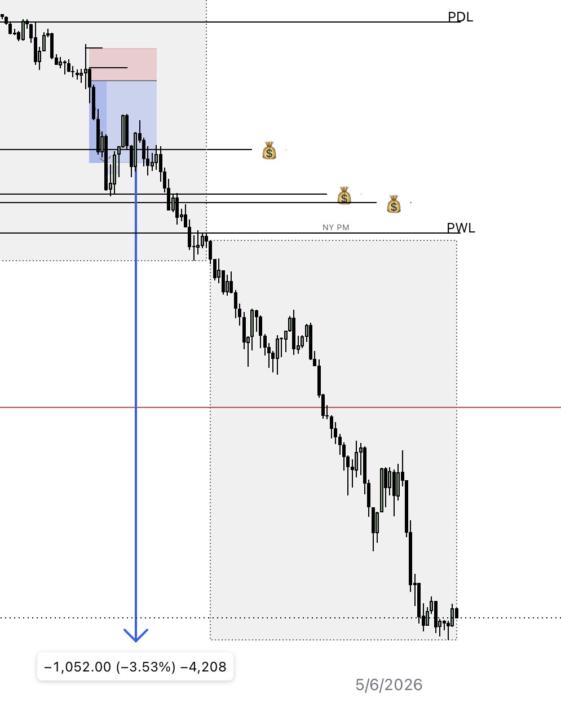
On Friday, we caught a 2.5R trade. The market then continued dropping another 3.5%, turning what we took as 2.5R into something that could have been around 17R. Frustrating? It used to be. But it doesn’t hurt me the same way anymore, because I know how many times in the past I chased price, got greedy, ignored my plan, and ended up giving money back to the market. Did we win? Yes. Did we make money? Yes. Could we have made more? Clearly. But could we have known the market would drop that much? No. And that’s the key. We take what the market gives us based on our plan. We don’t start making decisions based on greed, hindsight, or emotion. The market will always find a way to create pain. There is pain in closing too early.There is pain in closing too late after being in big profit.There is pain in not entering because you didn’t have the right confirmations.There is pain in chasing a move and getting burned. You don’t avoid pain in trading. You choose which pain you’re willing to accept. For me, I’d rather accept the pain of taking profit and leaving money on the table than the pain of breaking my rules and destroying my account. The goal is not to be emotionless. That’s unrealistic. The goal is to feel the emotion, recognise it, and still respond with discipline. That’s what changes your trading.
5
0
1-4 of 4
skool.com/liquidity-logic-trading
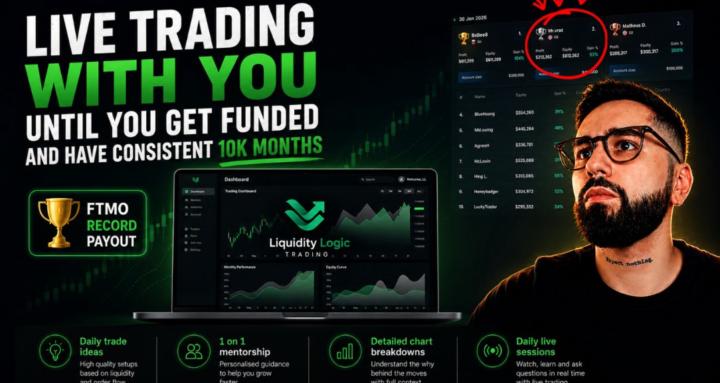
Helping traders understand how markets truly move through liquidity, structure, and disciplined execution.
Leaderboard (30-day)
1
+31
2
+28
3

+22
4

+13
5

+10
Powered by