
Write something
Pinned

Feb 23 •
The Instagram OSINT Framework 2026 - An Exclusive Comprehensive Cheat Sheet
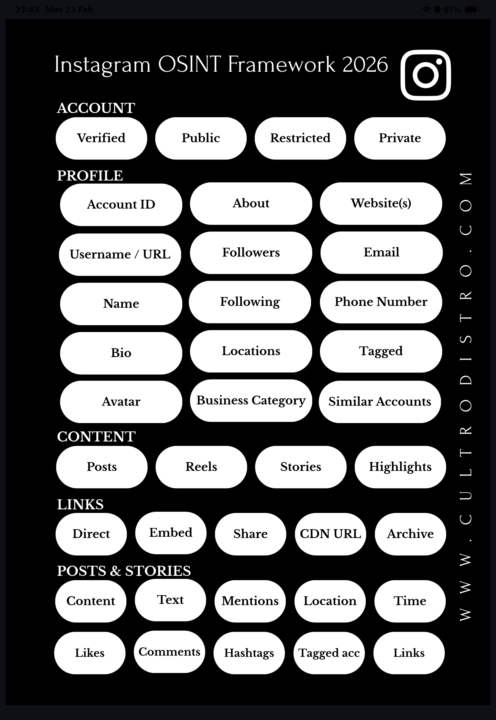
📌 INSTAGRAM OSINT FRAMEWORK 2026 In due diligence and compliance investigations, social media is often overlooked as an intelligence source. Instagram alone can reveal significant information about a subject, if you know where to look. This framework covers every layer. 🔗 All tools & resources referenced in this framework can be found at: • https://www.cultrodistro.com • https://www.cultrodistro.com/tools/socials • https://www.cultrodistro.com/tools/images 🔷 ACCOUNT TYPES • Public – fully accessible, crawlable with online tools • Restricted – public but hidden from some users due to content; still crawlable • Private – only username, bio & profile picture visible • Verified – public + Instagram-confirmed identity, usually business accounts 🔷 PROFILE • Account ID – assigned at creation, never changes, findable via crawlers or F12 > search “account ID” • Bio & name – often contains location hints, hobbies, personal clues • About section – shows account creation date and previous usernames • Avatar – can be enlarged and extracted for analysis • Followers/following – reveals interests and network connections • Location tags – verifiable via reverse image search or geolocation • Business profiles – expose category, website, email, phone number • Tagged posts & suggested accounts – additional context 🔷 CONTENT • Posts & Reels – permanent/semi-permanent visual content • Stories – disappear after 24h unless saved as Highlights • Highlights – thematically organized, often revealing 🔷 LINKS • Direct links – go straight to content • Embedded links – shareable on other platforms • Share links – ⚠️ contain metadata exposing your identity; avoid professionally • CDN URLs – bypass Instagram’s interface, ideal for archiving via archive.org 🔷 POSTS & STORIES • Reverse image search visuals • Analyze text for writing style, cultural clues, education level
Pinned
Feb 2 •
🧽 Content Removal: How to Remove Unwanted Content from the Web
🥀 Your past doesn’t have to haunt your digital present. Maybe it’s an intimate photo shared without your consent. Perhaps it’s outdated information that no longer represents who you are. Or it could be content that violates your privacy, defames your character, or infringes on your copyright. Whatever the case, unwanted content online can derail job opportunities, damage relationships, and cause immense emotional distress. 🦾 The good news? You’re not powerless. The internet may feel permanent, but there are proven pathways to reclaim your digital narrative. This guide cuts through the confusion and shows you exactly how to remove harmful content from search engines, social media platforms, and websites, step by step. Visit https://www.cultrodistro.com/tools/browsing for the direct links. 👙 Non-Consensual Intimate Content Stop NCII specializes in removing intimate images from partner sites including Pornhub, OnlyFans, and major social media platforms. They create a digital fingerprint of your images without viewing them, then share it with platforms for automatic detection and removal. Google offers several removal pathways: 📩 Personal Information - Remove doxxing content, financial information, contact details, and images containing personal data from search results. 📩 Legal Issues - Submit removal requests for content that violates laws in your jurisdiction, including defamatory or privacy-violating material. 📩Outdated Content - Remove information that’s been updated or deleted from the original source but still appears in Google’s cache or search results. ©️ DMCA Takedown Requests For copyright infringement, file a DMCA takedown notice directly with platforms (free) or through paid services. Include identification of your copyrighted work, location of infringing material, contact information, and a good faith statement. 👨🏻💼 Contact Website Owners Directly Use WHOIS databases to find website owner contact information. A direct removal request is often the fastest solution. For international domains, the IANA Root Zone Database provides information about top-level domain operators.

Oct '25 •
🗂️ Plus-addressing: Unlimited free accounts with one email address
Want free unlimited account aliases without creating a new account or separate inbox? Use plus-addressing: add +tag to your email (e.g. [email protected]). All mail still arrives in your main mailbox, but each signup gets a unique address you can track, filter and revoke. Like this you can keep track of who leaked your email, if you for example receive spam. This is also a great way to keep your inbox organized. If you go to the settings of your inbox you can created filters to apply to that specific email address or +tag. For example to delete if it was made for temporary use only. There are many more benefits and applications for plus-addressing. Just keep in mind that this is a productivity tip and not a security feature. It also does nothing in terms of security or anonymity. If thats what you are looking for you should actually use a temporary email address provider and follow the basics of anonymous browsing. Stay tuned. Anonymity 101 course dropping next month (november). Images 101 course is live.
Oct '25 •
🔦 Lumen Database: Archive of Content Removed by Search Engines
Have you ever tried searching something on Google but got hit with one of these? “In response to a complaint that we received under the (US) DMCA, we have removed 1 result(s) from this page. If you wish, you may read the DMCA complaint that caused the removal(s) at LumenDatabase.org.” This is actually great! One of my favourite tools to find hidden gems online is the Lumen Database. Here’s why: It’s a public archive of takedown and removal requests. The kind companies and individuals send to Google or platforms when they want something deleted from search results. By searching it, you can uncover traces of content that used to exist: old URLs, filenames, emails, usernames or real names that often reveal earlier identities or hidden connections. Combine what you find there with archive searches (like web.archive.org), and you can often reconstruct pages or profiles long after they disappeared. “The Lumen database collects and analyzes legal complaints and requests for removal of online materials, helping Internet users to know their rights and understand the law. These data enable us to study the prevalence of legal threats and let Internet users see the source of content removals.” https://lumendatabase.org/
May 15 •
🔪 EDC Knife or Weapon: The Legal Linguistic Trap
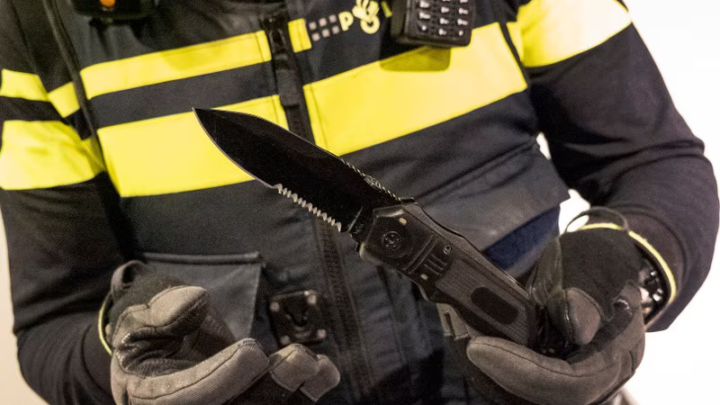
The Dutch police recently announced a “record number” of 2,300 weapon seizures from minors in 2025, claiming a surge from 1,800 in 2022. However, a closer look at their own data and imagery reveals a process of statistical laundering that criminalizes utility tools and targets marginalized youth through demographic profiling. The Example: A Tool Framed as a Threat The police often use professional photography to illustrate these “dangerous weapons”. In one prominent image, an officer holds a black folding knife. An OSINT analysis identifies this object as the Walther Emergency Rescue Knife (ERK). Legal Status: This is a commercially available tool sold legally in stores. Function: It is specifically designed as a life-saving tool, featuring a glass breaker and a belt cutter for emergency situations. Technical Compliance: According to the official Customs (Douane) flowchart, this knife is legally NOT a weapon because it has only one cutting edge and is under 28 cm in length. By using a rescue tool to represent “prohibited weapons,” the police perform “Linguistic Capture”—redefining a neutral utility object as a criminal instrument before any legal investigation into its use has occurred. Statistical Laundering and Enforcement Intensity The police admit they do not know the “true scope” of weapon possession among youth; their numbers only reflect how often they choose to seize items. Furthermore, they acknowledge that the “increase” is partly due to changes in counting methods and “increased attention” from officers. The Trap: This creates an unfalsifiable loop. Any seizure—even of a legal rescue tool—is used as evidence that a “weapon problem” exists, which in turn justifies more seizures. This isn’t a measure of crime; it is a measure of enforcement intensity. Legal Discrimination: The Double Standard The sources highlight a deep systemic bias in how the law is applied. Under Category IV sub 7 of the Weapons Act, a legal tool only becomes a “weapon” based on the “nature and circumstances” of its discovery. This grants police total discretion to decide who is a criminal:
1-30 of 49
powered by

skool.com/huisvestnl-3698
Get started in OSINT and learn how to find out about anything and anyone online, professionally.
Suggested communities
Powered by