

Aug 21 •
YouTube Is Changing. Music Creators Should Be Building for What Comes Next.
There’s a lot of conversation right now about changes coming to YouTube monetization. For music creators, I think the bigger lesson goes beyond whatever number YouTube ultimately puts on watch hours, subscribers, or Shorts views. The era of simply uploading content and hoping the algorithm eventually rewards you is becoming harder to sustain. If you're a producer, artist, songwriter, engineer, DJ, music educator, or anyone building a business around music, your YouTube channel should be treated like a content catalog, not just a place to upload videos. Here are a few things I would be doing right now. 1. Start optimizing for WATCH TIME, not just views. A video getting 10,000 views sounds great. But if people watch for 30 seconds and leave, that audience isn't nearly as valuable as 1,000 people spending 15 or 20 minutes with your content. Music creators actually have an advantage here because we naturally create content people can spend time with. Beatmaking sessions. Studio sessions. Production breakdowns. Music business tutorials. Song breakdowns. Beat tapes. Listening sessions. Live reviews. Interviews. Long-form educational content. Don't automatically chop everything into short content because everyone tells you attention spans are dead. Short-form can get attention. Long-form builds watch time, familiarity, and trust. You need both. 2. Turn individual videos into a SERIES. One of the biggest mistakes I see creators make is treating every upload like an isolated piece of content. Instead of: "How I Made This Beat" Think: Making a Beat From Scratch — Episode 1 Then Episode 2. Then Episode 3. Now build a playlist around it. Do the same thing with mixing tutorials, music business education, sample breakdowns, studio sessions, artist development, songwriting, or whatever your expertise happens to be. Your goal shouldn't always be getting somebody to watch one video. Your goal should be: Watch this → then watch this → then watch this. That's how you start turning a YouTube channel into something closer to your own television network.

Jul 24 •
SondSurge is here — and you can be one of the first on the chart. 🎵
I'm excited to announce that I've partnered with SondSurge — a live, fan-powered music discovery platform where artists compete on a real-time chart driven by real listeners, not industry connections or opaque algorithms. No label. No gatekeepers. No algorithm deciding who gets heard. There are two ways to get involved: 🎧 Have a released track? If your music is already on Spotify, Apple Music, SoundCloud, YouTube, or another streaming platform, you can submit it directly to the SondSurge Chart. • Free to submit • Keep 100% of your rights • Compete for chart placement based on real fan votes and engagement Submit here: https://sondsurge.com/submit 🔥 Have an unreleased track? If your song isn't out yet, submit it to a Live Surge session. Your music will be played live for real listeners and curators who provide immediate feedback. Once the track is officially released, you can then submit it to the chart and start competing for votes. Submit here: https://sondsurge.com/livesurges 📈 Watch the chart move in real time Every vote matters. Every share matters. The rankings change based on genuine community engagement. Explore the live chart: https://sondsurge.com/discover I'm sharing this with the Future Producer Society community before announcing it publicly. Right now, the chart is brand new, which means early submissions have a unique opportunity to establish themselves while the community grows. Getting your music on the chart now gives you the chance to build momentum from the very beginning. My live reviews aren't going anywhere overnight. I'll continue working through the existing review queue while we gradually introduce SondSurge into the community. Over time, I see this becoming the primary destination for music discovery, fan engagement, and chart growth. If you already have music released, don't wait. Claim your spot on the chart. Start building momentum.
7
0

May 9 •
Native Instruments Just Got Acquired: Here's What It Means for Producers
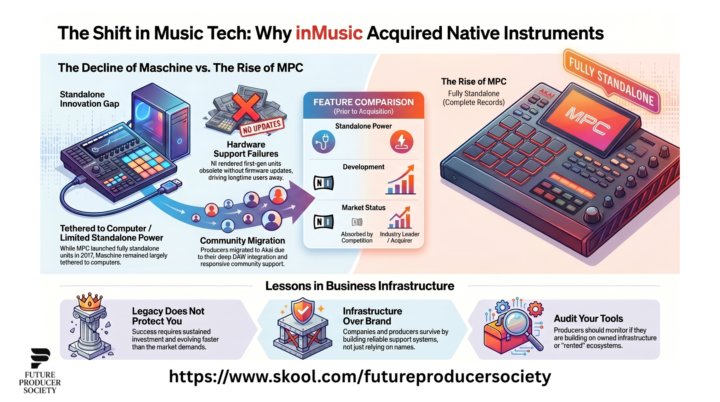
WHAT HAPPENED Native Instruments, (the company behind Maschine, Komplete, and Traktor) just signed a definitive agreement to be acquired by inMusic. If that name doesn't ring a bell immediately, their portfolio will. inMusic owns Akai Professional, Moog Music, Denon DJ, Numark, Rane, and M-Audio. They now own the MPC ecosystem AND the Maschine ecosystem under one roof. I CALLED THIS I've been saying this for years. When a hardware company stops innovating fast enough, they don't survive ,they get absorbed. I watched it happen in real time. My first generation Maschine unit was rendered completely useless when I upgraded my CPU. No firmware update. No support. No path forward. That was over ten years ago. That's not a bug, that's a strategy failure. When you stop serving the people who built your brand, you lose the brand. WHY THIS HAPPENED Native Instruments spent years as one of the most dominant forces in music production software and hardware. But while the MPC was evolving into a standalone production powerhouse with continuous firmware updates, Maschine stagnated. The hardware fell behind. The software ecosystem got bloated. The community started migrating. Meanwhile inMusic kept investing in the MPC line — standalone operation, continuous updates, deeper DAW integration. The market made its decision before the acquisition papers were ever signed. WHAT THIS MEANS FOR PRODUCERS The brands will continue operating — NI, iZotope, Plugin Alliance, Brainworx all stay intact for now. But the consolidation of Maschine and MPC under one parent company is a massive shift in the hardware production landscape. A few things to watch: - Will inMusic unify the NKS and MPC ecosystems into something bigger? - Does Maschine get the firmware investment it's been missing? - How does this affect pricing and competition in the hardware market? - What happens to the NI software ecosystem long term? THE BIGGER LESSON This isn't just a music tech story. It's a business story every producer needs to understand. The companies that survive in this industry are the ones that keep serving their community with innovation. The moment you start coasting on your legacy, someone else is already building what your customers actually need. That's true for hardware companies. It's true for labels. And it's true for producers who aren't building their business infrastructure while they're still relevant.
Poll
8 members have voted
May 11 •
253 Million Tracks Are on Streaming Right Now: Almost Half Got Fewer Than 10 Plays
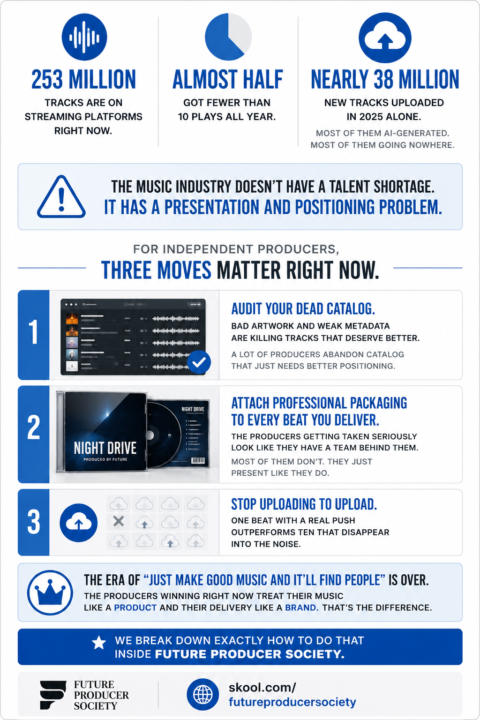
253 Million Tracks Are on Streaming Right Now. Almost Half Got Fewer Than 10 Plays. That number just dropped. According to Music Business Worldwide, streaming platforms closed out 2025 with 253 million tracks uploaded — up 37.9 million in a single year. That's 106,000 new tracks hitting the platforms every single day. Here's the part that should stop you cold. Nearly 120 million of those tracks got fewer than 10 streams all year. Not 10 per day. 10 total. Almost three-quarters of everything on streaming got fewer than 100 plays. Nearly 90% didn't clear 1,000. What's flooding the catalog Deezer reported they're receiving over 60,000 fully AI-generated tracks every day. 85% of streams on AI-generated music on their platform in 2025 were flagged as fraudulent. The platforms are drowning in content nobody asked for. What this means for you The noise makes discoverability harder, which means how you present and deliver your music matters more now than at any point in this industry's history. Talent isn't the differentiator when 106,000 tracks drop every day. Your brand, your packaging, your delivery — that's what separates you. Three things you can do this week First, audit your catalog on whatever platform you distribute to. Pull your stream counts. If tracks are sitting dead, update the artwork, rewrite the metadata, and re-pitch them. A lot of producers abandon catalog that just needs better positioning. Second, make sure every beat you send has a professional delivery attached to it — artwork, license, your name on it. The beat that looks like it came from a label gets treated like it came from a label. Third, stop distributing beats you're not going to promote. Quality over volume. One beat with a real push beats ten uploads that disappear into the 90%. Bottom Line The streaming era promised great music would find its audience. The data says otherwise. Build the business around the music or the music stays buried. What's one track in your catalog you've been sleeping on that deserves a second push?
4
0
May 1 •
The Music Industry May Not Be Trying to Stop AI — It May Be Deciding Who Gets To Use It
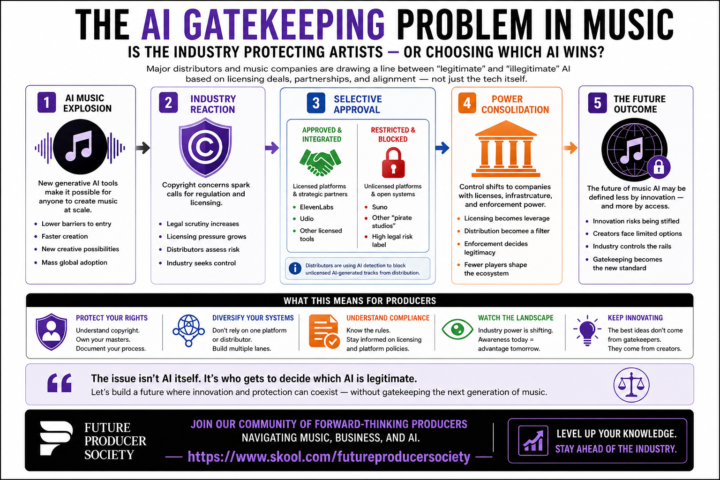
What’s becoming clearer is that this may be less about stopping AI altogether… and more about controlling which AI platforms are allowed to survive inside the music business. That’s a very different conversation. When you look at what’s happening, certain AI companies are being positioned as legitimate because they’ve secured licensing deals, strategic partnerships, or corporate backing. Others — especially platforms trained outside those systems — are increasingly being treated like liabilities, regardless of how powerful or useful the technology may be. So the real question producers should be asking is: Are we watching ethical regulation… or selective gatekeeping? Now to be clear — artists absolutely deserve protection. Rights holders deserve compensation. No serious person is arguing against that. But when the same corporations that once resisted disruption now appear to be deciding which AI companies are “acceptable,” it raises legitimate concerns. Because innovation should not simply belong to whoever has the deepest legal relationships. And that’s where this gets important for producers. We may be moving toward an industry where AI legitimacy is determined less by technology itself and more by: Who has the licenses Who has the partnerships Who has the legal infrastructure Who fits inside the corporate ecosystem That matters. Because if that becomes the standard, independent creators could once again find themselves navigating systems built more around control than creativity. This isn’t anti-AI. This isn’t anti-copyright. This is about understanding power. The future of music may not be decided by who builds the best tools. It may be decided by who gets recognized as “authorized” to use them. That distinction could shape the next decade of music production. My advice to producers is simple: Pay attention. Learn these systems now. Because AI is clearly going to be part of the future. The real question is whether that future stays open, or becomes another tightly controlled industry funnel.
1-7 of 7
skool.com/futureproducersociety
A community for producers mastering the music business, AI tools, royalties, and modern strategies to stay ahead in today’s evolving industry.
Leaderboard (30-day)
1
+6
2

+2
3

+2
4
+1
5

+1
Powered by