
Write something

22d •
I Sell AI Visibility Work. Here's How to Check People Like Me.
Quick disclosure before anything else: I do this work for a living. Which is exactly why I'm handing you the questions that filter operators from spam. If these questions would disqualify me, they should disqualify me. The AEO pitch wave is in full swing. Agency listicles flooding Reddit. "LLM optimization" retainers. Vendors borrowing credibility from real mechanisms (RAG exists, retrieval is real) to sell unproven tactics. One enterprise SEO director I follow described a company that added FAQs site-wide because an agency said it helps LLMs extract answers. Their SEO dropped across multiple content types. The AI lift never came. Now they're paying a second time to rip it all out. That's the failure mode: real mechanism, spam execution, no measurement. Here are the five questions that catch it before you sign. 1. "What do the engines currently say about my business?" Ask this first because it's the cheapest test. A real operator captures a baseline before proposing anything — what ChatGPT, Perplexity, Gemini, and AI Overviews actually return for your buying-intent prompts today. If they pitch tactics before they've documented your current state, they're selling a package, not solving your problem. You can't measure a change against a baseline nobody took. 2. "Can you show me before/after data on a site that isn't your own case study?" Stolen directly from an enterprise SEO director, because it's the best filter in the industry right now. Fair warning: almost nobody can fully answer it — controlled third-party proof barely exists in this space yet. That's fine. What you're listening for is whether they admit that. "Here's our internal data, here are its limits, here's what we can't claim" is an operator. "We dominate AI search for our clients" is a walk-away. 3. "Is this reversible?" Every structural change should have an undo path. The FAQ-everywhere company is paying twice because nobody asked this. Site-wide content injections, separate machine-readable sites, mass schema changes — if it can't be rolled back cleanly, the downside isn't zero results. It's site debt plus a cleanup project.
0
0
May 12 •
Entity Architecture Beats Vibe Building
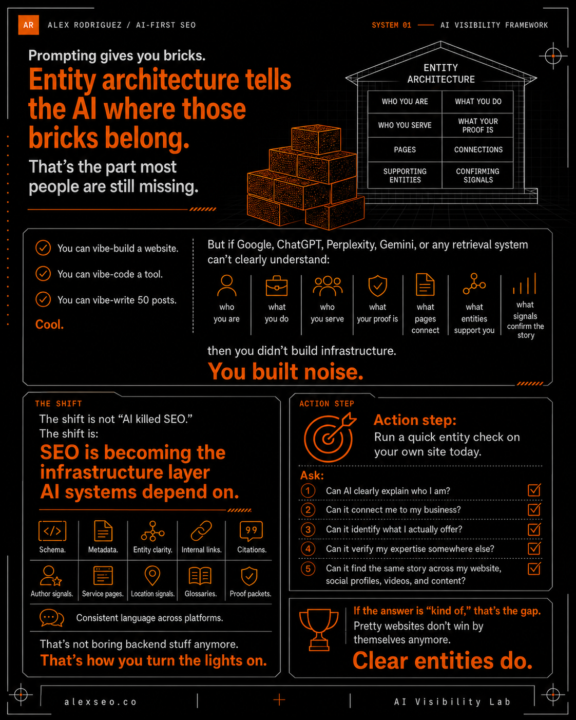
Prompting gives you bricks. Entity architecture tells the AI where those bricks belong. That’s the part most people are still missing. You can vibe-build a website. You can vibe-code a tool. You can vibe-write 50 posts. Cool. But if Google, ChatGPT, Perplexity, Gemini, or any retrieval system can’t clearly understand: who you are what you do who you serve what your proof is what pages connect what entities support you what signals confirm the story then you didn’t build infrastructure. You built noise. The shift is not “AI killed SEO.” The shift is: SEO is becoming the infrastructure layer AI systems depend on. Schema. Metadata. Entity clarity. Internal links. Citations. Author signals. Service pages. Location signals. Glossaries. Proof packets. Consistent language across platforms. That’s not boring backend stuff anymore. That’s how you turn the lights on. Action step: Run a quick entity check on your own site today. Ask: 1. Can AI clearly explain who I am? 2. Can it connect me to my business? 3. Can it identify what I actually offer? 4. Can it verify my expertise somewhere else? 5. Can it find the same story across my website, social profiles, videos, and content? If the answer is “kind of,” that’s the gap. Pretty websites don’t win by themselves anymore. Clear entities do.
1
0
May 9 •
Everyone keeps saying SEO is dying.
But I think we misunderstood where the game moved. Google reducing FAQ rich results doesn’t mean structured data stopped mattering. It means Google no longer needs to visually reward everyone for doing the bare minimum. That’s a very different thing. Schema was never supposed to be a cheat code. It was a translation layer. A way to help machines understand: - who you are - what you do - who you serve - what’s connected to what - what content belongs to which entity - which source should be trusted And now? That backend layer is becoming the entire battlefield. Most people still think SEO is “rank #1.” But realistically, traditional organic rankings now start halfway down the page. Before someone even reaches Position 1, you’re already competing against: - AI Overviews - Google Maps / Local Pack - Featured snippets - People Also Ask - Video carousels - Shopping results - Ads - AI-generated summaries So if your business isn’t clearly understood by machines, you don’t just rank lower… You slowly become invisible. This is the part nobody sees. The metadata. The entity relationships. The citations. The schema. The internal linking. The consistency. The disambiguation. The backend architecture. It’s the “Ready Player One” moment of SEO. Everyone was racing toward the obvious key. Meanwhile the real winners were studying how the entire system actually worked. Traditional SEO didn’t die. It evolved from “ranking tactics” into digital infrastructure. And ironically? The boring technical stuff everyone ignored for years may end up becoming the most important layer of online visibility in the AI era. (Search Engine Land)
1
0

1-3 of 3
skool.com/alex-rodriguez-seo
A practical AI visibility lab for business owners, marketers, and operators who want to get found, trusted, cited, and selected.
Leaderboard (30-day)
1

+1
Powered by