
Pinned

💎
⭐
2d •
🎉 Happy New Year, Everyone
It is always a good time to reflect on everything you accomplished this past year and to set some goals for what you want to achieve in the new one. Thank you for helping us build such an awesome community over the past year. I cannot wait to see how much more it grows by the end of 2026. Cheers, Nate

Pinned
💎
⭐
6d •
🚀New Video: How to Actually Deliver AI Projects (APIs, Hosting & Handover Explained)
In this video, I walk through how to actually deliver AI projects, covering APIs, hosting, and handover so clients can use what you build without things breaking or getting messy. This is for anyone building or selling AI services who wants clean delivery, happy clients, and fewer problems after launch. Hope you guys enjoy!
Pinned

🔥
6h •
🏆 Weekly Wins Recap | Dec 27 – Jan 2
We wrapped up the year strong and kicked off the new one with momentum. From first sales to real-world impact builds, AIS+ members kept shipping 👇 Here are this week’s highlights inside AIS+ 👇 👉 @Jon Roth made his first sale with a workflow built for a 3D print shop - optimizing Shopify order processing end to end. 👉 @Maciej Wesolowski secured a $5,200 client to build a lead-gen AI chatbot for a training firm — consistency paying off again. 👉 @Ai Stromae built a transcription - NotebookLM workflow that saves a client hours of manual effort every week. 👉 @Kevonte Demery launched a live AI program for underserved students - turning automation skills into real social impact. 👉 Satyam Sharma built a mini SaaS in just 3 hours, complete with payments and a live demo - fast execution, real product. 🎥 Super Win Spotlight of the Week: @Christian Barraza | From Do-or-Die to Full-Time Builder Christian joined AIS+ with almost nothing left in his bank account - and went all in. Within days, he restructured his offer, signed his first client, posted the win, and quickly landed a second client - all by applying what he learned and leaning into the community. 🎥 Watch his quick story 👇 Christian’s journey is proof that when you commit fully and take action, momentum can change everything - fast. ✨ Want to see more wins like these every week? Join the builders inside AI Automation Society Plus - where action, community, and consistency turn learning into real results 🚀


4m •
I used to be lazy with prompts
yes, i used to just type a few sentence on what i was thinking and fire off my prompt to LLMs to get the job done. Now i take an extra step. I do the same but use gpt4o or similar to do that and just type all the thoughts and details i have and ask it to make a prompt for me. I always have it target an actual role. like you are the expert copywriter, social media strategist, business architect etc. have it make a detailed prompt for you , then use that detailed prompt , along with any attachments on the smarter model this has greatly increased quality of results for me any prompting tips that work well for you ?
0
0

12m •
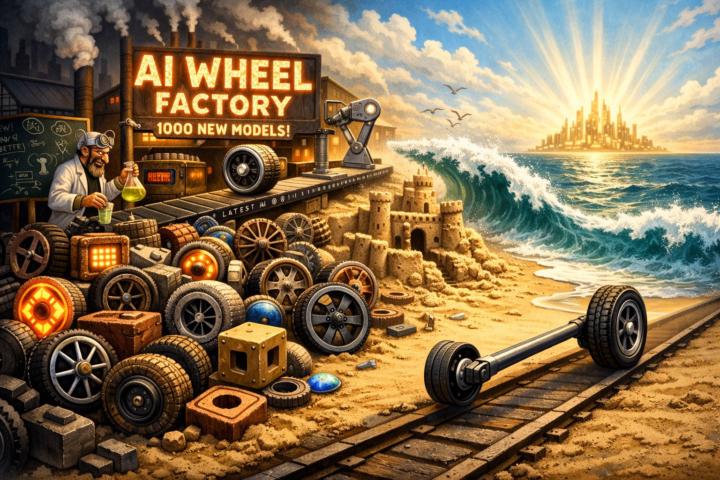
The AI Wheel Factory 🛞
We don’t need 1,000 slightly different wheels. Do we? The AI landscape today feels less like engineering and more like alchemy: an explosion of models—each tuned just enough to claim novelty, but rarely built for trust, transparency, or true progress. True innovation isn’t measured by how many models we release. It’s measured by how deeply we understand the problems we’re solving—and whether our solutions are reliable, reproducible, and responsible. Think about it: - Physics didn’t advance by building 1,000 pendulums—it distilled universal laws. - Computing didn’t scale by creating incompatible chips—it converged on robust, interoperable architectures. Yet in AI, we keep reinventing the wheel—slightly tweaked, heavily marketed, but often fragile, opaque, and untrustworthy. If every new model forces us to re-audit safety, bias, and reliability from scratch, are we building intelligent systems—or just stacking sandcastles before the tide? The path forward isn’t more variation. It’s disciplined convergence: ✅ Open, auditable foundations ✅ Clear standards for fairness, reasoning, and efficiency ✅ Collaborative governance over competitive chaos Let’s stop chasing novelty for its own sake. The future of AI shouldn’t mirror human inconsistency at scale—it should amplify human wisdom with precision, integrity, and trust. One well-engineered axle moves civilization farther than 1,000 crooked wheels.
1-30 of 11,531
skool.com/ai-automation-society
A community built to master no-code AI automations. Join to learn, discuss, and build the systems that will shape the future of work.
Leaderboard (30-day)
1

🔥
+6877
2

🔥
+3854
3

+2671
4

+2359
5

🔥
+1655
Powered by