
Pinned

💎
⭐
2d •
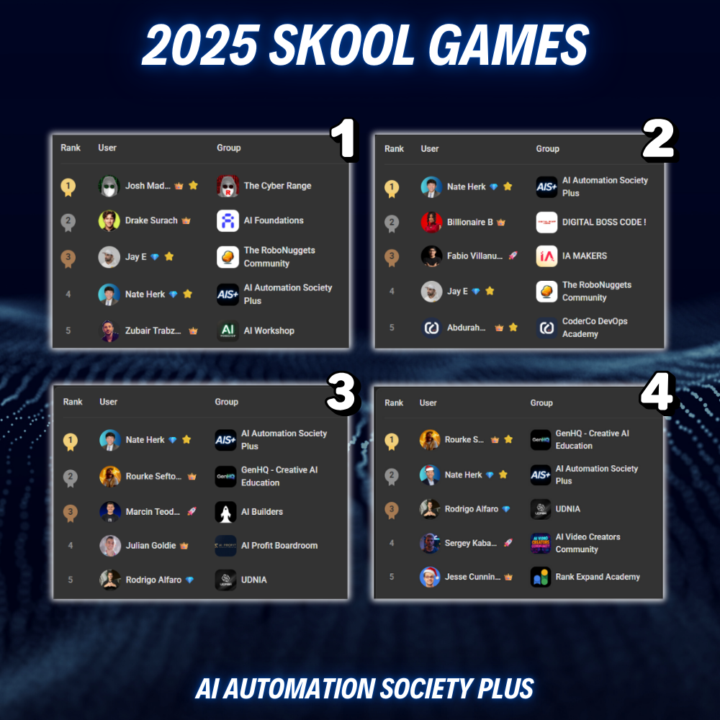
🎉 AIS+ Just Won the Skool Games
AI Automation Society Plus just won Q4 Skool Games, closing out 2025 winning all 4 quarters of the year!! This wouldn't be possible without each of you helping us make AI Automation Society a space for everyone. Truly grateful for this amazing community we're building together. Quick heads up: AIS+ pricing will be increasing in 2026. If you've been thinking about joining, now's the time. We'll give everyone a full week's notice before any price changes. Check it out here. Thank you all for the incredible support. You guys are the best! Cheers, Nate
Pinned
💎
⭐
2d •
🚀New Video: DON'T Build Another AI Agent Until You Watch This
In this video, I break down the AI systems pyramid and explain how I decide what type of system to build for a given problem. We walk through all four layers, starting with custom GPTs, then simple workflow automations with no AI, followed by AI workflows, and finally full AI agents. As you move up the pyramid, complexity, cost, and the chance of things going wrong all increase, and I explain exactly why that matters in real projects. I also show real examples of each layer so you can see how these systems actually work in practice. By the end of the video, you should be able to confidently decide which type of AI system you need to build and avoid overengineering solutions that do not need it. Access the Decision Tree HERE
Pinned

🔥
2d •
🏆 Weekly Wins Recap | Dec 13 – Dec 19
From $3K upsells to first-ever clients and smart AI systems - this week inside AIS+ was all about turning effort into real outcomes. Here are this week’s highlights inside AIS+ 👇 👉 @Abel Alvarado turned a focused weekend build into a $3,000 upsell from an existing client - fast execution, real payoff. 👉 @Noel Payano closed his first-ever $5K client at just 18 - a huge milestone built on courage and action. 👉 Evan Jones completed his first paid workflow, earning more in one hour than 10+ hours of Ubering - skills paying off. 👉 @Simon Cousineau signed a $50K deal using AI to ghostwrite 10 books - his biggest win yet. 👉 @Michael Wacht celebrated turning 60 by stacking wins - #1 on the leaderboard, launched his AI brand, and fully reinvented his path. 🎥 Super Win Spotlight of the Week: @Prentice Alston | From Stuck at 2 AM to Confident Builder Prentice went from late-night frustration and broken workflows to clarity and confidence - by leaning into community support and consistent practice. Through challenges, live help, and real feedback, his understanding of n8n clicked, and he’s now actively pitching, booking conversations, and moving forward. 🎥 Watch his quick story👇 Prentice’s journey is proof that when you don’t quit and you build with others - everything starts to change. ✨ Want to see more wins like these every week? Join the builders inside AI Automation Society Plus - where momentum, community, and action turn learning into real results 🚀


18m •
How Voice AI is Transforming Drive-Thrus and Workforce Strategies in Foodservice
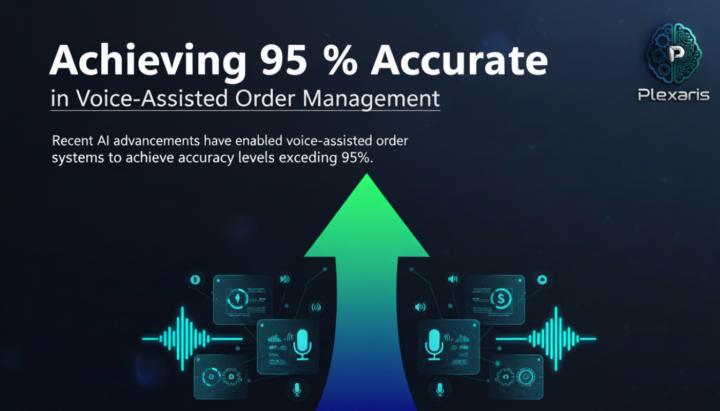
Sunday 21th December 2025, the food and beverage industry is witnessing a transformation driven by voice AI technologies that are reshaping drive-thru operations, enhancing order accuracy, and redefining labor dynamics. This edition explores how automated voice assistants are streamlining drive-thrus, achieving unprecedented accuracy in order management, and their broader impact on workforce strategies. Together, these developments offer strategic advantages for foodservice leaders aiming to improve customer experience and operational efficiency. read the complete newsletter Introduction to Automated Voice Assistants: A Game Changer for Drive Thru Automated voice assistants are revolutionizing the drive thru experience by significantly accelerating service speed and reducing wait times. Leveraging advanced voice AI technology, drive thrus manage orders more efficiently, minimizing errors and allowing staff to concentrate on food preparation and direct customer engagement. This integration enhances operational throughput and elevates customer satisfaction by delivering faster, more accurate service. Moreover, AI tools empower employees with instant access to relevant information and decision-making support, fostering a streamlined, responsive environment that meets heightened consumer demands for convenience and speed in quick-service restaurants. As these technologies mature, businesses adopting voice AI stand to gain a competitive edge by optimizing workforce management and improving the overall customer experience in drive-thru settings. retailtouchpoints Achieving 95%+ Accuracy in Order Management Recent AI advancements have enabled voice-assisted order management systems to achieve accuracy levels exceeding 95%. Key to this success is embedding AI directly into ordering platforms, rather than using it as an isolated tool. By organizing product data and analyzing historical ordering patterns, AI refines search accuracy and simplifies navigation through extensive product catalogs, which reduces errors and enhances customer satisfaction.Forbes Furthermore, AI powered voice assistants utilize real time call guidance and robotic process automation to assist agents with script suggestions and knowledge recommendations, promoting personalized and precise order processing. This intelligent automation accelerates order handling and lowers operational costs by reducing manual errors.Total Tele In sectors such as food and beverage, integrating AI enabled voice ordering with point-of-sale systems has advanced from pilot projects to full scale deployment, guaranteeing seamless order capture and improved workflow efficiency. For business leaders, this evolution implies scalable, reliable operations and the potential for new revenue streams driven by autonomous intelligence embedded within support frameworks.
48m •
🔥 NotebookLM just got supercharged with Gemini - but is it enough?
Google just merged NotebookLM into Gemini. Here's what it means: The Good: - Query multiple notebooks at once (finally!) - Combine your docs with web search in one chat - Your research + Gemini's reasoning = 🔥 The Reality Check: NotebookLM is great for learning & audio podcasts. But for serious work, these tools beat it: → Claude Projects - Better citations, deeper analysis → Elephas - Works offline, multiple AI models → SurfSense - Open source, self-hosted, free → Paperguide - Academic research & proper references Bottom line: NotebookLM + Gemini = casual research Claude/Elephas = professional workflows What's your go-to research stack? 👇

1-30 of 11,027
skool.com/ai-automation-society
A community built to master no-code AI automations. Join to learn, discuss, and build the systems that will shape the future of work.
Leaderboard (30-day)
1

🔥
+2889
2
+1288
3

+1106
4

🔥
+1064
5

+1037
Powered by