Activity
Mon
Wed
Fri
Sun
May
Jun
Jul
Aug
Sep
Oct
Nov
Dec
Jan
Feb
Mar
Apr
What is this?
Less
More
Owned by Wes
A place for CrossFit coaches to get better
WeBUS is intended to be a platform to help household leaders navigate the rough waters of life. 1 rule: No advice, shared experiences only.
Memberships
WeBUS International
52 members • Free
Skate IQ Team
1k members • $9/month
Skoolers
195k members • Free
Infinitely Scalable Community
48 members • Free
118 contributions to The Academy. by Wes Piatt

5d •
THROWN OFF??
Coaches, Let’s talk about the moments that actually make you better. Not when everything is going smoothly. Not when the class is easy to run. But when something catches you off guard and you’re not quite sure what to do. I want you to think about a recent situation in class where you felt a little flustered or unsure. Maybe it was a movement you didn’t know how to fix on the fly, a member who needed more attention than you expected, or a class that just didn’t flow the way you wanted it to. Drop it in here and give some context: - what was the situation - what did you do in the moment - what would you do differently now This isn’t about calling yourself out. It’s about getting better. Every coach has these moments. The difference is whether you learn from them or just move on. Let’s use this as a way to sharpen how we think, communicate, and lead a room. I’ll jump in and give feedback where I can.

0 likes • 5d
I recently had an athlete in our Foundations class refuse to do a burpee. She immediately said, “No way!” It caught me off guard, but I was glad I had a plan to scale if needed. I asked if she would be willing to try an elevated push-up instead, and she agreed. Over the next few weeks, we gradually lowered the height until she felt confident enough to give a full burpee a try. It reinforced something important for me as a coach. It’s not about compliance—it’s about competence. My job is to meet athletes where they are, both physically and psychologically, and give them a path forward.
10d •
No more warm ups????
BREAKING: CrossFit HQ just announced they are removing warm-ups from all affiliate programming effective immediately. The reasoning? “Warm-ups are creating artificial preparedness and masking real movement deficiencies. Athletes should adapt in real time.” Going forward: - Class starts → 3, 2, 1… go - First 5 minutes of the workout = your warm-up - Scaling is now “figure it out mid-WOD” Honestly… I don’t hate it. Thoughts? Jkjk. April fools :) But honestly, how many of you coaches do this when you workout?! I know I’m guilty 🤣

2 likes • 10d
@Jules Saunders Happy April Fools day!
17d •
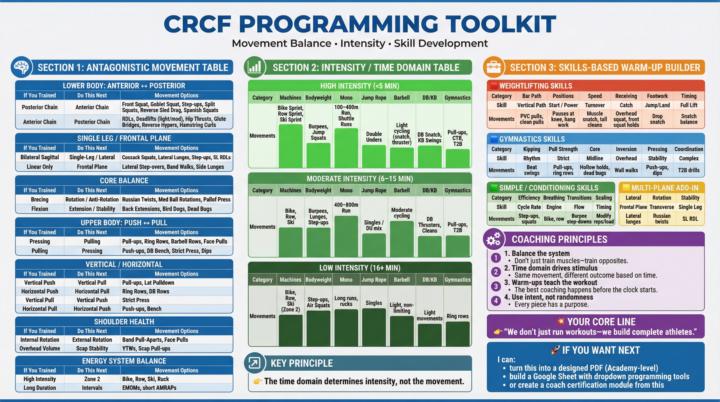
GENERAL WARM UP SPREADSHEET
Coaches, Here is a Programming Toolkit Spreadsheet I made for our coaches. This is something we use to take warm-ups from just getting warm and moving around to intentional, skill-based prep that actually improves your athletes. What’s inside: - Antagonistic movement pairings - Time domain and intensity breakdowns - Skill-based warm-up builder How to use it daily: Before class, ask yourself: What did we train yesterday?What’s the focus today?What skill actually needs to be developed? Then build your warm-up like this: 1. What muscles were worked yesterday. Use the antagonistic tab to choose an exercise for today, that helps those muscles recover and activate the antagonistic muscle groups for the day. 2. What's the stimulus for today? Use the stimulus tab then pick a time domain followed by a movement type. 3. What skills do my athletes need to work on? Go to the skills tab to round out your general warm up with either some skills that are in the workout today, may be coming up, or intentionally paste together skills daily and weekly that lead to more complex movements over time. Examples: If today is barbell cycling: Use positions and turnover drills If today is pull-ups or toes-to-bar: Use kip swings and core control If yesterday was posterior chain: Bias anterior chain today Big mistake to avoid: Don’t just throw in random movements Every piece of your warm-up should connect to the workout The goal: Better movement. Better understanding.Better workouts https://docs.google.com/spreadsheets/d/1q4nILnxRZvKAxvBS1RyQ6Y4zU4EW0SWAMtvqNKFd8S0/edit?usp=sharing
Dec '24 •
Welcome! Introduce yourself + share a pic of your Gym 🎉
Let's get to know each other! Comment below sharing where you are in the world, a photo of your workspace, and something you like to do for fun. 😊
3 likes • Mar 3
@Sylvie Calderon Sylvie!! 🙌 So good to see you in here — and what a time to take your L1 😂 COVID seminars built a different kind of coach. Respect. It was an absolute pleasure having you at the L2 in Reno. You brought great energy, humility, and a clear desire to get better — which is honestly the foundation of elite coaching. The fact that you’re already focused on sharpening your eye and refining tactile cueing tells me you’re thinking at a high level. Gymnastics is such a powerful lane to specialize in. It exposes everything — timing, positions, tension, awareness. If you really lean into developing your observation skills there, it will elevate every other domain you coach. And coaching while being a mom and grandma? STUD. Your athletes are lucky to have someone who understands both performance and life. Excited to see you continue to grow in here. Don’t hesitate to post videos, questions, breakdowns — that’s how we all level up. Let’s go 👊
1 like • 18d
@Julian Santillán welcome
20d •
I made something for you that you guys!
A Functional Fitness Garage Workout Guide This is built around:• AMRAP + EMOM structures• Block training principles• Minimal equipment The goal is simple: > Give you something you can hand to clients who: - travel - train at home - need structure outside the gym - or just need a simple, effective plan HOW TO USE THIS You can:• Give it to members who miss classes• Use it as a starting point for beginners• Layer it into your programming• Or offer it as a value add to your community Feel free to share it with your athletes, clients, and members. Let me know how you’re using it—I’d love to see it in action https://app.typeset.com/play/P0R7N0 — Wes
0
0

1-10 of 118

@wes-piatt-8240
Dad, husband, CrossFit gym owner, and wannabe skater 🛹
Active 2h ago
Joined Dec 28, 2024
Powered by