Activity
Mon
Wed
Fri
Sun
Nov
Dec
Jan
Feb
Mar
Apr
May
Jun
Jul
Aug
Sep
Oct
What is this?
Less
More
30 contributions to Redirect K9s
1d •
Káosz's Progress with Lizards
This happened just a few days ago and it still makes me smile on the inside. Káosz and I were outside of the lab after working on a project and he went to pee on a tree and spotted a lizard so of course he decided to stare at the lizard instead. I saw this from my car as I turned to look for him to load him up and instead of collecting him to put him in the car I wanted to see what he would do. The surrounding area was safe as there were no other cars, people, dogs or other animals so I stood off and watched him. He was investigating the tree, his body more relaxed than rigid, but didn't seem to notice me right away. I continued to stand there and watch. After a bit he looked at me and I gave his verbal marker to tell him that disengaging from the lizard encounter and looking at me was correct but unfortunately the encounter was to much at that moment and he turned back. That's ok. I continued to watch him then the next time he disengaged from the lizard I marked again and this time he came off of the tree and went after the treats I tossed in the opposite direction. Today it happened again on the same tree. I waited again as he sniffed the tree in hopes of another lizard encounter. After a bit he disengaged and looked at me so I marked again and this time he came right off and happily went to chase and consume the treats in the grass. What are some recent encounters you have had with your dog and how did it go?
0 likes • 11h
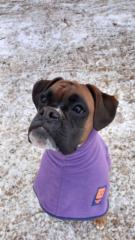
My dogs aren't very prey driven but my pup, Bjorn, does get too excited with other dogs to the point where he goes mental if he is restrained in any way. He is also quite dominant towards other dogs and he is getting a bit big for his boots so I am always extra cautious when we meet other dogs. On Sunday, we went for a walk around the top of the village where we live. To begin with we had a couple of horses walking in front so I slowed down our pace and even though he was excited and sniffing the air a lot he managed to stay close and to not pull too much. Then as we walked passed a garden a ball came flying over the fence and two dogs where right up at the fence. I managed to get him to move own with only a little bit of a growl as I pulled him away but he was mostly wanting to go for the ball. After that we had to walk past a field that had a fire that was crackling and apart from a little bit of curiosity he managed to walk past without an issue. Once we got to a nice field I put him on the long line for a bit of a run and some play. While we were there a child ran past, followed by a dog and lastly the father and he only gave them a quick glance. Then a young labrador came up off lead and even though the owner was calling her back the dog just wanted to play and kept sneaking up and doing play bows the whole way. I decided not to shorten the long line and watch as if I pulled Bjorn back I was more likely to get a reaction. They both did some play bows and had a little bit of a play for a few seconds then the owner got close enough that the other dog listened and left and I called Bjorn and he came back straight away. When I thought it was all over a local couple came by with their boxer, who Bjorn does not particularly like as she is very intense. However, she was off lead and I decided to just stand next to Bjorn but not put any pressure on the long line at all. They sniffed each other rather tensly and Bjorn was putting his head over the other dog's body in quite a dominant way. I was getting prepared to interfere when Bjorn gave a growl and the other dog looked away and walked off and when I called Bjorn he turned and happily followed me away.
12d •
What is something that you are working on with your dog this week?
Welcome to the first official post in Field Notes! I will go first in the comments.
1 like • 9d
@Christina Brewster Bjorn is still a pup at only 8 months old so for him most situations are high arousal. At the moment we are working on the basics so simply being able to listen when he is very excited so, for him, it is when there are other dogs around. He works better with movement so we are working on spins, middle on the move and hand touch while there are dogs at about 10 metres. He is still too overexcited if they are closer. Although I do occasionally mix in Freyja's training with Bjorn's as she is a very big distraction for him so he has to do exercises while she stays lying on her bed right next to us or viceversa, he stays in a sit or a lie down while Freyja works on something close by. We are also working on being able to throw a toy and getting him to stay still until we verbally release him to go get it. We started that by using a flirt pole to begin with and asking for a sit after he had had a run around, then releasing him to chase again but we have moved on to actually throwing toys and only letting of of the harness and verbally releasing him when he doesn't pull and sits down first. He has got a bit worse as he has entered the teen phase but we will keep at it until he can listen no matter what is going on around us.
1 like • 8d
@Christina Brewster Yes, both my dogs are Boxers so they are pretty slow to mature at the best of times. I have to keep reminding myself that Bjorn is only a pup. It can feel like an uphill battle at times but I know we will get there in the end 🥰
15d •
Csili Had A Big Win Yesterday
She drank water inside of a kennel in the vehicle! This is the first time without me having to spike it with something like tuna juice. Since I have had her she has had bad kennel/vehicle anxiety which I have now concluded is a blend of a conditioned emotional response and learned helplessness. This has been ongoing for over a year, setbacks included, with one month last year where we slept in my Equinox every night. That helped with her relationship with vehicles but not her relationship with the kennel unfortunately. How I am approaching the kennel in the vehicle context is giving her the choice to enter it while I lay in one half of it. We just hang out in the back, the kennel is pushed all the way in with no pressure for her to enter the kennel. Any pressure and she shuts down so it is all at her own pace. I do feed her her meals in the vehicle as well. Her drinking the water shows that she is starting to feel relaxed and safe enough to let her guard down which is very encouraging. What is a win with your dog that from the outside may not have looked like a big deal but actually was?

2 likes • 14d
The first time I managed to walk past another dog on a path without Freyja losing her mind!. To anyone else it would just be a normal dog walks past dog but for Freyja it marked the point where she felt relaxed and trusted me enough to keep the dog away from her so she felt no need to react to the other dog at all. There were far more important things to pay attention to such as the ball in my pocket 😆
18d •
🚨 Exciting Changes Ahead 🚨
First, the last Breed of the Week is up, and it’s an interesting one. Now for the news. Breed of the Week and the longer Trusty Tidbits pieces are moving to Substack, where they'll have room to breathe. There's already a piece up on Arousal Versus Stress in Dogs if you want to see where it's going. [Redirect K9s] What's changing here: Field Notes is new. Every week I'll post one question and we'll answer it together. That's the whole purpose of a community! Trusty Tidbits is keeping its name and while the posts become shorter: one idea, one observation, one thing that worked this week. No more long pieces here, that's what the Substack is for. This community will stay free, and it stays a place for questions and real dogs. More will get added as we grow. Since it's the first one, I'll go first. What did your dog do this week that you're proud of? I'll answer in the comments.
1 like • 17d
I am really proud of my two this week as we have finally cracked doing a spin without a hand gesture! Sometimes the silliest things are the ones that make me the happiest 😆
Sep 16 •
Consequence vs Punishment
These two words are sometimes used interchangeably in conversation but what do they actually mean. Let’s start out with definitions: Consequence: umbrella term for any outcome that follows and depends on a behavior, with its meaning determined by the effect it has on that behavior. Punishment: a specific consequence that reduces behavior; the opposite of reinforcement. When a trainer or owner/handler does something in response to a dog’s behavior they may have every intention for it be as force free as possible but the dog may not see it that way. This is something that I see and hear quite often in both the working and nonworking canine worlds; that is the dog does something undesirable and the response is not timed well, harsh and sometimes more than what the situation called for. The dog then has a reaction of fear or caution and the person may think that their dog had a consequence when in fact the dog received a punishment. This is not to paint the trainer or owner/handler as a bad person but to remind everyone that even if our intentions are good the dog may interpret the consequence as a punishment. This could be due to the reasons listed above but also could be due to past experiences, the dog senses you’re in a bad mood, or something else happened in tandem and the moment was overwhelming for the dog even if the events are completely unrelated. It is important to know and understand the dog in front of you and have the ability to adjust on the fly to what that dog needs in that moment. Do not be afraid to reach out and learn from others in order to add skills to your toolbox. If you are in it for the right reasons sharing information to better a dog’s life and learning opportunity/ability is never an issue.
1 like • Sep 16
So true. It is interesting to see how different dogs take the same thing. I have met dogs in class that a slight raised voice can be taken as the worst thing in the world while other actually love the attention and think raised voices are just part of the game!
1-10 of 30
@veronica-michaluk-1119
A relative newbie always looking to learn as much as I can to do the best I can for my dogs.
Active 11h ago
Joined Feb 19, 2026