Activity
Mon
Wed
Fri
Sun
Feb
Mar
Apr
May
Jun
Jul
Aug
Sep
Oct
Nov
Dec
Jan
What is this?
Less
More

Owned by Traci

CC
Canine Care Academy

17 members • Free

Learn, share, and grow with dog lovers who want to understand veterinary care, ask better questions, and advocate confidently for their pets.

Memberships

Skoolers

190.3k members • Free

30 contributions to Canine Care Academy
Infuriated with this profession.
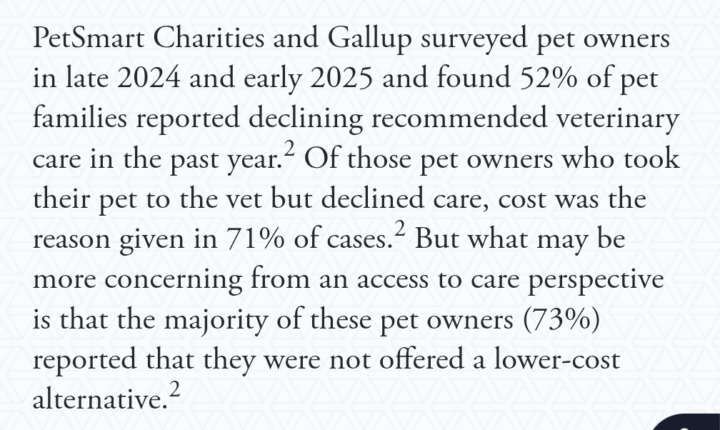
I ran across an article in one of our Veterinary publications today. This section of the article infuriated me on many levels. 1. That they needed a study for this? Are Veterinarians NOT listening to their clients' financial concerns? Do they not realize Veterinary prices are OUT OF CONTROL? And 2. Even more infuriating to me, 73% of pet owners WERE NOT offered a plan b, or lower cost option? Which, to me, equates to the pet possibly not receiving any form of treatment at all. People can afford, what they can afford and if that means a plan b, or plan c, it should be offered. It might not be considered "gold standard" but if it's something that can help a pet, it should 100% offered. The pet should ALWAYS come first. Period. Full stop. People want to take the best possible care of their pets, but with out of control pricing and corporations running most practices where only the bottom line matters, it's hard to do that. That's one of the reasons we keep our prices as low as possible, offer options and have a Pay it Forward fund to help those pets who need help. I'm so ashamed of what this profession has become.😢😢 What are your thoughts on prices or the profession as a whole?
0
0
Infuriated with this profession.
Taking the Stress out of Veterinary Visits🐶
Module 1: The Stress Starts before the Vet Visit is NOW AVAILABLE in the classroom area. Your feedback is greatly appreciated! If you have questions or comments, please let me know! :)
0
0
Taking the Stress out of Veterinary Visits🐶
How to Compare Dog Foods Using the Numbers (Dry Matter Basis)
If you’ve ever tried to compare two dog foods and thought “Why does this look so different?” — moisture is usually the reason. That’s where Dry Matter Basis (DMB) comes in. Why This Calculation Exists Dog food labels list nutrients with water included (“as-fed”). Because: Kibble has very little moisture Canned/fresh food has a lot of moisture The numbers can look misleading. Dry matter basis removes the water so you’re comparing nutrition to nutrition, not water to water The Simple Formula Don’t panic — it looks scarier than it is. Dry Matter Basis Formula Nutrient % ÷ (100 − Moisture %) × 100 That’s it. 🐾 Example: Example food label - what you are reading on the bag. Protein: 26% Moisture: 10% Step 1: Subtract moisture from 100 100 − 10 = 90 Step 2: Divide protein by that number 26 ÷ 90 = 0.289 Step 3: Multiply by 100 0.289 × 100 = 28.9% 👉 Dry matter protein = ~29% Why This Matters (Especially for Wet vs Dry Food) A canned food might say: Protein: 8% Moisture: 75% Using the same formula: 100 − 75 = 25 8 ÷ 25 = 0.32 0.32 × 100 = 32% protein (dry matter) On paper it looked “low protein” — but nutritionally, it’s not. You do not need to calculate this every time. This tool is helpful when: Comparing dry vs wet food Working with a vet or nutritionist Trying to understand why labels look confusing Your dog’s health, body condition, and digestion still matter more than the math. Takeaway The guaranteed analysis: (what is on the bag) Only gives starting information Doesn’t tell the whole story Dry matter basis helps you: Compare foods fairly Avoid marketing confusion Ask better questions 💬 Community Reflection Have you ever avoided comparing foods because the numbers felt overwhelming?
1
0
What Are Blood Chemistries?
Blood chemistries are a group of lab values that help veterinarians understand how your pet’s internal organs are functioning. Think of them as a snapshot of what’s happening inside the body, not a diagnosis by themselves. They’re usually part of routine bloodwork during: Wellness visits Pre-anesthetic screening Illness or injury Monitoring chronic conditions What Blood Chemistries Measure Blood chemistries look at substances in the blood that reflect how organs are working, including: Liver values → how the liver is processing and detoxifying Kidney values → how well waste is being filtered Blood sugar → energy balance and metabolism Electrolytes → hydration and nerve/muscle function Proteins → nutrition, inflammation, hydration status Each value is a clue, not a verdict. What Blood Chemistries Are NOT Blood chemistries do not: Always tell us exactly what disease is present Give a yes/no diagnosis on their own Replace a physical exam or medical history They are one piece of the puzzle — an important one, but not the whole picture. Why Vets Care About Blood Chemistries Blood chemistries help vets: Catch changes early Establish a baseline for your pet Monitor trends over time Guide next steps or further testing Make safer decisions (especially before anesthesia) A mild change doesn’t always mean something is “wrong” — it often means “let’s look closer”. Seeing values marked “high” or “low” can feel scary. But: Small changes can be temporary Stress, fasting, hydration, or medications can affect results trends over time matter more than one number Abnormal doesn’t always mean urgent. It means your vet is gathering information. Helpful Way to Think About It Blood chemistries are like the dashboard lights in a car: They tell you something needs attention They don’t tell you exactly what repair is needed They help guide the next step And catching things early is almost always a good thing. 💬 Community Reflection Have you ever received bloodwork results and felt overwhelmed by the numbers?
1
0
1-10 of 30
Traci Fulkerson
3
31points to level up
@traci-fulkerson-4607
Certified Veterinary Technician with 25+ years in vet med. Educator, practice manager, clinic partner — and dog mom to Rip the Rocket.

Active 37m ago
Joined Dec 29, 2025
Grand Canyon
Powered by