Activity
Mon
Wed
Fri
Sun
Oct
Nov
Dec
Jan
Feb
Mar
Apr
May
Jun
Jul
Aug
Sep
What is this?
Less
More
Google Ads Masterclass
15.7k members • Free
Automatable Free
24k members • Free
Agentic Foundations
9.6k members • Free
EverAds | Growth Boost Style
1.3k members • Free
Synthesizer
46.9k members • Free
Builder’s Console Log 🛠️
2.7k members • Free
ICEKIUB - AI Tech and ComfyUI
1.6k members • Free
The Success Club
16.1k members • Free
Data and Ai Automations
2.5k members • Free
7 contributions to AI-Driven Agent Network

9d •
Delegation the Outcome
Most people are using AI one task at a time. - Write this email. - Summarize this meeting. - Analyze these leads. - Give me five ideas. Useful, but you are still managing every step. The bigger leverage comes from delegating the outcome. Instead of: Help me improve this email draft Try: Review my priority inbox using superhuman mail, draft replies to the top 5 emails needing my response and archive any notifications/spam emails that don't need my attention. Flag any decisions that require my judgment. A strong AI delegation usually gives it four things: - Outcome: What should be true when the work is finished? - Context: What does it need to understand about the business or situation? - Boundaries: What can it decide, and what requires you? - Definition of done: What should it return when the job is complete? If your workflow still looks like: You decide → AI completes one step → you inspect → AI completes another step you have accelerated the task. You have not really delegated the outcome. Implementation: Take one recurring workflow this week and give AI instruction around the finished result you want instead of micromanaging every task.


0 likes • 2d
Shifting from micromanaging every single prompt to defining the finished outcome makes a massive difference in daily momentum. I like to map out the required context and boundaries inside a shared Discord thread with my team, then turn the target outcome into Floment AI project cards. That way everyone knows what done looks like without needing to check in after every small step.

Jun 26 •
The SOP Nobody Wants to Write
Every team has those processes that live in someone's head. "How do we onboard a new client?" "What's the listing launch checklist?" Nobody wants to sit down and document them. I started recording a quick call with my team lead where he walks me through the process. Then I drop the transcript into Claude and ask it to turn it into a clean, numbered SOP. Last month I documented 6 processes this way. Each one took maybe 20 minutes instead of the 2 hours it would've taken to write from scratch. If you're running a team and nothing is documented, this is where I'd start.

0 likes • 9d
Recording a quick verbal walkthrough is honestly the easiest way to pull those buried steps out of someone's head without friction. Once the messy transcript gets cleaned up, having an accessible home for the daily version is what keeps it alive. I drop raw voice recordings into Claude to generate the initial numbered steps, then pin the active checklist into Floment notes for day to day execution. That prevents great documentation from getting lost in a random folder nobody opens again.
11d •
The AI tools aren't the hard part. The system is.
I feel like a lot of people get into AI expecting one tool to suddenly save them hours every week. Then you end up with ChatGPT conversations everywhere, follow-ups in your CRM, random notes on your phone, content ideas in another app, and somehow you're still just as busy. What’s been more useful for me is giving each tool one clear job. ChatGPT / Claude – research, drafting, brainstorming, and repetitive thinking CRM – leads, client conversations, and follow-ups Floment – projects, to-dos, notes, and keeping track of what actually needs to get done Zapier / Make – connecting the repetitive pieces that don't need manual attention AI becomes a lot more useful when it's part of a simple system instead of another tab you have to remember to check. For agents using AI regularly, what part of your workflow has actually saved you the most time?
1
0
Jun 15 •
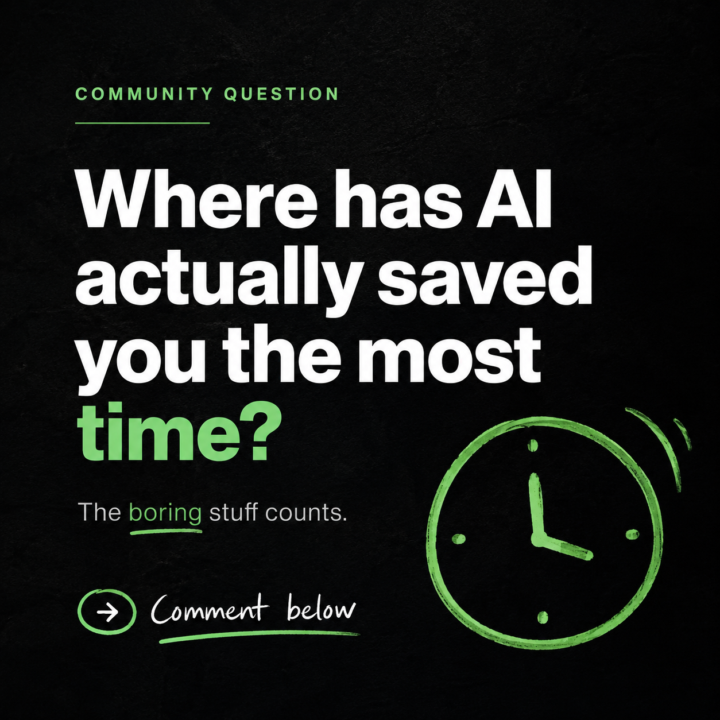
Where Has AI Actually Saved You Time?
Something I've been thinking about lately. We talk a lot about using AI for marketing and lead gen in here. But the place where it's made the biggest difference for me is the boring stuff. Organizing files. Writing SOPs. Cleaning up my inbox. Building checklists for recurring tasks. None of that is exciting, but it's freed up more actual working hours than any marketing tool I've tried. Where has AI saved YOU the most time? I'd bet it's something unglamorous.
0 likes • 23d
Storing master templates in Google Drive while managing recurring checklists on Floment project cards has cleared out so much admin clutter for me. Breaking down the repetitive operational tasks into clear daily to dos stops routine administrative work from eating into high priority hours. Sharing regular progress updates in a dedicated workspace also keeps daily execution on track. Flowie makes organizing those recurring workflows super quick so you can focus on building.
26d •
The practical AI and systems stack that actually cuts down daily real estate admin
In real estate, adopting AI often starts with collecting dozens of listing description prompts and watching system tutorials. The real challenge, however, isn't finding clever prompts—it's connecting those tools directly to daily transaction checklists, lead follow-ups, and listing coordination without adding extra friction. When client communication, transaction steps, and AI tools are scattered across separate browser tabs, administrative tasks can quickly eat into active selling time. The streamlined workflow setup that helps keep daily agent operations organized and focused on execution: - Claude / ChatGPT – Drafting MLS property descriptions, structuring localized neighborhood market insights, and refining client email copy from raw bullet points. - Floment – A workspace and community hub combining project cards, daily to-dos, and built-in AI assistance so transaction checklists and client pipeline tasks actually get executed in one spot. - Notion – Housing standard operating procedures, listing presentation templates, vendor directories, and compliance playbooks for quick team access. - Loom – Recording short async video updates to walk buyers through contract terms or explain inspection summaries without scheduling lengthy calls. - Follow Up Boss / Core CRM – Managing database lead routing, automated text drip sequences, and active call lists. Tying practical AI tools directly into a centralized execution workspace makes managing active transactions significantly smoother and prevents operational burnout. For agents actively building out their systems, what does your core tech stack look like right now? Which tool has saved you the most administrative hours this month?
1-7 of 7

@tony-iverson-7089
Building things online and trying to optimize my daily workflow. Here to learn from founders who are a few steps ahead.
Active 19h ago
Joined Jul 8, 2026
Powered by