Activity
Mon
Wed
Fri
Sun
Sep
Oct
Nov
Dec
Jan
Feb
Mar
Apr
May
Jun
Jul
Aug
What is this?
Less
More
Owned by Sara
Helping overwhelmed parents of neurodiverse kids create calmer days with better routines and more confidence.
Memberships
The Canon Club | A Book Club
11 members • Free
Affiliate Course Hub
14 members • Free
Client Acquisition for Coaches
695 members • Free
Skool Growth Free Training Hub
9.1k members • Free
LlynFay Inc. Marketplace
147 members • Free
Skooligans
595 members • Free
🎙️Skool Summit Stage🎙️
875 members • Free
Skool Events Daily
444 members • Free
Like A CEO
171 members • Free
82 contributions to The Social Growth Skool

🔥
2 likes • Apr 11
@Angel Fletcher thank you
🔥
1 like • Apr 12
@Lillian Odden thank you

Mar 8 •
If your AI-written posts all feel the same, you’re missing the 3 “human injection points” the pros rely on.👇
Human injection #1: Stories (AI can’t replicate your lived experience). Human injection #2: Contrarian takes (AI is trained to play it safe). Human injection #3: Specifics (AI generalizes, you specialize). Write your first draft with AI, then punch in these injections. That’s how you create content nobody else can copy … even with AI. Prompt 1 — First Draft Generator Act as an expert content writer who specializes in creating engaging social media posts for {{platform}} in the {{industry}} space. Background: I run {{business_name}}, a {{business_description}}. My target audience is {{target_audience}}. My brand voice is {{brand_voice}}. I want to create a post about {{topic}} that supports my goal of {{content_goal}}. Write a strong first draft of a {{platform}} post about {{topic}}. The post should be {{word_count}} words, lead with a hook that grabs attention, deliver clear value to {{target_audience}}, and end with a call to action aligned with {{content_goal}}. Structure it for readability on {{platform}} — short paragraphs, line breaks where appropriate. Ask me any questions you have. → What to do after Prompt 1: Copy the AI-generated draft. Read it once. You’ll notice it’s competent but probably sounds like it could have been written by anyone. That’s normal — and that’s exactly what the next three prompts fix. Paste the draft into Prompt 2. Prompt 2 — Human Injection #1: Stories Act as an expert storytelling coach who specializes in helping entrepreneurs weave personal narratives into business content that builds trust and emotional connection. Background: I’m working on a {{platform}} post about {{topic}} for my business {{business_name}}. I have an AI-generated first draft (below), but it lacks the personal, lived-experience element that makes content feel human. My audience is {{target_audience}} and they respond well to real stories because {{audience_story_preference}}. Here is my current draft: {{ai_draft}} Review this draft and identify the 2–3 best places to inject a personal story, anecdote, or real experience. For each spot, explain why a story works there and give me a specific prompt question I can answer to generate my story (e.g., “Tell me about a time you {{relevant_experience}}”). Then show me a revised version of the draft with placeholder brackets like [YOUR STORY: describe a time when…] inserted at each injection point so I know exactly where to add my lived experience.
🔥
3 likes • Mar 8
Thank you for this
Feb 7 •
ChatGPT + Pinterest = $$$$
i want you to treat this like a calm experiment. not a lottery ticket, not a hustle, not a flex. pick one niche you can live with, even if it is not your dream niche. you can always improve later, but you cannot learn if you keep restarting. then use the prompts like guardrails. they keep you from guessing. they keep you focused on what matters, which is clarity, repeatable ideas, and good matching between pin and destination. if you feel stuck, do not add more tools. remove choices. one niche. one set of boards. one pillar this week. one bridge asset outline. that is enough to start. and when the results feel slow, remind yourself what you are building. you are building a system that can create attention without your face, and attention is the hard part for most people. do the small moves. collect the learning. then repeat what works. 1.Pick a niche that can actually win (so you do not waste months) Principle: Pinterest rewards clear topics and repeatable ideas, not random posts. Strategy: Choose a niche where people already search to solve a problem, and where you can create many variations without being an expert. You want “evergreen” intent (things people look up all year), plus an easy path to a simple offer later (affiliate, digital product, email list). Why it works: If the niche is fuzzy, Pinterest cannot categorize you, and you will not show up in search. If the niche is clear, you become “the account for that thing.” Example: “Healthy high protein breakfasts” is clearer than “healthy living.” It creates endless pins, and clear keywords. Common mistake: Picking a niche based on vibes, not on search intent and repeatability. Prompt: “Act as a Pinterest niche strategist. Give me 10 evergreen niche ideas that are faceless-friendly. For each, include: who searches it, 10 keyword themes, 10 repeatable content angles, and 3 monetization paths (affiliate, lead magnet, digital product). My constraints: [time per week], [skills], [topics I can tolerate]. Then rank the top 3 and explain why.”
🔥
2 likes • Feb 7
Thank you for this.
Feb 4 •
the 50 most impactful books for entrepreneurs
Not "popular." Not "bestselling." Impactful. The ones that shifted entire industries. The classics that spawned a thousand knockoffs. THE TOP 50 (Ranked by Impact) MINDSET & SUCCESS PHILOSOPHY 1. Think and Grow Rich – Napoleon Hill (1937) 2. The 7 Habits of Highly Effective People – Stephen R. Covey (1989) 3. How to Win Friends and Influence People – Dale Carnegie (1936) 4. Awaken the Giant Within – Tony Robbins (1991) 5. Mindset: The New Psychology of Success – Carol Dweck (2006) 6. The Greatest Salesman in the World – Og Mandino (1968) 7. Rich Dad Poor Dad – Robert Kiyosaki (1997) 8. Outliers – Malcolm Gladwell (2008) STRATEGY & INNOVATION 9. The Art of War – Sun Tzu (~500 BC) 10. Good to Great – Jim Collins (2001) 11. Blue Ocean Strategy – Kim & Mauborgne (2005) 12. The Innovator's Dilemma – Clayton Christensen (1997) 13. Zero to One – Peter Thiel (2014) 14. Built to Last – Collins & Porras (1994) 15. The Lean Startup – Eric Ries (2011) 16. Traction – Gino Wickman (2011) 17. The E-Myth Revisited – Michael Gerber (1995) 18. Crossing the Chasm – Geoffrey Moore (1991) MARKETING & PERSUASION 19. Influence – Robert Cialdini (1984) 20. $100M Offers – Alex Hormozi (2021) 21. They Ask, You Answer – Marcus Sheridan (2017) 22. DotCom Secrets – Russell Brunson (2015) 23. Expert Secrets – Russell Brunson (2017) 24. Platform – Michael Hyatt (2012) 25. Purple Cow – Seth Godin (2003) 26. Positioning – Ries & Trout (1981) 27. Made to Stick – Heath & Heath (2007) 28. Contagious – Jonah Berger (2013) 29. Ogilvy on Advertising – David Ogilvy (1983) SALES & NEGOTIATION 30. Never Split the Difference – Chris Voss (2016) 31. You Can’t Teach a Kid to Ride a Bike at a Seminar – David Sandler (1994, 2nd ed. 2015) 32. SPIN Selling – Neil Rackham (1988) 33. Uncopyable Sales Secrets – Steve (Kay) Miller (2022) 34. The Challenger Sale – Dixon & Adamson (2011) 35. Secrets of Closing the Sale – Zig Ziglar (1984)

🔥
4 likes • Feb 4
Thank you for this
Feb 1 •
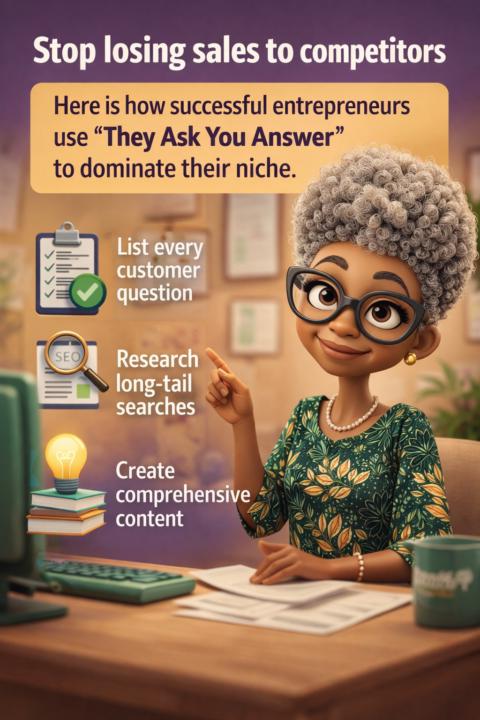
Stop losing Sales to your Competetors
Here is how successful entrepreneurs use "They Ask You Answer" to dominate their niche. 1. List every question your potential customers ask. Include the obvious ones. ① Act as a Customer Insights Specialist. Your goal is to identify the full spectrum of inquiries a potential customer might have regarding [PRODUCT/SERVICE]. Using your knowledge of the [INDUSTRY] market and common consumer pain points, generate an exhaustive list of every question a potential customer might ask during their journey, from initial awareness to the final purchase decision. Include "obvious" or foundational questions as well as complex, technical, or high-friction inquiries. Ask me any questions you have. 2. Research the exact keywords and phrases customers use. Focus on long tail questions. ② Act as an SEO Keyword Researcher. I need to understand the specific language and search patterns used by [TARGET AUDIENCE] when looking for solutions in the [NICHE] space. Based on the list of customer questions provided, research and identify the exact keywords and long-tail phrases they use in search engines. Focus specifically on "informational intent" queries and conversational "how-to" or "why" questions that indicate a high level of interest. Ask me any questions you have. 3. Create comprehensive content. Answer each question better than anyone else. ③ Act as a Subject Matter Expert and High-Conversion Content Writer. Your task is to create the definitive answer for the question: "[SPECIFIC CUSTOMER QUESTION]". Using the provided [KEYWORD DATA] and [COMPETITOR URL/REFERENCE], write a comprehensive response that is more detailed, easier to understand, and more authoritative than any existing resource. Ensure the content provides unique value, such as proprietary data, expert tips, or simplified frameworks. Ask me any questions you have. 4. Optimize your content for search engines. Make it easy to find. ④ Act as an On-Page SEO Expert. I have a piece of content regarding [TOPIC]. Please optimize this content to ensure it ranks highly for the primary keyword "[TARGET KEYWORD]" and related secondary terms. Provide specific recommendations for the H1-H4 headings, meta title, meta description, image alt text, and internal linking structure to make the content easily discoverable by search engines. Ask me any questions you have.
🔥
1 like • Feb 1
Thank you for this
1-10 of 82

🔥
@sara-fredrick-9503
Hi, I'm an online tutor, virtual assistant and a health and life coach.
Active 10m ago
Joined Jun 21, 2025
Jacksonville, FL
Powered by