Activity
Mon
Wed
Fri
Sun
May
Jun
Jul
Aug
Sep
Oct
Nov
Dec
Jan
Feb
Mar
Apr
What is this?
Less
More
Memberships
REDLUX ACADEMY
164 members • Free
Mastering.com Members Club
34k members • Free
The Reverse Engineer
1.8k members • Free
Mixing Intensive
233 members • Free
33 contributions to Mastering.com Members Club
⭐
7h •
New music
If you have new music you want to share to get some exposure, post it below! If you want feedback or have a specific conversation about the song, you can do a dedicated post. But if you just want to share something you've release to help get streams, post it below (and make sure you stream other peoples music too!)


1 like • 6h
And obvs all these new things are going on the playlist
0 likes • 4h
@Zephyr Quoreenton done (and done). I love the artwork by the way, very Savage Pencil.
⭐
3d •
Feature requests?
Hey guys, wanted to get some thoughts on how we could make this group (both free and paid membership) even better value for everyone. Post your ideas/requests below, and drop a like on the requests you like the most! Some prompts: - What could we START doing that we’re not already doing? - What could we do MORE of? - What features would you like to see added? - What do you get the most value from right now, and how could we make it even better? Obviously can’t make any promises in terms of following through on every suggestion, but I can promise that your suggestions will all be considered and we heavily weight user feedback when thinking about improvements.

0 likes • 7h
@Rob Mayzes There aren’t nearly enough submission spots for a week. This week, for instance, all the slots were booked by Monday. So if I attend a slot then spend a bit of time doing revisions, by the time I am done the slots for the next week are full. So it slows the process of working a track through with the same mentor down to an absolute crawl and is very frustrating.
0 likes • 4h
@Rob Mayzes yes. I want to be able to book a session with the mentor so I know what time I’m going to be speaking to them and I find that the slots are booked up way before I’ve had time to do any work from the last session. Which essentially means I’m working on a two to three week review cycle, which is not helpful. I don’t want to immediately book a session and supply a placeholder just to have that session booked but it appears that that is the way to go. And I don’t want to drop into a random ‘open’ session because there’s no continuity there.

11d •
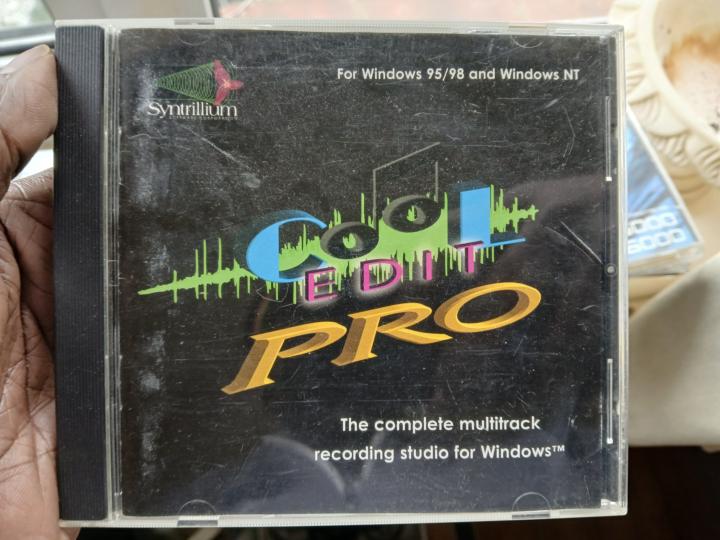
Look What I Found! What Do You Use Now?
Doing a well needed clear-out and found this. I was introduced to Cool Edit Pro at the start of my brief stint as a broadcast assistant, back in the day. It was a brilliant, really easy to use. I continued using it as my go-to editing software after Adobe bought it in the early 2000s and changed its name to Audition, up until the beginning of this year; the CC subscription became a "want", a rather expensive one and, unfortunately, Audition is a part of it. Which audio editing software do you currently use? Or do you just use your DAW?
0 likes • 11h
My go to audio editor would be Fission. Inexpensive, easy to use, very basic. Lots of export options. And yes, it does the ‘edit a clip by allowing you to edit the wave form’ thing.
9d •
Logic Session Players use of Plugins
I was just noticing Logic automatically assigns a myriad of plugins to their session players. For example: Session Bass uses 9 plugins. Seems like a lot to me. Right? The one I use often is Session Drummer. When you use the producer packs the tracks are separated which is what I want so a drum kit is around 14-16 instruments plus rooms plus sub groups plus fx returns. In total it's about 24 tracks. No problem with the tracks but the plugins? 46! Wow! Am I wrong? And the routing? 32 sends! I mean it sounds okay but creates a chore for me. I have no trust of other people making that many decisions for me. I have to touch it all and evaluate it. Brings to mind another thread where a user was having CPU issues with Logic. Session players were my first thought. I have noticed things play fine unless and until you flip the widget to display all the individual tracks and / or try to edit midi if you have converted to midi which I eventually always do. The work around is to only make edits while the drums are in solo when the whole mix won't play without CPU problems. My ultimate workaround is to use a laptop as a midi player and offload the entire task to a 2nd computer. I bring the audio back via Danté using Danté Virtual Soundcard.
0 likes • 11h
@Gus Dikteruk I agree that the last Logic update (version 12) was far more focused on the creative musician rather than the producer/mixer/masterer, but I don’t see anything specifically negative about that. They’re focusing Logic (and all their Creative Studio products) as being about creativity and the session player elements will help creative people. And sure it’s as much to sell Creative Studio subscriptions as it is to benefit existing Logic Pro users, but maybe the next upgrade will all be about the producers/mixers and masterers.
1 like • 11h
I think that Apple want their session players to sound professional and the plugins and chains they use are ones that most recording engineers would use on a drum track. Even if you only put a channel strip plugin on each individual track, you still have an EQ, some dynamics and potentially some other processing. So 46 plugins for 20+ channels seems pretty normal to me. If you are worried about CPU performance, you can always bounce out each track so you are working with audio instead. Or change all the plugins so the drums sound the way you want.

13d •
Measurement Software?
All, having invested in sound treatment-solid speakers etc is the final step to calibrate the room using a measurement mic and some hardware / software or is it a waste of time and money ?
0 likes • 13d
@Shaun Fothergill I suspect if you have successfully treated your room, you will benefit from two types of software treatment. First a speaker correction on (like ARC or SoundID) which will ensure that your speaker are providing as flat a sound as possible at your listening position. Second an ‘ear correction’ one like Hears Perfection. This will correct for your own individual hearing ie it will be the difference between what a reference mic hears and what your ears hear at your listening position. Because even if your speakers produce the flattest response ever, that’s not helpful when your ears can’t hear 15kHz that well.
1-10 of 33

@sam-king-7372
Hi I make and produce music in London, England. From 4 piece guitar, bass and drums to electronic music. Inspiring sounds of creative beautality.
Active 39m ago
Joined Nov 23, 2025
London
Powered by