Activity
Mon
Wed
Fri
Sun
Aug
Sep
Oct
Nov
Dec
Jan
Feb
Mar
Apr
May
Jun
What is this?
Less
More
Memberships
AI Automation Society Plus
3.8k members • $99/month
Claude Code Kickstart
516 members • Free
AI Automation Society
417.1k members • Free
AI Bits and Pieces
799 members • Free
23 contributions to AI Automation Society

🔥
27d •
🏆 Weekly Wins Recap | May 30 – June 5
From $50K+ pipelines and first SaaS launches to automated outbound systems and accidental ERPs - this week inside AIS+ was all about building systems that compound. Some members landed clients. Some built machines that find clients for them. Both count. 🚀 Standout Wins of the Week inside AIS+ 👉 @Mohammad Sallam crossed $50K+ in pipeline within weeks by building a lean team and leaning into automation opportunities most businesses still ignore. 👉 @Emanuel Cira shipped a 24/7 outbound system that automatically finds, qualifies, and routes leads every morning before he even starts his day. 👉 @Giacomo Benedetti accidentally turned a payment-chasing workflow into a lightweight ERP running core operations for his dad’s travel business. 👉 @Sai Santosh Kumar D launched his first SaaS product — a Telugu caption tool originally built for himself and validated through 60+ videos before launch. 👉 @John Catholic generated $3K from just 20 Upwork proposals using a repeatable workflow combining Claude, visual explainers, and Loom walkthroughs. ⸻ 🎥 Super Win Spotlight | @Pedro Gomez Pedro has lived through multiple technology waves. He saw the internet reshape industries 30 years ago. Now he sees the same thing happening with AI - just faster. Since joining AIS+, he has: - Gone from limited web development experience → building his own website - Used Claude Code to move from consuming → creating - Built confidence to take action instead of overthinking - Used community feedback to improve faster than building alone - Found experienced builders who challenge ideas with real-world experience


🔥
10 likes • 27d
Lets goo guys Keep them coming 🔥
🔥
Apr 28 •
What's your biggest GTM pain point right now?
Curious what's actually blocking people.
Poll
2 members have voted
2
0

💎
⭐
Apr 15 •
🚀New Video: Claude + HeyGen Just Changed Content Creation Forever
In this video I walk through how I built a fully automated video production pipeline using Claude Code, HeyGen, and ElevenLabs. You'll see how Avatar V creates realistic AI clones, how to get voice cloning that actually sounds like you, and how Claude Code orchestrates the entire process so you can go from raw script to finished video overnight. I also cover the real costs, the limitations, and the objections you're probably already thinking about.
🔥
3 likes • Apr 15
Everything's good with HeyGen but it's a little bit expensive. That's the only bottleneck. Hope we'll see lower costs in the future. and great video nate gonna try this. But at least recently they have switched from a pay-as-you-go model API. It used to be a hundred dollars per month or something, if I remember correctly. But
🔥
Mar 25 •
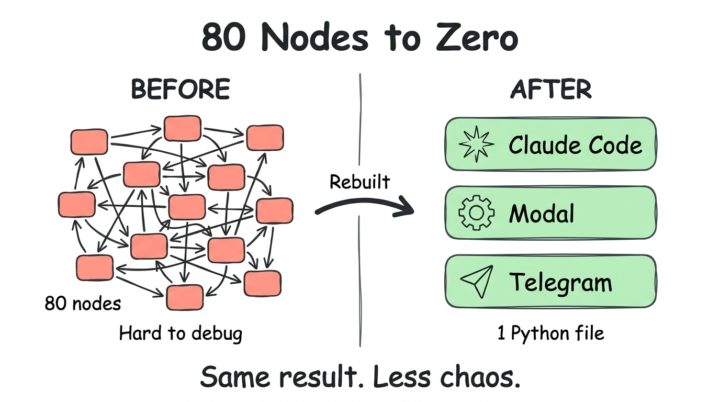
80 nodes to Zero
80 nodes in n8n. Now zero. A few months ago I built a system to handle collaboration and sponsor emails automatically. It worked. But it was 80 nodes, hard to debug, and one wrong step from breaking. The pain: collab emails come at all hours. Miss one and you lose a deal while you were sleeping. Last week Claude Code rebuilt the entire thing in Python. Deployed on Modal. Now it runs every 15 minutes, reads my inbox, classifies every email by intent, and sends me a Telegram message with approve/reject buttons. During my active hours — I review and approve. During off hours — it follows base guidelines I set and replies on its own. Lead stays warm. Deal doesn't go cold. Zero n8n nodes. Zero missed opportunities. This is what building with Claude Code actually looks like in practice.
🔥
Mar 18 •
I Build An Animated Website Like Apple
What you're seeing right now is not the official Apple website. I built this in 30 minutes with Claude Code. 192 frames. Scroll-driven canvas animation. A MacBook Neo gliding through the screen as you scroll, perfectly synced to every pixel of movement. Smooth transitions, massive typography, the whole thing. Websites like this used to be a nightmare to build. Not years ago. Last year. Setting up GSAP, canvas frame rendering, Lenis smooth scroll, getting the product video to sync frame by frame with scroll progress... just the boilerplate alone took half a day. Making it actually look premium was a different battle. I decided to solve this once. I built a skill inside Claude Code that knows the entire stack, the design rules, the animation logic, everything. You give it a product and a video. It does the rest. The first output genuinely shocked me. Let me know what do you think in the comments.

🔥
3 likes • Mar 18
@Kyan Cordes I definitely agree, but even if it is not 30 minutes, it wouldn't take too long for sure. We'll get the first draft, which will be almost ready to use, but there will be some minor tweaks that we have to do. That's not a big deal. We just need to identify what has been missing, and the Claude code will handle it. As for the skill, I've got some reference skills from Nate and official Anthropic Skills, and I tweaked them according to my liking.
1-10 of 23

🔥
@sai-santosh-kumar-ssk-3096
Building AI Growth Systems!!
DM me: Let’s map a solution for your business.
Active 7h ago
Joined Feb 8, 2026
Powered by