Activity
Mon
Wed
Fri
Sun
Sep
Oct
Nov
Dec
Jan
Feb
Mar
Apr
May
Jun
Jul
Aug
What is this?
Less
More
Memberships
AI Marketing Insiders
1.7k members • Free
DeFi University
322 members • Free
TikTokWiz
907 members • Free
AI Profit Boardroom
3.8k members • $59/m
fundusi
3.8k members • Free
Lux Blueprint Academy
1.1k members • $12,000/year
UGC & TikTok Creator Academy
1.9k members • $97/month
Licensed to Legend
22 members • Free
Scale Amazon FBA Community
23k members • Free
3 contributions to DeFi University

Apr 2 •
Public Portfolio
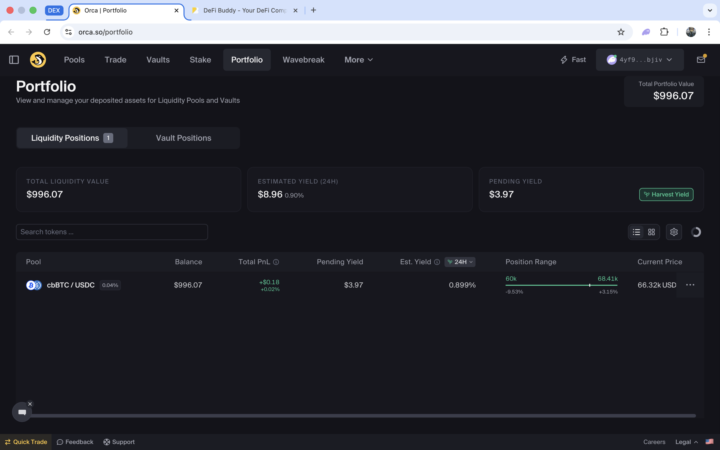
Yesterday, I started a Public Portfolio (no joke). I will show every step I make. I opened a single sided LP $1000 cbBTC/USDC and I will document every step on X.

0 likes • 2d
That's awesome
Mar 6 •
🤖 The Invisible Edge: How Algorithmic Bots Are Outsmarting Human Intuition on Polymarket
Hey fam! 👋 The 15-minute BTC and ETH markets on Polymarket have become the most high-velocity arena in the crypto-prediction ecosystem. 🚀 To the retail trader, these are five-minute bursts of adrenaline fueled by: 🌊 "Vibes" 📱 Social media sentiment 🎲 The hope of catching a trend But while the "gut feeling" crowd is busy tweeting about moonshots, a silent layer of automated trading bots is reading the WebSocket feed, identifying Order Flow Imbalances (OFI) before a single price candle even moves. 🤖 🎯 This Isn't Prediction — It's Extraction This isn't a game of prediction; it's a game of sub-second extraction. Behind the curtain of the order book, bots are using pure mathematics to exploit the lag between human emotion and cold, hard probability. 🧮 Let me show you the 5 invisible edges that bots are using to print money while retail trades on vibes. 👇 💵 1. The "Dollar Rule" That Retail Panic Frequently Breaks In a binary prediction market, there is one non-negotiable law of physics: The price of a "YES" token + the price of a "NO" token must ALWAYS equal exactly $1.00. 📏 This is Invariant Arbitrage, and it is the bot's primary tool for harvesting "retail panic." 🎯 😱 When Panic Breaks the Math When news breaks — a sudden liquidation cascade or a macro data release — emotional takers flood one side of the market. This creates order book fragmentation where: $0.62 + $0.41 ≠ $1.00 ⚠️ For the bot, this is a directionally neutral gift. It doesn't care who wins; it only cares that the math is broken. 🤑 🎰 The Two Arbitrage Scenarios Case A (Buy-Merge): When the combined ask prices are < $1.00 📉 Example: YES token ask: $0.58 NO token ask: $0.40 Total: $0.98 (less than $1.00!) Bot action: Buy YES at $0.58 ✅ Buy NO at $0.40 ✅ Merge both tokens → receive $1.00 💰 Net profit: $1.00 - $0.58 - $0.40 - fees = ~$0.01-$0.02 ✅ Case B (Mint-Split-Sell): When the combined bid prices are > $1.00 📈 Example: YES token bid: $0.63 NO token bid: $0.42 Total: $1.05 (more than $1.00!)

1 like • 2d
Like what you are teaching
6d •
🚀 Premium Live Call Recap: GetRunway.Trade Updates (July 29)
In yesterday’s live session, we covered critical updates on our development roadmap, infrastructure, and current market positioning. Here are the key takeaways: 🔄 Trading Agent Migration We are migrating our trading agent from Hyperliquid to GMX. This shift is essential to mitigate regulatory risks and ensure we are operating on a completely permissionless platform. 🛠️ Infrastructure Strategy We’ve decided to keep our current Telegram-based trade tracking system for now instead of migrating to Google Cloud. This keeps operations lean so we can focus on building a verified performance track record before scaling up our tech stack. 📉 Market Strategy: Scaling Short Outlook: Bearish on Bitcoin ($BTC) and Ethereum ($ETH). Execution: Actively scaling into short positions at $15,000 per day through end of July. Goal: Reaching our full short position by the first week of August. 📊 Macro Outlook We are keeping a close eye on rising bond yields, which continue to signal heightened risk for the broader equity market. ⚡ What’s Next? My current focus is finalizing the agent’s readiness for mainnet execution. 💬 Over to You: What’s your take on the current market setup? Drop your thoughts and strategies in the comments below! 👇
1 like • 2d
Hey i am brand new here and like the content
1-3 of 3

Active 2h ago
Joined Aug 3, 2026
Powered by