Activity
Mon
Wed
Fri
Sun
Sep
Oct
Nov
Dec
Jan
Feb
Mar
Apr
May
Jun
Jul
Aug
What is this?
Less
More
Owned by Robert
Design a professional-looking book, from cover to interior. Find simple guides and tips to avoid DIY design mistakes that hurt credibility and sales.
Memberships
Skool Events Daily
446 members • Free
Skool Extensions 🧩
762 members • Free
Raw Leader Premium & VIP
20 members • Free
Pro Raw Launch Lab
28 members • $97/month
Solomon’s Temple
68 members • Free
Learn
473 members • Free
Resolve School
337 members • $9/month
Make AI Ads
197 members • $7/month
Affinity Creatives
2.4k members • Free
9 contributions to Royalty Guild. Amazon KDP

Feb 19 •
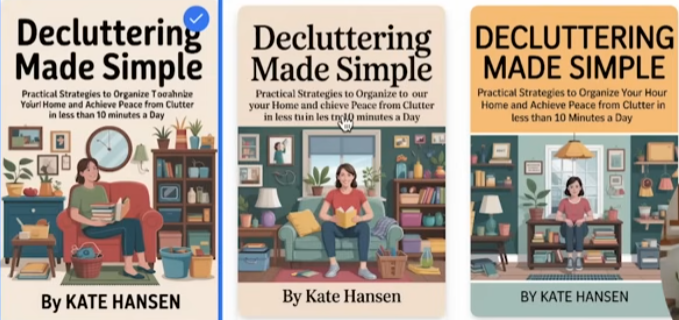
Covers Designer Hire: Which Set of Covers Do You Like Better?
Imagine you are creating a book about decluttering. If you hired two cover designers and gave them a task: Create a cover for a book about decluttering with the title: "Decluttering Made Simple. Subtitle: Practical Strategies to Organize Your Home and Achieve Peace from Clutter in Less than 10 Minutes a Day. By Kate Hansen." Designers returned with their concepts. What offer would you prefer as a prototype to continue with? Your ideas about the quality of designs? Cast your vote for the set you like better. ----- ⚠️ If you recognized some designs, NO SPOILERS please.
Poll
22 members have voted

3 likes • Feb 20
@Igor O Definitely the one I’d pick as well. It carries that fresh, decluttered space promise a reader would be shopping for. Great point about refining the title and subtitle to support the cover.
1 like • Feb 21
@Igor O Appreciate you saying that. Really glad it helps, Happy to share a quick take anytime 🙂
Jan 14 •
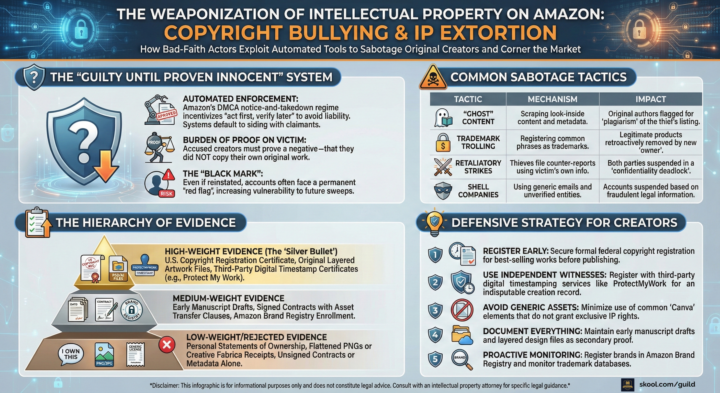
🔴 Why Your Book Could Be a Target (and It’s not Piracy)
Most authors worry about piracy. But there's a much more dangerous threat: Copyright Weaponization. On Amazon, your original content isn't just an asset - it's a vulnerability. Bad-faith actors are now using Amazon's own "Safe Harbor" tools to sabotage legitimate creators. Here is how the "Strategic Sabotage" loop works and how to protect your account. The Trap: "Guilty Until Proven Innocent" Amazon operates under a "notice-and-takedown" regime. Because they want to avoid legal liability, their systems are hard-wired to: - Act First, Verify Later: They remove content immediately upon a claim, favoring the claimant by default. - Shift the Burden: You are forced to "prove a negative" (that you didn’t steal your own work), usually within a 5-7 day window. - Automated Bias: AI bots handle these claims. If a bot sees a similarity, you get the "strike" - even if the other person stole from you. Tactics to Watch For - "Ghost" Content: Thieves using your manuscripts or scrape your "Look Inside" preview, publish it themselves, and then report you for plagiarism. - Retaliatory Strikes: If you report a copycat, they file a false counterclaim against you, resulting in a "confidentiality deadlock" where both accounts are suspended. - Trademark Trolling: Bad actors trademark common phrases used in titles (e.g., "Mamma Bear" or specific niche keywords) to retroactively wipe out top-selling competitors. Your Defensive Checklist To survive the "copycat era," you need a defense-first workflow. Don't wait for a strike to happen: 1. Register with the USCO: A formal Federal Copyright Registration is your "Silver Bullet." 2. Use Independent Witnesses: Services that provide digital timestamps are available. This creates an indisputable record that your work existed before the thief's version. 3. Keep the "Paper" Trail: Always save your original layered files (PSD, AI) and early manuscript drafts. Flattened PDFs or Canva receipts are often rejected as "low-weight" evidence.
5 likes • Jan 14
This is super insightful! Thanks for sharing @Igor O !
Nov '25 •
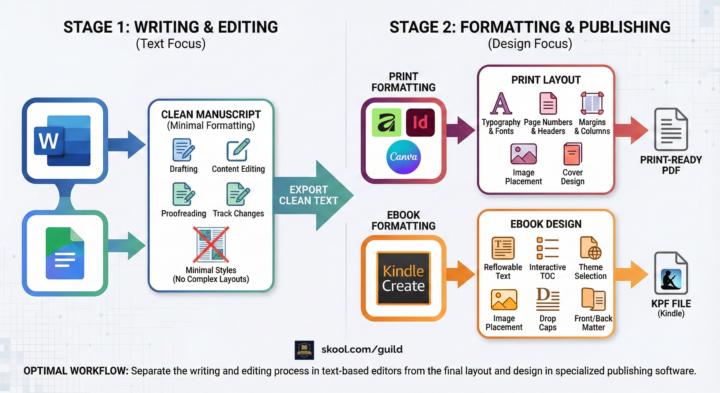
📑 Manuscript Formatting Process Basics
I didn't plan on publishing anything today so as not to disturb anyone on Thanksgiving. However, a conversation with @Sonja Ray led to the creation of this illustration of the manuscript formatting process. Step-by-step Manuscript Formatting Guide you can find in the Classroom. I hope it will be useful! Do you have any additions or updates to the process?
1 like • Nov '25
@Igor O Agree 🙂 with Affinity free hard to find a good reason to use it for book design...
1 like • Nov '25
@Kris Hus Exactly ! 🙂
2 likes • Nov '25
🖱📚💵
1 like • Nov '25
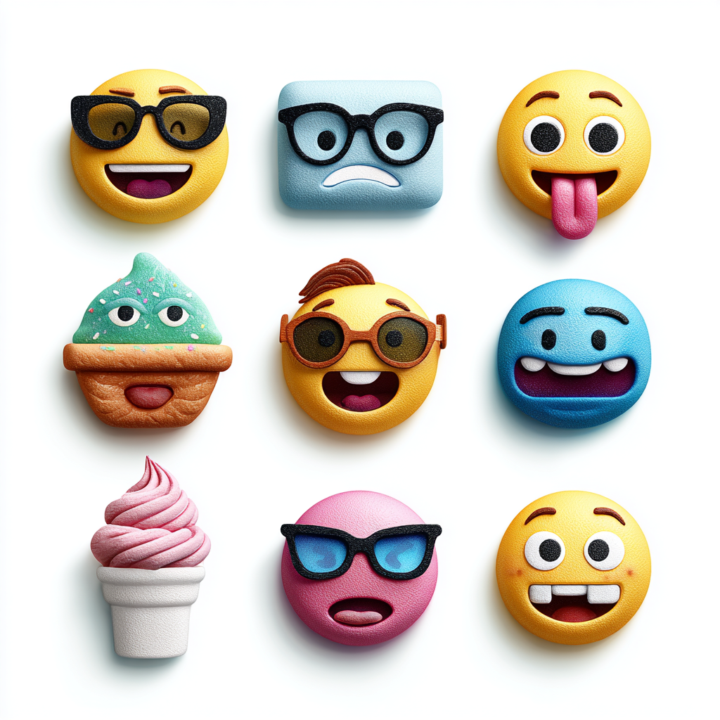
@Igor O well, those emojis looked quite different on my cellphone 😄... designing book covers that actually sell.
Nov '25 •
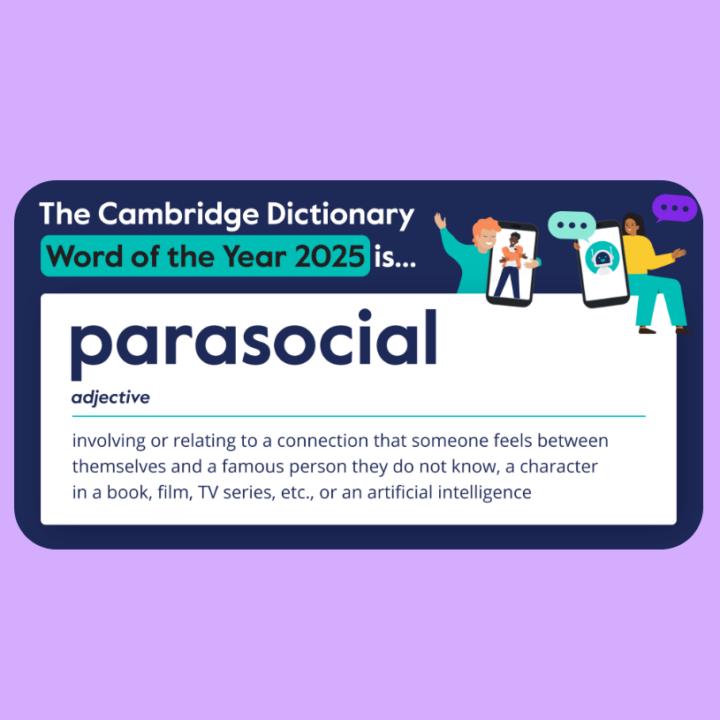
‘Parasocial’ is Cambridge Dictionary’s Word of the Year 2025
Following on from @Laura Diaz 's thoughts on how AI can give you superpowers or become a super distraction, the Cambridge Dictionary has named 'parasocial' as the Word of the Year for 2025. This refers to people forming parasocial relationships with influencers, characters in books, gurus and even chatbots. If we bear this in mind in our publishing business, it could be a great tool. However, if you find yourself in such a relationship unconsciously, it can have a negative impact on your life. That's why the Guild is so important to me. I really care about how well @Thomas Juuls cover will perform. I really worry, will @Laura Diaz outperform me in Barry's group. When @Paul Davidson sharing with me his experience, I know it's genuine and that he has taken the time to help me. When I see @Pamela Henkels considering a paid tool, I want to find a good free alternative because she's a real person and I care about her. When @Temmy Ay showed me his first manuscript and I couldn't stop reading it, I realized that he was no ordinary author. Will @Swati Kadam next book perform well? Will @Matt Radkiewicz , @Robert Alan and @Kris Hus communities grow fast? I could go on and on. I really hope that the Word of the Year will be 'Social' next year. At least, I think it will be for us in the Guild.
1 like • Nov '25
@Igor O Spot on. Social has definitely drifted into bubbles. The interest side feels much closer to something sustainable. Curious to see how it evolves as well.
1 like • Nov '25
@Igor O Couldn't agree more. We definitely do 🙂
1-9 of 9

@robert-alan-3942
Passionate about systems and book design, I've designed several books for authors and editors. I love streamlining & simplifying design processes.
Active 3h ago
Joined Nov 13, 2025
INTJ
Canada
Powered by