Activity
Mon
Wed
Fri
Sun
May
Jun
Jul
Aug
Sep
Oct
Nov
Dec
Jan
Feb
Mar
Apr
What is this?
Less
More
Owned by Pedro
Automate your business processes with AI—no coding required. Join me as I build automation systems in public and share the exact playbooks that work.
Memberships
The AI Advantage
112.8k members • Free
AI Automation Agency Hub
312.2k members • Free
Skoolers
194.8k members • Free
AI Automation Society
341k members • Free
14 contributions to AI Automation Society

21d •
Need a sanity check on pricing 👀
Just had an interesting situation and want to get the community's take. Client came to me wanting an AI personal assistant built on N8N. WhatsApp as the main interface, tasks auto-created to Google Drive, daily briefing, context memory, bilingual (Arabic/English), deployed on his own infrastructure. I scoped it as a 5-milestone roadmap: M1 — WhatsApp AI Co-Pilot (1 week) £2,600 M2 — Email + team task management £3,400 M3 — Unified memory / RAG layer £4,500 M4 — Data analysis + web dashboard £3,000 M5 — Multi-user team operations £4,100 Total roadmap: £17,600 His response: the quote is 10x what other developers offered him. He said he understands it’s not a “cheap $20 workflow” but that £17k is way too far and asked if we could work something out around £1,500 for what he had in mind. Client is a Saudi construction company owner. Technical understanding is good. Has another developer working on a separate AI project already. My questions for the community: 1. Is my pricing fair for this scope or am I actually way off? 2. How do you handle the gap when a client is comparing you to low-cost automation developers? 3. Would you negotiate down or walk away? Happy to share the full scope doc if useful. Genuinely want honest feedback, not validation.
1 like • 21d
@Chris Jadama thanks a lot for input!

Jan 23 •
Building on LinkedIn in 2026
I wanted to share something I've been actively learning over the last few weeks, in case it helps anyone else here. I've been putting focused effort into building a real presence on LinkedIn. Not just posting, but treating it as a credibility surface, a relationship engine, and eventually, a monetizable channel. This isn't me "figuring it all out." It's me sharing the working model I'm currently following while I learn. One thing that's become very clear: To succeed in AI and automation on LinkedIn, you have to move past the cringe of generic, robotic content and stop treating your profile like a résumé. LinkedIn is a B2B marketplace. Something like 80% of B2B leads originate there, which means decision-makers are already spending time there. Here's the simple framework I'm using right now. 1. Treat your profile like a storefront, not a résumé Your profile has one job: convert attention into trust within seconds. What I'm focusing on: - A headline that immediately tells who I help and how - A clean headshot (approachable over flashy) - A banner with a single, clear CTA - A featured section with one long-form trust asset (newsletter, doc, guide) and one clear next step (booking link, waitlist, etc.) The goal isn't perfection. It's clarity. 2. Content quality beats volume (by a lot) You don't need to post every day. Most strong creators post 3-4 times per week, max. I've been using a simple structure for posts: Story → Lesson → Advice → Reflection Start with something real or personal. Extract a lesson. Offer something practical. End with context or a genuine question. Also, I'm being very intentional about not letting AI think for me. I use AI for structure and clarity, but the specificity, taste, and experience have to stay human. 3. Hooks go broad before they go niche The first 2-3 lines matter more than anything else. What I'm practicing: - Start with a broad emotional hook anyone can relate to - Then bridge into AI, automation, or systems - Avoid starting niche or technical too early
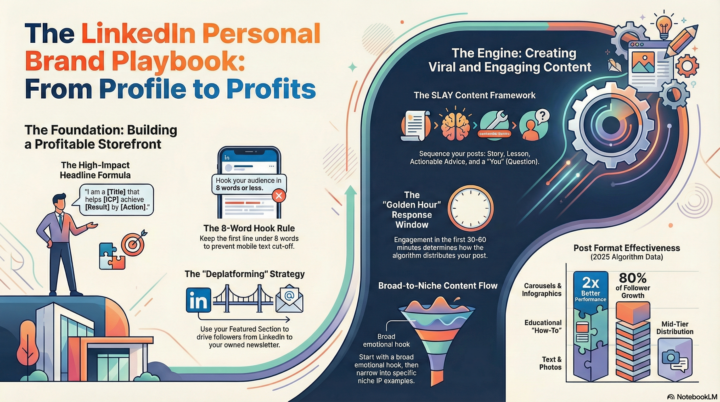
2 likes • Jan 23
what has been your own results/outcome? any business coming through that channel?

Jan 23 •
🚨 A quick security reminder about automation workflows
Don’t run workflows from strangers without inspecting every single node first. Whether it’s an n8n workflow, Make scenario, Zap export, or a random JSON someone drops in a Discord or Skool post — blindly importing and running automations is risky. There are bad actors out there. Some are obvious. Some are very good at hiding what they’re doing. I’m sharing workflows to help people learn and move faster — but you should still verify everything before you run anything. Why this matters Automation tools usually have deep access to: - APIs - Databases - Credentials - File systems - Webhooks - Internal business data A single hidden node can: - Exfiltrate credentials - Send your data to a third-party server - Create hidden webhooks - Write or delete database records - Trigger actions on a schedule you never notice And the scariest part? ⚠️ It can look completely harmless at first glance. Good security practices (please don’t skip these) 1️⃣ Inspect every node — no exceptions - Open each node - Check URLs, endpoints, headers, payloads - Look for unfamiliar domains or IPs - Be suspicious of “utility” or “helper” nodes 2️⃣ Verify the source - Who posted it? - Do they explain what it does and why? - Does the workflow come with context or documentation? - Anonymous drops = 🚩 3️⃣ Never import with credentials pre-attached - Remove all credentials before testing - Re-add your own manually - Never trust “ready-to-run” workflows with keys baked in 4️⃣ Test in a sandbox first - Use a dev instance - Use test APIs / fake data - Never run unknown workflows in production first 5️⃣ Watch for outbound traffic - HTTP Request nodes - Webhooks - “Logging” endpoints - Anything sending data “for analytics” If you don’t recognize the destination — investigate. 6️⃣ Least-privilege access - Use limited API keys - Separate prod vs dev credentials - Rotate keys regularly 7️⃣ Assume automation = code No-code does not mean low-risk.
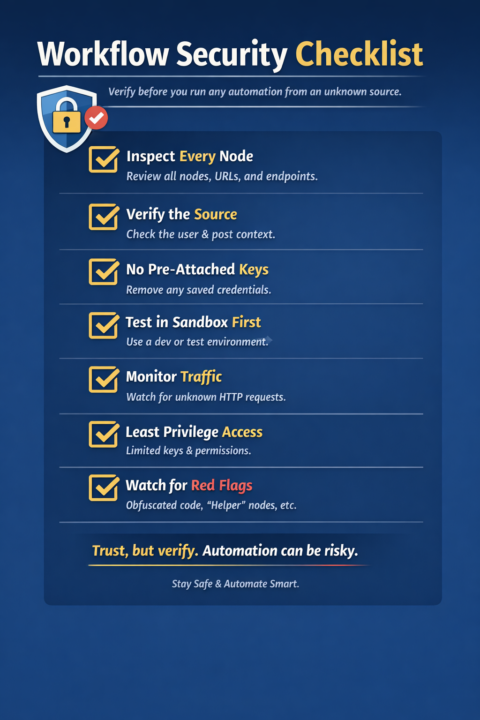
2 likes • Jan 23
Nice to see someone actually thinking of the crucial stuff!

Jan 23 •
AI Clone
I have this question, Nowdays there are so many agency and people are pitching they will teach you build your clone, is this something which is done with n8n or more than that. Is anyone in that space I would like to mastermind/talk to them. Thanks for your time
2 likes • Jan 23
Most "AI clone" offers are overhyped. Here's what they actually are: → LLM API (ChatGPT/Claude) handling language → Workflow tool (n8n/Make/Zapier) orchestrating logic → Database storing context and past interactions → Prompt engineering making it sound like "you" The tech stack isn't complicated. What IS hard: 1. **Knowledge capture:** Documenting how YOU make decisions 2. **Context design:** What info does the AI need to respond like you? 3. **Scope definition:** Which tasks can it handle vs which need human judgment? 4. **Quality control:** How do you catch when it says something you wouldn't? **The real question isn't "can I build an AI clone?"** **It's: "Which specific tasks am I doing repeatedly that follow a pattern?"** Start there. Build a system for ONE repeatable task. See where it breaks. Iterate. Example: - Email responses to common questions → AI assistant works great - Strategic business decisions → AI is dangerous - Client onboarding questions → AI with human approval = perfect Don't buy a "build your AI clone" course. Most are selling hype. Instead: 1. Pick one repetitive task you do 2. Document your decision process for that task 3. Build a prototype (LLM + workflow tool + database) 4. Test it for 2 weeks 5. Iterate based on what breaks That'll teach you more than any course—and cost you $0 except your time. I'm actually building one of these systems right now (AI assistant for business process automation)—documenting the entire build publicly so people can see the real implementation, not just theory. If you're curious how it actually works or want to talk through your specific use case, feel free to reach out. Always happy to help cut through the noise.

Jan 22 •
Hello
Hey everyone, This is Bristin. I’m currently working as a web and mobile app developer, specializing in AI and Blockchain-driven products. I’ve worked across multiple SaaS projects and startup environments, and through these experiences, I’ve gained strong exposure to building and scaling real-world products. I’d love to connect with like-minded people to brainstorm ideas, discuss technical challenges, and collaboratively build impactful products fast and efficiently. Happy to connect and always open to helping wherever I can. Thank you.
1 like • Jan 22
Hi Bristin. Would love to connect 100%. I have similar background and also miss that too. feel free to reach out
1-10 of 14

@pedro-lima-9405
Helping business owners automate repetitive work—so they can focus on growth, not manual tasks | Building automation systems in public
Active 21d ago
Joined Jan 12, 2026
Portugal
Powered by