Activity
Mon
Wed
Fri
Sun
Jun
Jul
Aug
Sep
Oct
Nov
Dec
Jan
Feb
Mar
Apr
May
What is this?
Less
More
Memberships
The Paid Up Club
383 members • Free
The Hyper Growth Accelerator™️
58 members • Free
Fulltime Freedom
6.3k members • Free
ChatGPT Insiders
981 members • Free
7 contributions to The Paid Up Club

6d •
Here is something I have noticed consistently over many years of client work.
Many professionals put enormous energy into winning a new client. And then they wing what comes next. The first 90 days of a client relationship set the foundation for everything that follows. I want to share the framework I use, because I think it is genuinely one of the most overlooked areas in the helping industry. Before the first working meeting, send a welcome pack. A personalised welcome letter, your working agreement in plain English, a short questionnaire about goals, and clear next steps. It signals professionalism before you have even sat down together. At the first meeting, cover what I call the soft contract alongside the hard one. The hard contract is what you are doing. The soft contract is how you are going to do it. How will you communicate? What does success look like? What might get in the way? Break the 90 days into 30-day segments with shared objectives. Document every win. And build trust deliberately, through consistent action, not passively through good intentions. I made the mistake early in my career of assuming trust would build naturally. It does not. It is built deliberately. The 90-day review is not an ending. It is a beginning. I am curious how structured your first 90 days currently are. Tell me which fits best: a) I have a clear onboarding process and it works well b) I do some of this but it is not consistent across every client c) I mostly wing it after the contract is signed and I know it costs me d) I am just starting out and I want to build this in from the beginning Drop your letter below.

0 likes • 5d
a
0 likes • 5d
Peter, I completely agree that getting the first 90 right sets the foundation for everything that follows which is why it has its own chapter in my latest book: Chapter 16 - The First Ninety Days The previous chapter described the rhythm the practice runs on. This chapter describes how a new client is brought into that rhythm. The first ninety days are the structured diagnostic phase, in which the engagement runs through Stages 1, 2, and 3, in sequence, on a defined timetable, with specific deliverables landing at specific points. The shape of the ninety days matters. Done well, the client arrives at the end of week twelve as a working participant in the monthly rhythm, with their Intent Statement, their Management Reports and Commentaries, and their Critical Business Drivers Template all in place, and a relationship that can carry the work that follows. Done badly, the engagement drifts. The diagnostic stretches to four months, then five. The Intent Statement is signed off but never quite returned to. The first Report arrives weeks late. The drivers are agreed but never used. The relationship slips into the shape of a friendly retainer that produces little of the value the Method exists to produce. This chapter sets out the structure that prevents the second outcome. The deliverables for weeks one, four, eight, and twelve. The discipline of pacing. The hand-off from diagnostic to monthly rhythm at week thirteen. The chapter is short on purpose, because the ninety days are operational and the operational work benefits more from a clear timetable than from extended exposition. Why ninety days, and why this shape Ninety days is not arbitrary. Three months is enough time to do Stages 1, 2, and 3 properly, with the natural pace each stage requires. Compress the period and the work becomes superficial. Stretch it and the client loses momentum, the Intent Statement starts to feel stale before the drivers have been agreed, and the engagement begins to drift before the rhythm has been established.
Mar 3 •
NotebookLM just added 10 styles for infographics !!
Here’s one I just created. Useful info for you too. Do you use Infographics in your business?
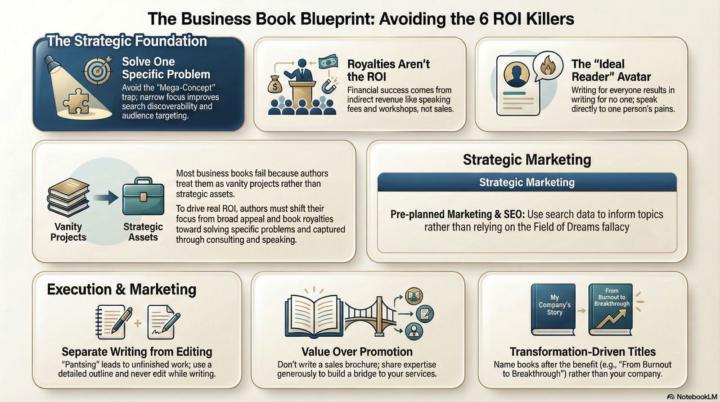
5 likes • Mar 3
I've been using NotebookLM for some time for several outputs, not just infographics; it, and Claude, do most of my heavy lifting now. Definitley worth getting the paid version. Thanks for the heads up on the new styles Peter. Here's one I made with the storyboard style.
0 likes • Mar 4
Where did the Storyboard style go on Infographics? That was my favourite.
Feb 23 •
The moment I quoted 2.5× my normal fee, and he said yes without blinking
Are you comfortable with the fee rate you're currently charging? If the answer is yes, that might actually be the problem. In my experience, the moment a fee feels comfortable is usually the moment it needs testing upwards. Here's an exercise worth trying before your next client conversation: Imagine you were going to quote 10 times your normal rate. How would you describe what you do differently? What would you emphasise? How much more specific would you be about the outcome and the value? Now, go back to your normal rate. But deliver the description you just imagined. Most people who do this exercise come away with one thought: I've been undercharging for years. The 4 questions I always come back to: 1. Am I dealing with the right type of client? 2. What is the real value of the outcome I deliver? 3. What is one day of my life worth? 4. When will I next test my price? Would love to hear your thoughts on this. Drop your comments below 👇
3 likes • Feb 23
As business advisers it is always possible to increase the value we provide - usually at little or no cost - so a regular price increase can always be mollified by adding something extra to offset the pain.
Dec '25 •
Every professional business that grows predictably masters these three things:
1. Positioning – The right people instantly know “this is for me.” 2. Packaging – You sell outcomes, not hours. 3. Pricing – Your fees reflect value, not personal comfort. Most people start with pricing.That’s the mistake. Pricing only works after positioning is clear and packaging makes the value obvious. Which of the three is quietly holding your business back right now?
2 likes • Dec '25
We have a simple philosophy that if the value you get isn't greater than whatever you pay us we are the wrong advisers for you. It is always possible to increase the value to your ideal client.
Dec '25 •
Friday Thought: Why Our Standards Quietly Decide Our Income
Quick thought for you. After decades in business, one thing keeps showing up again and again: success doesn’t come down to luck or timing, it comes down to standards. In this video, I share why the small things we tolerate (lateness, vague promises, slow follow-up) quietly cap our results… and how raising the bar just a notch can completely change the quality of clients, income, and impact we create. Question: What standards can we improve on in 2026?

2 likes • Dec '25
Quite right Peter; the improvement I'd like to see all small businesses make is in the quality and timeliness of their financial reporting and forecasting. With software such as Xero it's possible to automate most of the bookkeeping and then get detailed reports such as gross margin by business segment. Link Xero to a forecasting app - even it's inbuilt Syft - for a view of the future. This improved data flow and analytics is available to all businesses not just large corpoates and will transform the business performance if interpreted correctly.
1-7 of 7
@noel-guilford-4976
Noel Guilford is a Chartered Accountant with over 40 years experience working with small businesses.
Active 5d ago
Joined Nov 5, 2025
Powered by