Activity
Mon
Wed
Fri
Sun
Nov
Dec
Jan
Feb
Mar
Apr
May
Jun
Jul
Aug
Sep
Oct
What is this?
Less
More
guitarwavers
61
Free
7 contributions to guitarwavers

16d •
October 2026 releases
This week my Release Radar was full of new music from guitarwavers, so here is the next round-up. "minouski" by @Sebastian Jautschus: Once again great sound design, with interesting layers and textures. You just float along. https://open.spotify.com/track/0AfFLupRaWuBhOKczvRqxR "We Had Everything" by Friend from Work/@Peter Monrad: A song that feels like a journey, and those swell sounds are wonderful. https://open.spotify.com/track/5gxc3SgUKEnzNq7ZXakNEW "Before You Arrived" by @Nathaniel Graham and @Rebecca Mardal: I had been waiting for this collaboration 😊 Congratulations on a beautiful track! https://open.spotify.com/track/5PD0l2qxxAvXD9Gw8fZkFT And today I released "The Widest View", an acoustic piece I wrote this summer in the Austrian Alps, below the 'Wilder Kaiser': https://open.spotify.com/track/4VqoYaPQqxomZUWv6Jvt10 This time I tried something new alongside the release. I separated the stems of the track and built a small listening page around them. You look through a telescope at the mountain panorama, and two guitars are hidden somewhere in the view. On a phone, the telescope follows as you move it, so you can simply turn around until you find them. Best with headphones 🎧 https://widestview.chasingreverbs.com/inside/ Feel free to add to the list if you put something out too 🎸


1 like • 15d
Thanks Martin! All brilliant tracks 😊
Apr 10 •
Claude Code for Music Analytics
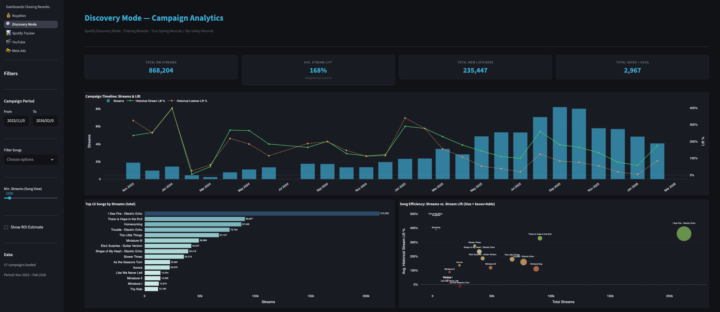
AI gets a lot of (justified) criticism in the music world right now, and watching what Suno and others are doing, I share those concerns. But I wanted to highlight a use case that's been genuinely helpful for me: data analytics. Over the course of one afternoon, I used Claude Code to build a set of dashboards with a tool called Streamlit, running locally on my machine and updated regularly with fresh data. No more wrestling with CSV exports (anyone who's dealt with DistroKid's royalty reports knows the pain 😅), just clean, visual overviews of everything that matters. And it goes beyond display. One question I'd always wondered about: how many songs should I actually put into Discovery Mode? Claude helped me work through that properly, with the data to back it up (see second screenshot). AI isn't replacing the music. But for the business side of things, the admin, the analysis, the stuff we'd rather not spend our creative energy on, it can be a serious time-saver. Happy to share more if anyone's curious. 🎸
2 likes • Apr 11
Sorry, I see you’ve detailed more on the dashboards in reply to Sebastian. Very cool!
3 likes • Apr 11
@Martin Eibisch yes I think the conclusion is reasonable and I think I’ve seen Spotify themselves say opting in everything is a bad strategy and you should cut down to just the number of songs that seem to perform best. So, if using DM, this would be the best strategy I would think. Great work with the data! One thing to be aware of is that I have seen and heard that often what happens after using DM mode for a while, stopping it tends to cause a big drop off. But after a while it picks right back up again. The thing I find hardest in all this is even understand what Discovery Mode is - I.e. how is it different in function to Spotify’s normal Radio algorithm? There’s really not enough scrutiny of this in the music community (instead focusing on often irrelevant things to scrutinise Spotify over!). That said, I do largely give Spotify a pass as at least they do have a proper algorithm that gives small artists exposure. Literally no other service compares possibly with the exception of Pandora. With all the other major services, every stream we get we basically have to pay for with ads.

Apr 10 •
april releases ✨
I mainly wanted to hop on here and congratulate everybody for the great music that has come out today! it makes me so happy to see—knowing you all (at least through the community) is just sooo fun :) great stuff from @Hvetter Hvetter, @Nathaniel Graham, @Simon Burkhardt, @Martin Eibisch, and a special shout out to @Rebecca Mardal & @Jacopo Ramonda—a little community collab no? 🥲🫶🏼🦦 and please tell me if there are more releases that I haven't noticed yet. the guitarwave playlist is happy about every new song :)
6 likes • Apr 10
Fantastic company to be in today! Very excited to be back releasing music after a few years off focusing on building Sky Valley Records. Got some really amazing collaborations with other members of the community in the coming weeks/months I’ll be excited to share 😃
Feb 1 •
new podcast episode | 2025 recap
this one is a bit different; it's just maja and me (maja being the little dog I'm dog-sitting atm). I'm recapping everything I did in 2025, sharing how much I earned, what worked, what didn't, what I've learned along the way, plus a little preview of what I'll focus on this year. next episode will be with a guest again. if you have any wishes for whom we should invite on the podcast next, please let me know. sending you all relaxed energy from sweden 🦦
1 like • Feb 7
@Sebastian Jautschus for song/artist popularity tracking I use https://www.artistxray.com/ It does the same thing as Musicstax and all the other similar websites but I find it a little quicker/cleaner to get straight to the data I’m looking for (popularity score). You just type in an artist and it’s gives you their artist popularity score and the song popularity score for their top 10 songs
1 like • Feb 8
@Sebastian Jautschus I am not sure about ArtistXray, but when I used to use Musicstax i remember it only updated once every few days? Not sure if that is still true! I think Artist X Ray was showing '41' a few days ago, so i think that one may be more up to date.
Sep '25 •
shady Spotify strikes again
I’m so lost in all of this. so just wanted to ask how you guys feel about all of this? here’s a video of the latest changes to their terms: https://www.instagram.com/reel/DOrgbUNCYj_/?igsh=MW01eTZhNzhsem96cQ==
6 likes • Sep '25
Hey! I am not surprised you feel lost, as these terms of services are extremely (probably deliberately) confusing. However, I’d like to urge everyone not to panic/worry. It’s probably not intentional, but there is a lot of misinformation on Instagram and YouTube. Here’s a better video breaking it down: https://youtu.be/jQAQicMj1Y8?si=HjN2Bq4kQDs1OQho The TLDR is that this new terms of service has little to do with your actual music. It’s to do with content directly uploaded to Spotify (incl. Spotify for Artists). The terms affecting your music is the agreement between your distributor and Spotify, since that is who uploads your music onto Spotify. Secondly, these terms of service often look scarier in writing than in practice. The terms of service for everything you use look terrible - meta has the right to everything you post on Instagram, YouTube has rights to all your videos etc. In some cases these rights are necessary - Spotify is constantly innovating new features (ie their new remix features), unlike other services which are mostly side-shows for major tech companies (Apple, Amazon, etc). There is a strong narrative of hate towards Spotify at the moment and so people are keen to jump on that for any reason they can. So I’d just be careful with what you see/read and seek out multiple and well-researched or informed sources (Andrew Southworth, from the video linked above, is in my view one of the best for this).
1-7 of 7
@nathaniel-graham-9976
Sky Valley Records is a record label dedicated to chill instrumental guitar music
Active 15d ago
Joined Aug 24, 2025