Activity
Mon
Wed
Fri
Sun
Jun
Jul
Aug
Sep
Oct
Nov
Dec
Jan
Feb
Mar
Apr
What is this?
Less
More
Owned by Michael
Build real-world AI fluency to confidently learn & apply Artificial Intelligence while navigating the common quirks and growing pains of people + AI.
Memberships
AI Automation Society Plus
3.6k members • $99/month
AI for Life
28 members • $297
63 contributions to AI for Life

🔥
4d •
Claude Code Pro User Workflow
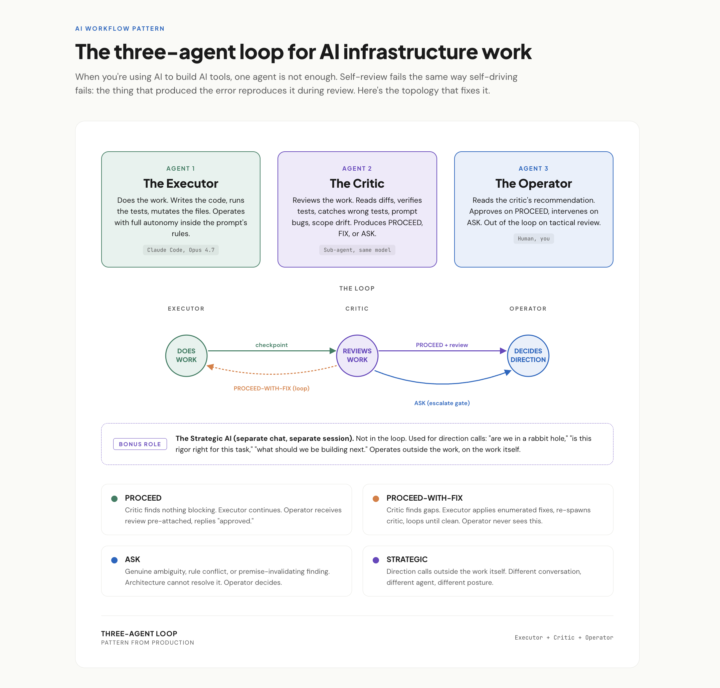
* Confidential. Use, Do not share.* Thank you! Pattern from a real session this week. When you're using AI to build AI tools, one agent is not enough. Self-review fails the same way self-driving fails: the thing that produced the error reproduces it during review. The fix is three roles, not two: The Executor does the work. Full autonomy inside clear rules. Stops only when it genuinely can't decide. The Critic reviews the work. Same model, different posture: read, verify, find what's wrong, recommend PROCEED, FIX, or ASK. The Operator (you) reads the critic's recommendation, not the raw work. Approves on PROCEED. Intervenes on ASK. Out of the loop on tactical review. Bonus fourth role I didn't have a name for until this week: a Strategic AI in a separate chat, used for direction calls outside the work. "Are we in a rabbit hole." "Is this rigor right." Operates on the work itself, not in it. The unlock isn't capability. It's posture. Same model, three system prompts, three different jobs.

🔥
1 like • 3d
This is very well thought out and organized. Great great value for new and seasoning builders.
🔥
5d •
📦 Out of The Box in 90: Suno Turns My Poem Into AI Song for Daughter
Welcome to the Out of The Box Series — where I test how far curiosity and AI can take you in 30, 60, or 90 minutes using today’s best no-code and low-code tools. No studio. No production team. No advance training. Just exploration to see what we can do — right out of the box. 🎧 Finished Song*: I Got Your Six Little Girl 🎬 This Episode: Suno.com – AI Song Creation 🕒 Time Limit: 90 Minutes 📂 Category: AI Music & Personal Creativity 🎶 What Is Suno? Suno is an AI music generation tool that can create songs from prompts, lyrics, and style direction. In this case, Suno did the musical composition. I uploaded my original lyrics. 🎧 Finished Song*: I Got Your Six Little Girl Because rights and ownership matter, I started with lyrics I had written myself and kept the words original. With Suno Pro, you can publish what you create, so I wanted to be thoughtful about what I uploaded and refined. 📝 Backstory In February 2020, I wrote a poem for my daughter called I Got Your Six Little Girl. It was written from the perspective of a father looking back on all the firsts: - first heartbeat - first breath - first steps - first bike ride and moments in between The poem was already written. But I cannot sing. I cannot play instruments very well. I was never in the band. So I wanted to see if I could use AI to help turn the poem into a song to give her as a graduation present. ⏳ What I Built in 90 Minutes: Within one focused session, I: 🎼 Uploaded my original lyrics into Suno 📝 Converted the poem format into a song lyric format 🎚️ Used Suno’s interface presets to guide the style 🔁 Generated multiple versions 🎧 Listened for tempo, transitions, hooks, and continuity 🎵 Created a strong working version of the song 🎧 Finished Song*: I Got Your Six Little Girl The prompt was less of a traditional instruction and more of a music style descriptor.

🔥
1 like • 5d
@Matthew Sutherland Fathers and daughter have a special relationship.
🔥
6d •
Testing New Logo
Taking advantage of ChatGPT's pretty amazing image gen.
Poll
2 members have voted

🔥
2 likes • 6d
I like everything except the price at the bottom, I would not make that part of your identity. Technically the 7 day trial, in for life and price is a campaign, and you should keep and reserve the right to change that...
🔥
7d •
GSD 2.0: Read This Before You Pay for Tokens
There's a new tool making the rounds called GSD 2.0. (Launched in early March 2026) The pitch sounds incredible: type one command, walk away, come back to a built project. Autonomous coding agent. Crash recovery. Cost tracking. The works. I went deep on it this week. Here's the part the hype tweets are skipping. What GSD 2.0 actually is The original GSD was a clever set of prompts you'd plug into Claude Code. It worked, but it was a prompt layer on top of Claude Code. GSD 2.0 is a different beast. It's a standalone application that runs the AI agent itself. You don't run it inside Claude Code anymore. You run it instead of Claude Code. That's the headline change, and it's the detail getting lost in the excitement. It manages git branches for you. It splits work into chunks small enough to fit in one conversation window. It retries when things break, recovers from crashes, and tracks every dollar you spend. On paper, it's serious engineering. Where the cost actually hits GSD 2.0 charges you per token. Same way you'd pay if you used the raw Anthropic API. If you have a Claude Max subscription, the $100 or $200 a month flat-rate plan that powers Claude Code, you already get effectively unlimited AI usage for one fixed price. Developers have publicly reported burning five figures of API spend in months that cost them $200 on Max. GSD 2.0 doesn't use your Max subscription. It bills directly to the API. It gets worse. GSD 2.0 is structurally more expensive per task than Claude Code, by design. It throws away the conversation history between every task to keep things "clean." That sounds great until you learn that the recycled conversation history is exactly the thing that makes Max so cheap. With Max, you pay nothing extra to reuse context. With GSD 2.0, you pay full price for it again every single task. Real numbers A small project on GSD 2.0 will cost you somewhere between $15 and $50 in API charges. A medium project, $40 to $150. A gnarly one with retries and crashes, several hundred dollars. None of that is covered by your Max plan.

🔥
2 likes • 7d
Keep them honest. Thanks for having our backs. Great breakdown and analysis.
🔥
8d •
When's the last time your in-person meeting actually needed to be in-person?
A 60-minute in-person meeting rarely costs 60 minutes. Five of them a week costs you a full working day of hidden overhead. Every week. Nobody audits that number, so nobody fixes it. Default to video for execution work. Use in-person strategically. Most organizations still treat in-person meetings as the standard and video as a fallback. Flip the default for execution-layer work and speed goes up the same week. The operator case for video as baseline: 1. Meetings cost more than the meeting A 60-minute in-person meeting is rarely 60 minutes. Add 30 to 90 minutes of travel, buffer time on either side, and the cognitive hit of leaving your workspace. Run the math across a week. Five meetings, two hours of hidden overhead each, ten hours back. A full working day reclaimed every week. 2. Scheduling becomes elastic (with discipline) Video calls collapse to fit the work. Ten-minute syncs become viable. Reschedules stop cascading into lost half-days. The trap: video defaults can expand meeting volume instead of shrinking duration. Pair the elasticity with a protocol. Default length 15 minutes, agenda required, no agenda no meeting. 3. The cost structure runs deeper than fuel Surface costs: gas, parking, vehicle wear. Real costs: opportunity cost of lost working hours, meeting room infrastructure, coordination overhead, travel reimbursements. Most of it is invisible on the books. Video removes nearly all of it with no drop in output on execution-layer work. 4. Decision velocity compounds Pulling stakeholders together takes a calendar invite instead of a commute. Decisions happen in hours instead of days. Fewer blockers. Tighter feedback loops. Competitors still scheduling in-person reviews fall behind on iteration speed alone. 5. Meetings become assets, not ephemera This is where the operator edge lives. A typical pipeline: Fathom or Fireflies records the call. Transcript drops into n8n. Claude or GPT extracts action items, owners, and deadlines. Output writes to Airtable, Notion, or the CRM. A Slack DM fires to each owner with their tasks.

🔥
1 like • 7d
Just drove 2-hours for a prospect meeting, never again.
1-10 of 63

🔥
@michael-wacht-9754
AI Bits and Pieces | Learn to Close Deals | Become an AI Standout
Active 7h ago
Joined Feb 19, 2026
Mid-West United States