Activity
Mon
Wed
Fri
Sun
Dec
Jan
Feb
Mar
Apr
May
Jun
Jul
Aug
Sep
Oct
Nov
What is this?
Less
More
Make it Match
353
5.0
Free
13 contributions to Make it Match
Jun 2 •
3M cartridges
Hello, I’m new here and this is my first post. I am painting an airplane (homebuilt) using Axalta AF400 series paint (AF403 packaged white to be specific) and I am pretty sure it contains isocyanates. I have been using a respirator with 3M 6003 cartridges, but have read a few things recently that claim that no cartridge is really adequate for isocyanates and that a forced fresh air respirator is needed. Anyone here more expert in the PPE field than me who can comment? I have posed this question to my Axalta paint supplier, but haven’t received an answer. I suspect this may be a question they will dodge given liability concerns. I looked at the Hobby Air systems and they aren’t super expensive. Looks like I could get one with a full hood for well under 1 AMU. AMU = Aviation Monetary Unit which is $1,000. Pilots and airplane owners use AMUs as it sounds better to tell your wife that something only cost 2 AMUs rather than 2 grand. 😂
0 likes • 2d
@Brad Oren Yes, Amazon can be the Wild West in regard to Chinese knockoffs. I always buy from the official 3M store on Amazon and have had no issues. I never smell a whiff of paint smell when spraying. If you smell anything at all, I’d say the cartridges are not correct for the type of chemical being sprayed. I smell absolutely nothing when the filters are in good shape. I did catch a whiff the last time I sprayed and then noticed some paint on my nose one each side where the mask seals. Turns out, I had used the prefilters too long and when I inhaled, the pressure was high enough due to the filter restriction that I was drawing a smidge of air through the seal at my nostril crease on each side of my nose. I replaced the prefilters today and no more issue. I didn’t notice anything different with my breathing difficulty, but the prefilters had collected enough paint to be too restrictive. If I get even a hint of paint smell, I know something is wrong.
0 likes • 2d
@Brad Oren Yes, PPE is a poor place to try to economize. I don’t mind buying cheap paint mixing cups and such as long as you check them for accuracy before using them. I don’t try to cheap out though on PPE.

Sep 28 •
Fiberglass How far down do I need to sand?
Currently working on a fiberglass bodied dune buggy. Other than the original gel coat, the body has been painted once around 2016. That paint consisted of a layer of primer (definitely not a high build) and a base color + Clear coat. I've started the bodywork, correcting the previous repairs that used a regular body filler rather than actually repairing fiberglass and using a body filler made for fiberglass. The areas that need repair get taken down all the way to bare fiberglass. My question is how far down to I need to sand the other areas. I know that there's no way to see all of the potential problems without removing the latest respray, but can I stop at the original gel coat layer or do I need to strip EVERYTHING down to the bare fiberglass? My original thought was that I'd take it down to the gel coat, cover with an epoxy primer and follow that a high build primer to block it? While I don't want to waste time sanding if it isn't needed, it would be way worse to waste the sanding time, the materials cost, AND additional time to re sand because of a skipped step that causes an issue. Any guidance greatly appreciated.
2 likes • Oct 1
Don’t sand through the gelcoat unless you have damaged fiberglass that needs repair. You don’t want to sand into the fibers and begin to break them as that compromises the strength of the panel.

Jul 16 •
Booth ventilation - positive or negative pressure
I am getting started on building my paint booth. It will be modular, 12 x 24 ft, with 6 x 8 ft panels that will be fastened together. I've got a 5000 cfm exhaust fan, and was planning to use it to blow air into a plywood plenum, through a dozen intake filters, and then exhaust out the other end through exhaust filters. This will be inside my 40x50 shop that has heat and AC. It will pull conditioned shop air in, but I am uncertain if it can be just be exhausted through the exhaust filters into the shop, or if I need to make it a negative pressure booth, pulling air out and exhausting it outside. I was thinking of using zipwalls to allow me to enter/exit, and also for the truck parts to enter and exit. I would sure appreciate any info/recommendations anyone to help me figure this all out.
2 likes • Jul 18
You definitely want to exhaust outside your shop. I have filters on my exhaust to catch the big stuff before the fans, but a lot still gets on the fans and goes out the window I use for exhaust. So, my booth is negative pressure, but that is less than ideal as it pulls in dust through every opening in the booth and whenever you open the door with the fans on. I sometimes wish I had added fans on the intake side to provide positive pressure in the booth to help with dust control.
Jul 12 •
Aftercooler for my air compressor
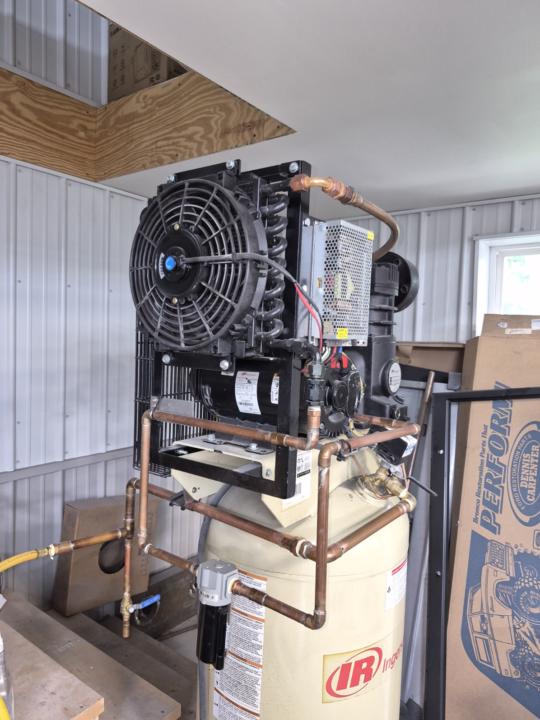
So after watching Aarons recent YouTube video on bone dry air, I decided to share a picture of my aftercooler setup that I recently finished. I used a 10 x10 transmission cooler with AN to NPT fitings to connect it to the copper lines. As you can see in the picture, I put a water separator at the lowest point to expel any accumulated water each time it runs. I used a transformer from Amazon to convert from 240V AC to 12V DC, pulling off the compressor supply, converting it to 12V, so now the fan cuts on whenever the compressor receives power. The temp of the cooler intake line runs over 250F, but coming out of the cooler is only 84 degrees, and by the time it gets back to the tank, is about 75F. After 2-3 days of running here in NE Tennessee, I drained the tank and only got 1 oz of water out of it. I hope this helps someone.
1 like • Jul 18
That should be very effective. For anyone wanting a simpler and passive system, you can also just make a serpentine run of copper air lines and it will do the same without need for electricity. My shop is fairly large, 32x48 so I simply ran my 3/4” air lines near the 14’ high ceiling. My paint booth is at the opposite corner from my compressor. I ran a 3/4” loop around the perimeter of my shop and then ran 3/4” drops in 4 places where I needed air. I put a drain stub at each drop so I can drain water there, but I’ve yet to have any water at any drop. My compressor exits to a filter and water separator and regulator combination unit and I get a little moisture there, but very little. After the air climbs 12’ up to my copper loop, travels nearly 80’ to my paint booth drop and then down the 10’ long drop, the air is basically at ambient temperature and very dry. Obviously, if your compressor is right outside your paint booth, then you need a more advanced cooling system such as you built or you need a refrigerated drying unit or several vertical copper pipes in serpentine form.

Jun 30 •
Has anyone here sprayed single-stage metallic?
A friend of mine on the other side of Finland is doing a nut-and-bolt restoration of an early ‘70s Opel Diplomat. He chose to paint the car with Tikkurila Temadur 90, an industrial 2K polyurethane that’s a single-stage silver metallic. He’s not happy with the result, mainly because of tiger striping. From what I’ve been able to find, he used a generic, inexpensive thinner that appears to have been a fast thinner. He also sprayed the car with a sub-$100 bottom-feed spray gun (probably not ideal! 🤣). He knows I’ve been trying to learn automotive painting and has invited me to respray the car. I plan to use an Iwata WS-400 Series 2.1 Clear gun with either a 1.3 HD or 1.4 HD setup. I’ll spray a number of test panels in my shop before driving over to paint the car. I’ve already picked up some slow thinner for the test panels, as I think it may help reduce tiger striping, especially since it’s a relatively large car. Any advice would be greatly appreciated! I’ve only sprayed one complete car before, and that was more than 30 years ago. The doors will be installed, but the hood, trunk lid, and sunroof will be sprayed separately on stands.

1 like • Jul 10
I have not sprayed single stage metallic, but I am spraying a single stage 2K white aviation paint and Axalta recommends applying two medium wet cross coats to avoid tiger striping even with the plain old white paint. Cross coats are a pain on some shapes, but that might be worth trying on a test panel.
1-10 of 13
@matthew-whiting-4598
I am a fairly inexperienced painter and am about to paint a homebuilt airplane that I am in the final stages of building.
Active 2d ago
Joined May 30, 2026
Powered by