Activity
Mon
Wed
Fri
Sun
Nov
Dec
Jan
Feb
Mar
Apr
May
Jun
Jul
Aug
Sep
What is this?
Less
More
Kenjutsu Online
158
5.0
Free
23 contributions to Kenjutsu Online
5d •
Te No Uchi - Grasping the Sword
Has anyone had a difficult time with how to grasp the bokken ("te-no-uchi")? This is the specific way to grasp and "connect" to the sword. It takes practice to learn to proper keep to-no-uchi at all times.

3 likes • 4d
I have found that when I was gripping too tightly, I could spend some time going through kata or rokudangiri just gently pinching the bokken between my thumb and index finger. It helps back off on the tension and helps you realize how little friction is actually required to maintain control of the sword.

7d •
Training equipment
Hi do you have any recommendations for training equipment, what to look for etc. I’ve looked online and there’s a lot to choose from but would appreciate some guidance. Thanks in advance 🙂
2 likes • 7d
Most of the time, something is better than nothing. For our style we tend to use longer blades and handles, so it gets harder to find suitable weapons. One of our senseis in Michigan in the US makes bokken and training knives for us. You can reach out to Randy sensei, he may have the links. As far as uniform goes, a kaku obi is strongly recommended. It's wider than a normal karate belt, and will hold weapons more securely. A hakama may be wanted eventually, as it goes over the obi and helps secure belt items even more. Ebogu is a good site to start on. If they have okatana or (n)odachi, they're usually closer to the right size for us. Their stuff is usually decent quality for the price, which isn't cheap, but isn't outrageous, either. There's no rush though. Like I said, something is better than nothing, whether it's a prop, a stick, a broom handle, or an empty hand at the end of your arm. Especially when starting out, the tool matters less than the movement you're doing with it.
25d •
Must haves in your vehicle.
Hey everyone just curious what people have in their vehicles as far as preparedness. I have basic first aid, bandages, gauze, scissors and knife. For winter I have wool blanket, gloves, jumper cables and shovel. Although my shovel is plastic. I need to step it up and get a metal shovel. Oh, when i first started driving as a teen my father told me to keep $5.00 in my glove box in case i get really low on gas i will have enough to get home. I still have that $5.00 bill in my glove box. 🙂 What do you all recommend?
1 like • 18d
I keep a cheap pocket knife and window breaker/emergency tool in my console, asking with most of the stuff you mentioned. I'm not usually around as much snow, but I do have a metal folding shovel also. O'Connell sensei in Flagstaff mentioned getting a cheap crow bar or cats paw tool to keep in your door pocket. I've been meaning to get one.
Aug 12 •
Where are you with your training right now?
Hi everybody, I just created this poll to get a better idea of where you are at with your training right now. If you're already a distance student, there's no need to answer since this poll is for members who arend distance students yet. Also, there's no wrong answer, I'm just curious to learn where you're at so I know where to direct my time.
Poll
7 members have voted
3 likes • Aug 20
I've flown recently with botanto and wak in checked luggage. Have not tried carry on.
Aug 19 •
Training space
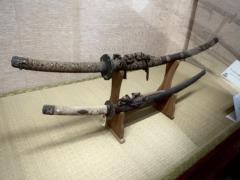
A fun question for everyone; what is your training space? Is it somewhere separate from where you live? Is it the dojo itself or whenever the mood strikes you wherever you happen to be? What are some interesting places you’ve trained or places you make a point to train at? For me, I travel quite a bit for work these days so usually the type of hotel I find myself in will dictate what I focus on and whether or not I can tune in on class. When I’m home I usually clear a large space in the living room when the house hasn’t woken up yet and for interesting places, I’ve enjoyed finding a quiet spot or two in the mountains after work occasionally. Sometimes changing things up is a gift in and of itself. I think, for me at least, the objects we dedicate ourselves to signal the spirit of training. For example, the bokken/shinken is here, so here I may begin.
1 like • Aug 20
@Wayne Nadler I recently changed to some smart light bulbs just for fun and my wife noticed immediately. I thought I had the settings pretty close, guess not close enough! Lol
2 likes • Aug 20
At home, I'm usually doing suburi and rokudangiri in my living room because of the high ceilings. Everything else is wherever I'm at when the inspiration hits.
1-10 of 23

Active 4d ago
Joined Sep 10, 2025
Powered by