Activity
Mon
Wed
Fri
Sun
Jun
Jul
Aug
Sep
Oct
Nov
Dec
Jan
Feb
Mar
Apr
May
What is this?
Less
More
Memberships
Kinship Cafe
61 members • Free
9 contributions to Kinship Cafe
2d •
Controlling life
Could self-imposed discipline and daily routines be ways to control life? I enjoyed mopping the floor every evening until I couldn't do it anymore. It feels like I started to see it (also) as a Zen practice, as a structure. It appears that my inner guru or autopilot refuses to have a rigid structure imposed by my mind. It is like living in the future and not in the now. Or is this my mind telling me a story and trying to control the chaos I am in? I will try to spend the day without elements of a future-oriented structure. It is not spontaneity. It is doing things because I want them to be done, not because they match my plan for my life. Thank you for listening.
0
0
4d •
Enjoying and stillness - my two paths into Wu Wei
Yesterday we reflected in the online event on Tao Te Ching 1. At the end, there were two lines on the screen about “Enduring the absence” and “Enduring the presence.” I cannot remember the bridge between the text of the Tao Te Ching and the idea of enduring. As my problem is to feel like starting the day without having my mind to do it, I thought maybe it is about the rejection of the 10,000 things, and I shall start the day by focusing on enduring the 10,000 things. But today this felt wrong: If the 10,000 names and the nameless are the two sides of the coin named "Mystery" or "Source," and if I have to live also in the world of the 10,000 things, why shall I start the day in the morning with the proposal of ENDURING? This felt entirely wrong. I decided to start the day with ENJOYING the 10,000 things. In the last months I was looking for the source; I was diving deep into the mystery through solitude, fewer distractions, and perception of what C. G. Jung called the collective unconscious. But today I understood, or accepted, that I have to leave space as well for the world of the 10,000 things. And if so, I can also enjoy it. My conclusion today is to restart with music and dancing in the morning, to allow myself to start with enjoying the day. I stopped it, because my day was full of music and inner or outer dance. It seems it is about enduring the fracture of the source in namelessness and names and, for the moment, enjoying both separately. I know that when I start to enjoy, I may forget the names, at least for some minutes. Maybe this is my way or DAO into the mystery or back to oneness. I still cannot start the day in a state of wu wei, but I will allow my mind to remind me that after the night, it is the time to enjoy the 10,000 things: - to bring my bedding on the terrace and to feel the fresh air of the new day, - to wash up my face with a linen-hemp cloth dampened in cold water, - to grind the coffee beans manually, to boil the clove water for 5 minutes, and to pour it over the coffee - etc., etc.
0 likes • 3d
I understood today (by listening to a YouTube video) that: 1. After waking up, I am stressed by the noise of my thoughts. 2. What helps is aligning with reality and doing what needs to be done, which in my case is very little: taking care of my body, home, and mind. It feels that by focusing on reality, I will focus on the rhythm of the day and night. Maybe, focusing will reduce the noise in my mind in the morning.
0 likes • 3d
Wu Wei is aligning with reality. But there is an outer and an inner reality. The outer reality needs action (cleaning, fitness, etc.). The inner reality requires lack of action, stillness, and acknowledging intent. I am back to the starting point: what to do so that I don't control? How does water flow between the outer and the inner reality?

29d •
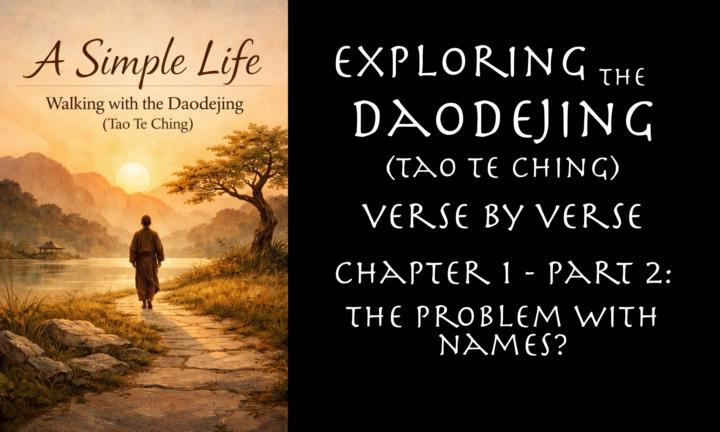
The Problem with Names
What if the way we name things is distorting how we see reality? In the opening lines of the Daodejing (Tao Te Ching), we’re challenged to see the gap between reality… and the words we use to describe it. Names help us navigate life—but they also: * Simplify what’s complex * Fix what’s constantly changing * Turn living processes into static “things” In this session, we’ll explore the fascinating reflections on names in the Daodejing (Tao Te Ching). 1. Join the live online sessions on Fridays at 7am PT. The link is in the community's Calendar section.
1 like • 7d
There is this form of meditation: keep eyes open and try to see what is around you without putting labels on it: "table" or "chair" etc. The effect on me is that when I am looking for something on the kitchen table, often I do not see it, and I have to remember how it looks (the object I am looking for) , in order to find it.
1 like • 5d
I thought today about names having a specific vibration, beyound our concepts of what they denominate.
Feb 25 •
There is a natural order and rhythm to life.
In a remote forest, there are cycles of day and night, the changing of the seasons. Plants grow, animals are born, rivers flow, and the air moves. Growth and decay. And yet there is no conductor, no leader. It has found a rhythm and balance of itself. The Daodejing (Tao Te Ching) suggests that human community would respond in a similar way if the leaders learn from and follow the natural rhythm of life rather than pursuing their own interests. What do you think? Join the Kinship Cafe discussion this Friday or Sunday as we explore the way of the Dao from chapter 37 of the Daodejing (Tao Te Ching). Online this Friday at 7am PT: The link is in the Calendar section. In-Person this Sunday at 9am PT. Location: Hilltop Spiritual Center, 331 E Elder St., Fallbrook, CA 92028

1 like • 7d
There is a pendulum movement even if leaders are ego-driven. And maybe this pendulum movement is the rhythm of existence, even if it includes horrible times.
Mar 18 •
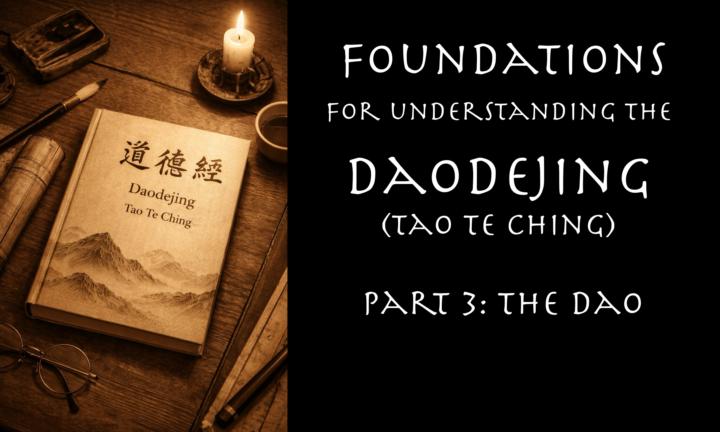
What is the Dao (Tao)?
In this upcoming Kinship Cafe, we’ll explore the concept of Dao. Learn about the underlying oneness of reality and the patterns that shape everything from nature to our daily lives. If you’ve ever felt like there’s a hidden coherence to life — something connecting it all — this conversation is for you. Join us this Friday or Sunday as we explore the hidden depths of reality. Links in the Calendar section.
1 like • 7d
Most people say ONENESS and mean either "there is no one out there" or "being one either with the universe or with God". But, in my opinion, before that, reaching an inner onenes is required. C. G. Jung called it "individualisation" and meant integrating the shadow, which is partly individual, partly collective. ' I like the approach of Ken Wilber saying that anything needs four perspectives to be understood. To put it in relation to Tao: in simplified words: 1. the inner psychological view, 2. the social-relational view 3. the actions 4. the values/priorities. Listening often to Tao Te Ching helps me to realize what matters (point 4) and helps me to try to get an inner consistency between values and actions (point 3). By now I couldn't find any reference to the healing of the heart, which is, in my opinion, required to reach the inner oneness.
1-9 of 9
@ligia-lutticken-6639
Wandering along the waves of life to feel the DAO. At the age of 70, it gets quiet and clear. Now am practicing to stay in my center AND to nourish.
Active 1d ago
Joined Apr 15, 2026