Activity
Mon
Wed
Fri
Sun
Jun
Jul
Aug
Sep
Oct
Nov
Dec
Jan
Feb
Mar
Apr
May
What is this?
Less
More
Memberships
Affinity Creatives
2.3k members • Free
H E F F · creative
120 members • Free
✍️ 1 Month Sculpt Challenge
281 members • Free
Learn Arabic | تعلّم العربيّة
726 members • Free
Master Realism Drawing (Free)
1.5k members • Free
Di-Maccio Art Academy
5.1k members • Free
2 contributions to H E F F · creative

9d •
Painting the Sunlight
G'day Legends. Just a quick video drop on how i paint the sunlight through the foliage. There's no right or wrong way this is just the way I did it on the day. Don't fall into the trap of knowing everything. Some days things will happen for you and another day things wont and you have to figure out a different way. But one thing's for certain, you won't learn anything if you don't try! Get a paintbrush in your hand and go for it. Heff.

1 like • 9d
I think properly placed highlights bring a certain magic to the picture.
0 likes • 8d
@Ben Heffernan Hello Ben. I know, from the perspective of a digital artist, that highlights can be layered as with most other things. As such, I take it that your Titanium white is a very bright white and is used in very small amounts and in areas where a very thin but bright line of light is required.
8d •
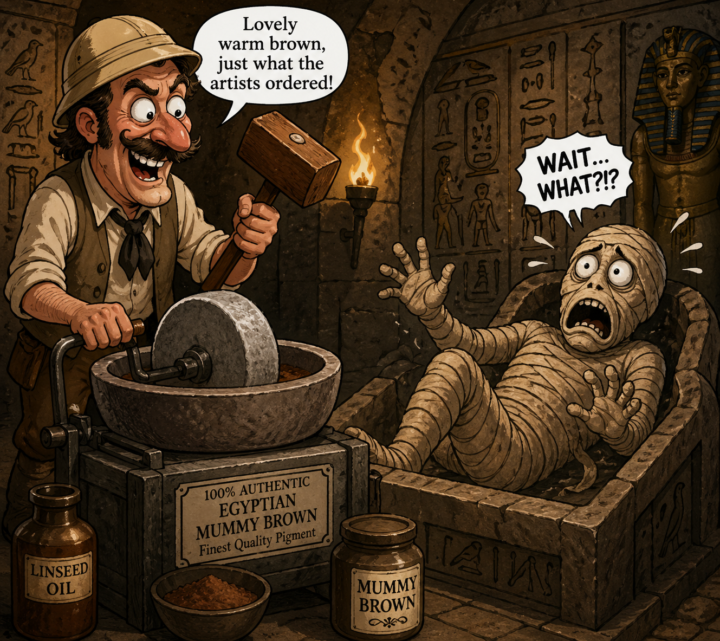
Does anyone know the story behind Mummy Brown?
🎨 Did Artists Really Paint With Mummies? As strange as it sounds… yes, they did. For hundreds of years, artists used a paint colour called Mummy Brown — a rich transparent brown pigment made partly from ground-up Egyptian mummies. Human remains, linen wrappings, and resin were crushed and mixed with oil to create a warm earthy colour loved by painters in the 1700s and 1800s. It became popular because it created beautiful shadows, glowing skin tones, and deep transparent layers that other browns struggled to match. Many respected artists used it, often without thinking too deeply about where it came from. The trade was fed by a growing European obsession with Ancient Egypt. As tombs were opened and artefacts shipped overseas, mummies became collectibles… and sadly, also raw material. Some were sold to museums, some to private buyers, and some ended up in pigment factories. One famous story tells of artist Edward Burne-Jones. When he discovered his tube of Mummy Brown was made from an actual person, he was horrified. He reportedly buried the paint tube in his garden out of respect. By the early 1900s, real Mummy Brown began disappearing. Supplies ran low, public attitudes changed, and people realised how disturbing the practice truly was. Paint makers eventually replaced it with synthetic versions using ordinary pigments. Today, when you see “Mummy Brown” sold in modern art ranges, it contains no mummy at all — only a colour recreation. So next time you squeeze out Burnt Umber or Raw Umber, be thankful. Some old paint history is better left in the tomb.
1 like • 8d
@Ben Heffernan, so, are Burnt Umber and Raw Umber the modern day replacements for Mummy Brown, or is there an equally horrifying story behind those names?
1-2 of 2

@kamal-ali-3731
A non-photographer photomanipulation and photo-composite hobbyist. Commonly known as Kamal Ali, and Big Daddy Zhandt
Active 7h ago
Joined Apr 9, 2026
South Carolina, USA