Activity
Mon
Wed
Fri
Sun
May
Jun
Jul
Aug
Sep
Oct
Nov
Dec
Jan
Feb
Mar
Apr
What is this?
Less
More
Owned by Jon
Claude Code tutorials, AI coding tips, Claude Code community, learn Claude Code, AI pair programming
Memberships
The SKOOL Directory
710 members • Free
Synthesizer: Free Skool Growth
41k members • Free
Skool Extensions 🧩
368 members • Free
Simcha Healthcare
43 members • Free
🔌 The Plug
12 members • $2/month
🎮 OnlyLANs Gaming Group
130 members • Free
Very Social Animal
3.7k members • Free
Chase AI Community
58.6k members • Free
Elevare
3 members • Free
63 contributions to The AI Advantage

Dec '25 •
Context Engineering
In reference to the AI world, we heard about Prompt Engineering, which of course it is important, because you need to know what questions/prompts to ask ChatGPT. This morning I read a post about something new (at least to me, the newbie) Context Engineering. Has anybody some thoughts to share about this? Many thanks!

3 likes • Dec '25
@Luther Tyson Thanks, I hop in this community here and there to drop some useful info to good questions and general help questions. I was new to AI and I know how most people start off trying to move at 1000 mph before they learned the small steps. For most of the questions Jon-OS answers, I am really just doing an extended version of "Asking ChatGPT". I built Jon-OS by asking questions of Claude Code and watching YT vids on Claude Code. It's sort of like robotic super intelligence, not quite but feels like it.
3 likes • Dec '25
@Iris Florea sorry, i didn't do the course. I took the time to learn on my own. Building the avatar is something core to you and cloning someone else isn't going to produce good results. Your avatar will grow as you learn more, trying to introduce noise from someone else's avatar may create issues later when the misalignment gets exponentially "off track". I hope that helps. If you find a starter template, use that. If you find the time to learn more ask your AI to teach you, it already knows how it works and you will learn a lot from those conversations as well as teach the ai model more about you and your own voice/personality/goals.

Dec '25 •
Migrating projects from Chat GPT to Google workspace
Hi everyone! I’m currently in the middle of a massive ecosystem shift: I’ve decided to move from my personal ChatGPT account to Google Workspace Gemini (with a business account). I exported my GPT history—a 60MB file of every conversation I’ve had over the last few years—and realized I didn't want to just move the "noise." I wanted to distill it. --> The Vision: From Data Dump to 10 Focused Workbooks in Notebook LM that keep track of the conversations as they were nested under projects in chatGPT. For reference the nature of the 10 projects is: 1. New Ventures: The startups and side-hustles I'm building 2. Personal strategies: e.g. investing 3. Thematic Knowledge: Deep-dive research bases --> The Underlying logic: moving that "clean" history inside 10 dedicated notebooks in NotebookLM, Instead of one giant chat history, would allow me to: - Generate instant mind maps and project refreshers. - Ask questions across only the context of that specific project. - Feed that curated knowledge into Google Gems to create specialized experts on those matters. Has anyone else gone through the process of "de-noising" their GPT history before a migration? I read that one possible approach would be to write and run a script on the .json file, but that goes beyond my technical capabilities, especially because I wouldn't know how to identify the right meta data that nest conversations under one project. Another option would be to download as PDF each conversation nested under the project. Half a day worth of work, so a possible last resort... but quite a defeating one on my path of trying to get smarter and more effective with AI 😅 I’d love to hear how you handled the data sorting and/or if you might have a smarter approach to offer.
1 like • Dec '25
great post! very thoughtful. have you tried pasting that into gemini or chatgpt or one of your custom gpts (i'm assuming you have built some)? i bet the .json process is easily understood by AI since that is a native format to an AI model. ask ai the questions and iterate over parts that need more explanation and make sure the goal is to automate or at least produce documented and detailed instructions with some safe guards like backups of the critical data on a disk somewhere.
0 likes • Dec '25
@Daniele Perotti i just tried pasting your post and the replies into chatgpt. here's what the results are, maybe they help: Really thoughtful problem framing — and after reading the replies, I think the key insight is this: **you’re not migrating data, you’re reconstructing intent.** A hard truth (as Emilie hinted): the ChatGPT export rarely contains reliable “project” metadata. So trying to *recover* nesting usually leads to frustration. What *does* work better is semantic classification. A practical middle ground I’ve seen work well: 1. **Split the JSON into individual conversations** (titles + full text). 2. Run them through AI in batches with a prompt like: *“Summarize this conversation into a capsule (goal, key insights, decisions, next actions) and assign 1–2 of these 10 project buckets + tags.”* 3. Store only the **capsules + links to raw transcripts**, not the full noise, inside NotebookLM. That gives you: * Project-scoped recall (what NotebookLM is great at) * Way less manual work than PDFs * A clean knowledge layer you can later feed into Gems Think of the raw chat history as an archive, and the capsules as your *operating system*. Once you accept that the past needs reinterpretation—not preservation—the process gets much lighter. Curious what you end up testing next — this is a problem a lot of serious AI users are quietly running into.

Dec '25 •
AI is Da Bomb! 💣💥
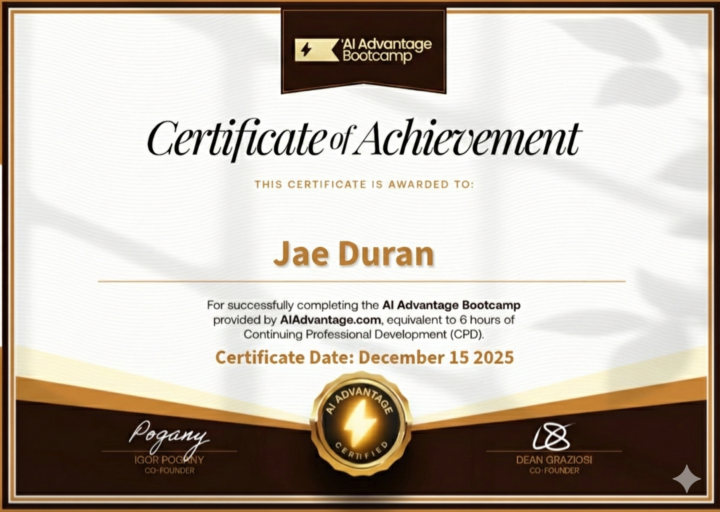
I ran into an issue with the certificate. The file was very blurry and essentially unreadable. My name also didn’t appear on the correct line and was pushed onto a second page. Rather than adding another ticket to an already busy support queue, I fixed it myself using Banano. If you’re having trouble getting a clean, professional-looking certificate, Banano is a solid solution. PS—ChatGPT was a little uptight and wouldn’t do it.
0 likes • Dec '25
so are you using a round about way of sharing how to make any certificate with anyones name? that could be entertaining to make humorous certs and putting like celeb names on them

Dec '25 •
If your competitor installed AI this month, where would they beat you first
Imagine your closest competitor installs AI properly, not just ChatGPT for captions. Where do they beat you first • Faster response to enquiries • Better follow up and higher close rate • Cleaner operations, fewer staff headaches • Better customer experience• Lower costs, higher margins Be honest, which one is the biggest threat for you Reply with one line. This will tell you exactly where to start.
0 likes • Dec '25
@Arbaz Riaz look at "monica"s profile info, all bot looking replies

2 likes • Dec '25
Perplexity is actually one of the easier AI tools to start with. Here's the quick rundown: What it is: An AI search engine that answers questions and cites its sources (so you can verify what it tells you). To get started: 1. Go to perplexity.ai and create a free account 2. Type a question in plain English like you're asking a friend 3. It'll give you an answer with numbered sources you can click to check Features worth trying early: - Follow-up questions - After it answers, ask clarifying questions in the same thread. It remembers context. - Focus modes - Click the "Focus" dropdown before searching. "Writing" helps with content, "Academic" pulls from research papers, "YouTube" searches video content. - Collections - Save related searches into folders to build a knowledge base on topics you're researching. Best uses: Research, fact-checking, getting up to speed on unfamiliar topics, finding sources for articles or projects. The free tier is solid for getting started. You'll figure out pretty quickly if you need Pro. (And sorry about the bot swarm in the replies - hopefully this actually helps!)
1-10 of 63

@jon-gerton-9814
https://www.skool.com/you-craft-ai-helps/about
Empowering developers to think like architects and grow like mentors
Growth is designed, not accidental
Active 33m ago
Joined Nov 6, 2025
The Last Frontier
Powered by