Activity
Mon
Wed
Fri
Sun
Oct
Nov
Dec
Jan
Feb
Mar
Apr
May
Jun
Jul
Aug
Sep
What is this?
Less
More
Fretboard Freedom
372 members • Free
Marc's Jazz Guitar Academy
159 members • $99/month
2062 contributions to Marc's Jazz Guitar Academy
21h •
Little trick
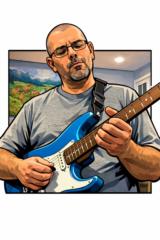
After talking with @Mentor Bob Kinney and @Nancy R about hidding the pick i tried to implement it... not so subbtle but it worked. I guess with work i could get better.

3 likes • 20h
You might try to walking around with a pick in your hand all day. Using it like one of those fidget things for nervous people. The objective is to get used to easily manipulating it in your hand.

28d •
Staple chord substitution question
As I haven't gotten to the very cool shells and voice leading lessons, I am trying to put together a staple chord version of Round Midnight. Marc has a harmonic analysis video for this tune which I have linked (in case your interested). Starting from that, I made my best guess at swapping in staple chords. I am attaching the Standards Navigator version and my attempt. I have left the F7b9 chord as it feels similar to the F9 (fingering-wise), but I think the b9 does sound better. I have played the melody over the top of the staple chord arrangement and I think it sounds okay. Any corrections or suggestions?
3 likes • 27d
Rick, not exactly sure I know what you mean by swapping in staples. Marc's staples are voicings (shapes) of a chord and you can not identify a staple voicing from any other voicing by looking at it's name. I'm general you can always subtract extensions/tensions from a chord and still remain true to the harmony, i.e., you could reduce any chord all the way to it's basic triad and it will work although it may not sound great it at least would not clash. You can also add extensions/tensions to any chord but when adding you need to more mindful of staying consistent with the melody, bass and what others might be playing. For example, it's usually safe to convert a dominant 7th to a 9th chord but this might not sound as good if the melody was relying on a flatted 9th. If the chords you selected sound good to you and fit the melody, go for it.
3 likes • 25d
Yes, I believe you've got it correct. Marc's staple chords are voicings that are good sounding and useful in many contexts. He's using staples to simplify the learning process. Instead of spending enormous amounts of time learning different "grips" he wants you to learn songs, and by using the staples the learning process will be more efficient. The staples are useful now and in the future but in the future you will begin expanding your "go to" voicings and create your own group of "staples".

Aug 3 •
Blue Bossa Live
Hi everyone- had a great time yesterday at our Summer Sounds festival here in Edmonds Washington, a village about 20 minutes north of Seattle. We are an art-focused community with lots of music and art festivals all summer long. My church, North Sound Church, sponsors one of the music venues - and I had the opportunity to participate and choose some tunes. So we played: Blue Bossa and Summertime. I also played and sang on Summer Breeze and Dance w Me (pop songs from the 70s). It was a good experience. The outdoor sound system was set up and run by a local audio engineer who does this for a living. It was a day long process. Anyway here is a iPhone recording of Blue Bossa. Since the sound check took 2 hours and the band played 16 tunes, we did not have a chance for a rehearsal- what you will hear is a cold start. What I learned: be prepared to be able to play without hearing your instrument. Even with in ear monitoring- the stage noise was deafening (my family said that you could hear the band from our house which is 1 km away from the venue)! I am the old guy to the far left of the screen. The lady playing the violin, since she was playing on some other tunes - decided to join. Kinda weird.. anyway - good experience and hope to have more! Thank you! https://youtu.be/kKafcc5ums8?is=49bBP-PNAZYbZ-Lk
3 likes • Aug 4
@Casey Childers well congrats anyway for great not heard or seen performance. 🤔. Just kidding. The group of you sounded good. Are you gonna post your solo songs?
3 likes • Aug 4
@Casey Childers yes I saw that one and it was great. I just wondered if you captured them in public performance
Jul 3 •
Help me to understand this cord and it’s function
Help me understand this cord and it's function Song: there will never be another you Place: in the C-section, bar 28 what: a minor 2 5 cell, Am7b5 - D7 Okay, in the key of Eb, I would normally see bar 28 as a secondary minor 2 5 leading naturally into the iii cord which would be G minor. But, it's A Head fake of sorts and leads not to the iii chord but instead resolves back to the tonic cord where it begins the long turnaround. I'm not too disturbed by this as I understand that the three cord and the tonic along with the iv are in the same functional group of "home" type chords so I can see how that works. The question: That Am7b5 chord is clearly there to produce a tension leading into the turnaround, but I'm not sure how to understand and think about this. This cord is built off the b5degree of the key and I am wondering, is this odd little 2 5, or b5 chord, some kind of common device in jazz that performs a particular function in songs? I know that in this case it produces the tension needed to start into the turnaround. It's classic tension - whenever I hear it I think of Dudley do right frantically untying Nell from the railroad tracks as the train approaches. Again, what is this harmonic device and how should I think about it?
2 likes • Jul 5
@Philip Halton I finally was able to look at the music and I don't think what I said is correct for this situation. It's like the composer wanted to "suspend" the harmony over the D dotted half note in that measure. Now that I see the melody I don't think I interpreted this correctly. Did Marc address it in your call yesterday? I'll be curious to hear his take on it .
2 likes • Jul 5
Thanks, you know it occured to me that its really just 2 5's except for one of them kind a hangs around an extra bar. It's like a suspended resolution or something. I don't think Modal Interchange has anything to do with it anymore. I think something similar occurs in Oleo. It's kind of like a rhythm changes sequence. No?


3 likes • Jun 13
I liked it too. If you turned the piano off I would have still heard the harmony so you were playing through it. Some nice use of quarter note triplets if I remember correctly. Good job
1-10 of 2,062

@james-rumora-4222
Retired. Played guitar in my teens/twenties then traded that for suit, tie, wife and kids. Finally getting back into the groove.
Active 4h ago
Joined Sep 26, 2023
Florida, USA
Powered by