Activity
Mon
Wed
Fri
Sun
Aug
Sep
Oct
Nov
Dec
Jan
Feb
Mar
Apr
May
Jun
Jul
What is this?
Less
More
Memberships
Fellowship of Mad Scientists
44 members • Free
78 contributions to Fellowship of Mad Scientists
2d •
Newly packaged LED lights:
LED FIlaments....COOL! https://www.facebook.com/reel/4275573509372277

1 like • 2d
Those are called COB LEDs. Chip On Board
2d •
Celominisignum
https://chatgpt.com/share/6a4d47e6-674c-83ea-b905-58951cfc04a2 What the heck? My BS meter is reading high.

24d •
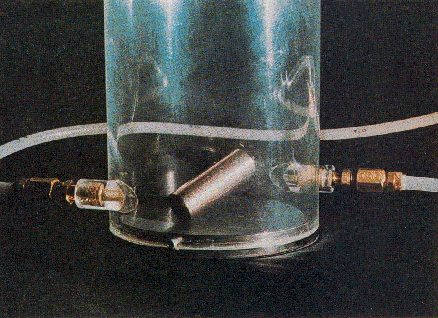
Why Does a Spinning Coin Speed Up Right Before It Dies?
Flick a coin and watch it wobble to its death — that rising clatter at the end isn't random. It's a physicist's puzzle hiding in plain sight: the coin is losing energy while its precession rate increases. But how? This piece digs (Delights of the "Wobbler," a Coin or a Cylinder That Precesses As It Spins) from pages of The Amateur Scientist into the surprisingly rich physics of wobbling objects — coins, bottles, cylinders — revealing a "forbidden zone" of inclination angles where steady precession simply cannot exist, determined entirely by an object's geometry. The ratio of a cylinder's half-length to its radius dictates everything: whether it dies lying flat, balanced on its edge, or something stranger. The real gem is Whitehead's apparatus — a polished concave Plexiglas chamber with precision air jets that can sustain a wobbling aluminum cylinder for three to four days, frozen in strobed slow-motion so you can watch both the spin and precession simultaneously. It's the kind of elegant, obsessive experimental apparatus only a true mad scientist builds. Simple enough to explore with a coin on your kitchen table. Deep enough to keep you up at night.
1 like • 23d
Sounds a bit like Euler's disk https://www.youtube.com/watch?v=psrqMZ9DQNk You can spin a dinner plate on a hard surface and press down on the center of the plate to get a similar sound.
Jun 8 •
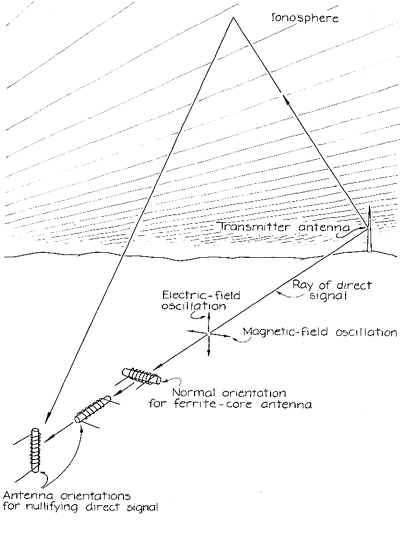
Billows in the Ionosphere Are Tracked with Transistor Radios
In the last few weeks, quite a few posts have appeared on this forum on exploring the inner workings of the Earth's ionosphere. Here's another addition for the ambitious mad scientist to consider. It comes from September 1980 issue of The Amateur Scientist, and it explains how one can inexpensively detect "gravity waves" as they roll through the upper-most reaches of the earth's atmosphere. (Note: The term "gravity wave" here refers to very long period pressure waves that use gravity as their restoring force, and NOT ripples in space-time that are created by collapsing stars.) This is a fun electronics product that could easily be improved these days using better op amps and current amplifiers than were available way back when I was still an undergraduate. Enjoy! PS: Apparently some of the images aren't displaying on the online link. So I've attached them all here until I can get them fixed on the server.
2 likes • Jun 9
The effects of the gravity waves can also be photographed. Our local astronomy club is host to a camera operated by SRI that records the emissions of oxygen at two wavelengths which makes the waves visible. MANGO Network These waves can be photographed by amateurs. See this video for an example. Airglow and Gravity Waves from Ridgway, CO [6/21/23] - YouTube
May 28 •
How can I, (a person) off load a huge email history, accumulation of archived emails in my computer, to a recently purchased large capacity hard drive?
I have to off load a huge accumulation of emails, including text letter, and images. I bought A new, empty, 320 GB hard drive with a USB connector.
1 like • Jun 4
Nowadays anything less than 1 Tb is a small drive.
1-10 of 78