Activity
Mon
Wed
Fri
Sun
Aug
Sep
Oct
Nov
Dec
Jan
Feb
Mar
Apr
May
Jun
Jul
What is this?
Less
More
Owned by Shawn
Mad Scientists Unite! Find community amongst the atom smashers and X-ray tubes. Over 1000 high-level STEM projects. Find your minions!
Memberships
Home Lab Explorers
1.5k members • Free
Community Launch
14.9k members • Free
Science Nerd 🤓 🧫🧬🔬⚗️🔭
148 members • Free
Diva Network
478 members • Free
Skoolers
166.2k members • Free
368 contributions to Fellowship of Mad Scientists

Apr '25 •
Welcome to the Fellowship of Mad Scientists
Welcome. Please complete the following tasks Download Skool • iPhone • Android Introduce yourself in the comments of this post: • Who are you? Tell us a little about yourself. • What are you hoping to get out of your membership? Then, check out the START HERE course in our Community Classroom.
1 like • Feb 9
Hey Randall, welcome. I hope you check out our weekly chats on Wednesdays, Noon Eastern. Many of our members are older folks who are looking for fellowship with like minded people. Most have deep expertise and love doing all sorts of interesting science projects on their own. We’re quite an eclectic group. I see you dm’ed me on another matter. Check your dm’s for me reply. Take care and tallyho!
0 likes • 6h
@Rick Cunningham — we are definitely nerdy enough to do that!

1d •
INTRO>>>
Hello, my name is Jerry, and I’m from North London. I wouldn’t describe myself as a science nerd, but I am deeply fascinated by how the human body works and how science and technology can help us better understand ourselves. I’m especially interested in the future of mental health, human development, and the possibility of creating tools that help people build greater self-awareness, resilience, and mastery over their own lives. I’m currently exploring several ideas that combine emerging technology with human wellbeing. They’re still in the experimental stage, but I’m passionate about turning these concepts into something that could make a meaningful difference. I’m always open to connecting with scientists, researchers, engineers, entrepreneurs, and curious minds who enjoy discussing bold ideas. If there’s an opportunity to collaborate, share knowledge, or help bring these visions closer to reality, I’d be delighted to connect and see where the conversation leads.
1 like • 13h
Hello and welcome Jerry! I'd love to learn more about what you're doing and find out how I and other mad scientists in this group might be able to support you. I have some experience in teaching resilience, grit, and growth mindsets to students, so I hope to be able to make a useful connection with you on your interests, through I suspect you've thought more about these topics that I have. I hope you can make it to the next LabChat (they happen every Wednesday at 2:00PM Eastern -- I think that's 7:00PM GMT) so I can meet you in person and introduce you to some of our most active members. I have family visiting all next week so my time will be quite limited for the immediate future. Take care!
13h •
Homemade Thermoacoustic Engines!
Yesterday we shared a video that showed talked about a Chinese innovation that created a highly efficient thermoacoustzic Sterling engines that could have applications in Space flight and beyond. Today I thought I share the secret of how you can make your own thermoacoustzic Sterling engine at home. It's actually quite simple! For those who want a serious application to generate your own energy, check out the second video below. Enjoy.
1
0
14h •
Shadows On the Bottom of a Swimming Pool are Very Strange Indeed
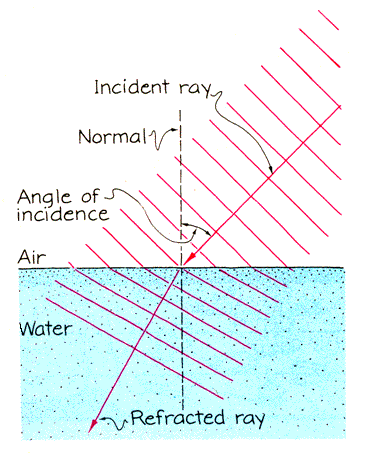
Underwater shadows shouldn't do this. A leaf floating flat on a pool casts a plain gray blob — until the water gets a bit deeper, and suddenly its shadow sprouts a glowing white rim, as if lit from below. Drag a hairbrush through your bathtub, pull it out, and dark rings with luminous edges keep swirling on the tub floor for minutes after — nothing is even there anymore. Poke a pencil into a basin at an angle and its shadow splits into two fat "sausages" with a bright gap between them, like the pencil is casting two shadows of itself. None of this is a trick of the eye. As detailed in this delightful article from The Amateur Scientist by the great Jearl Walker, it is refraction, and it is stalking you in ordinary bathwater. A floating razor blade dents the water surface just enough to bend light into razor-sharp focal lines called caustics — the same optics that paint the wavering bright net you see on a pool floor, or the ring inside a coffee cup on a sunny table. Depending on the water's depth to the millimeter, that blade's shadow can be smaller than the blade, bigger than the blade, ringed in light, or perfectly normal. A vortex left behind by your hand has a paraboloid core wrapped in a hyperboloid skirt, and the article works out — with a drinking straw, a stack of razor blades, and a sheet of paper you can raise and lower — exactly which rays are responsible for which bright line. The best part: every experiment described uses nothing but a bathtub, a razor blade, a pencil, a straw, and a lamp. It's a full afternoon of DIY physics that ends with you being able to predict, and then produce on command, effects that most people go a lifetime writing off as "weird stuff." If you've ever wondered why your own shadow in a pool looks a little off, this is the article that explains it — read it before your next bath.
1-10 of 368

@shawn-carlson-8472
Mad Scientist Extraordinaire, Physicist and Educator, Scientific American Columnist, Founder-Society for Amateur Scientists, MacArthur Fellow
Active 6h ago
Joined Mar 30, 2025