Activity
Mon
Wed
Fri
Sun
Jun
Jul
Aug
Sep
Oct
Nov
Dec
Jan
Feb
Mar
Apr
May
What is this?
Less
More
Owned by Isabelle
Tired of guessing your wine tasting notes? Learn about wine through sensory practice. No rote memorization. Just your palate, finally trained. 🥂
Memberships
The Growth Squad
6 members • $5,000
Next Level Growth Hub
338 members • Free
Pinterest Marketing
423 members • Free
Social Selling with Sam
836 members • Free
The Content Revenue Lab
943 members • Free
Grow With Evelyn
2.8k members • $33/month
the skool CLASSIFIEDS
1.8k members • Free
Skoolers
186k members • Free
Community Lab
629 members • Free
11 contributions to The Authority Engine

🔥
29d •
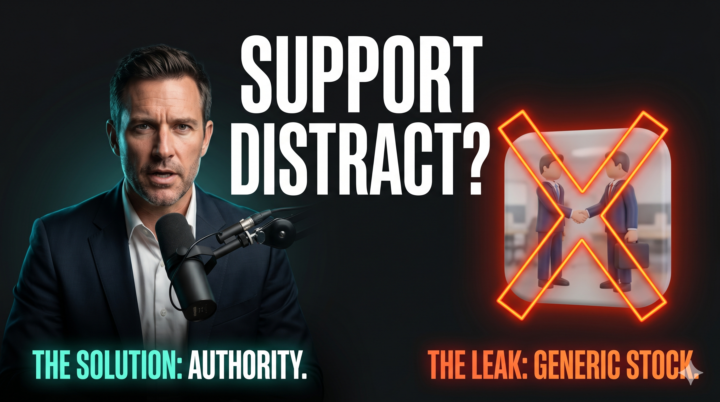
When B-Roll Hurts Your Authority (And When It Doesn't)
B-roll is one of those things coaches and consultants overthink before they've even filmed a single video. Here's the honest answer on when it earns its place - and when it doesn't. **Add B-roll when:** The point you're making is abstract. If you're explaining a concept that lives in someone's head - a sales cycle, a lead generation gap, a methodology - a visual cuts through faster than words alone. You've just delivered a big insight. Attention dips after a value peak. A cut to something visual buys the viewer a beat before the next point lands. It's a re-engagement tool, not decoration. The section is running long. If you're 90 seconds into a single talking-head sequence, B-roll breaks the fatigue before the viewer decides to leave. **Skip B-roll when:** You're making a direct, personal point. If the credibility of the statement comes from you saying it - a client result, a diagnostic observation, a direct challenge - cutting away undermines it. Stay on camera. You don't have footage that matches. Generic stock imagery is worse than no B-roll at all. A consultant explaining lead generation over footage of people shaking hands in an office is a positioning leak. If the visual doesn't match the argument, leave it out. You're still early in production. Getting the script, the delivery, and the hook right matters more than covering every cut. Build the asset first. Refine the production second.

🔥
3 likes • 28d
Great advice, thank you.
🔥
Mar 30 •
The Moment I've Been Building Towards
Some moments you feel before you can name them. This is one of them. I've just been accepted to speak at two events, one online at the end of May, one offline in June. For most people, that's a diary entry. For me, it's the moment everything I've been building towards becomes real. Let me give you some context. In June 2025, I walked away from a job. Not because I had it all figured out. Because I knew, at a level I couldn't argue myself out of, that I was supposed to build something. Something that mattered. Something that lasted. By November 2025, I went full-time. No salary. No safety net. Just the work, the system, and the belief that if I built the right infrastructure, the right people would find it. And they have. But here's the thing I've been wrestling with quietly. An online-only business built on third-party platforms is, if we're honest about it, shaky ground. You don't own the audience. You don't own the reach. You don't own the relationship. You rent it from YouTube, from Skool, from LinkedIn, and the landlord can change the terms any time they want. I decided a while ago that wasn't enough. So I made a decision. Not just to build online authority, but to take it offline. To stand in rooms. To be present in a way that no algorithm can replicate and no platform can take away. That decision has led us here. One online event. One stage. Then rooms with real people in June. I want to be honest with you, I'm nervous. I have never spoken to a crowd before. Not once. I've looked down a lens hundreds of times. I've delivered to cameras, to recordings, to screens. But standing in front of people who are physically in the same room as me, that's new territory. Part of me is telling myself it's the same thing. Just live. Just in person. The other part of me knows it isn't, and that's exactly why it matters. The research backs up what I already felt intuitively. In-person presence compresses trust in ways that content alone cannot. One meeting delivers the impact of three virtual interactions. Event-sourced leads convert at higher rates, with larger deal sizes and shorter sales cycles. And being selected for a stage by an event organiser who has vetted you carries a third-party authority signal that no amount of self-published content can manufacture.

🔥
1 like • Mar 30
Congratulations! Part of the scientist journey is to present your research at peer conferences. So yeah, I have spoken to crowds before, but it's always nerve-wracking. My insight: After you pass the first minute of your presentation, if you know your stuff, you would be fine.
🔥
1 like • Mar 30
@Des Dreckett I spoke to my sensory peers, including academics and industry practitioners, and wine industry technical staff and executives. These were not TED Talk style; more behind a lectern with PowerPoint slides. So I could hold on to something if my nerves were getting at me 🤣
🔥
Mar 23 •
Quick question for the community - and I want your real answer.
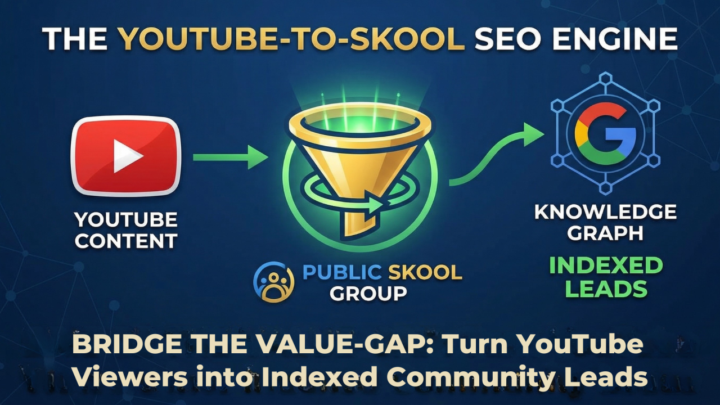
When someone watches one of your YouTube videos and finds it useful, where do they actually go next? Not where you hope they go. Where do they actually go? For most coaches and consultants I speak to, the answer is: nowhere. They watch, they nod, and they disappear back into the feed. The content does its job, and then the lead evaporates. I've been working through why this happens structurally (not just "better CTAs") and wrote up the full breakdown in a LinkedIn article last week. The short version: the problem usually isn't the content — it's the architecture sitting behind the content. There's no indexed destination waiting for them. There's no specific reason to arrive anywhere. I'd love to know where your setup currently breaks down: Drop your answer below. If you want the full article context before you vote, it's linked in the first comment.
Poll
1 member has voted
🔥
1 like • Mar 23
I hadn't realized this community is public. Good to know. In your LinkedIn article, @Des Dreckett you wrote "The approach that works is making specific discussion threads public - the ones that match your YouTube content topics - while keeping coaching-specific and premium content behind the membership." How do you make specific discussions public? I'm not sure I understand.
🔥
Mar 18 •
How I Turn One YouTube Video Into Three Weeks of LinkedIn Content (Without Recording Anything New)
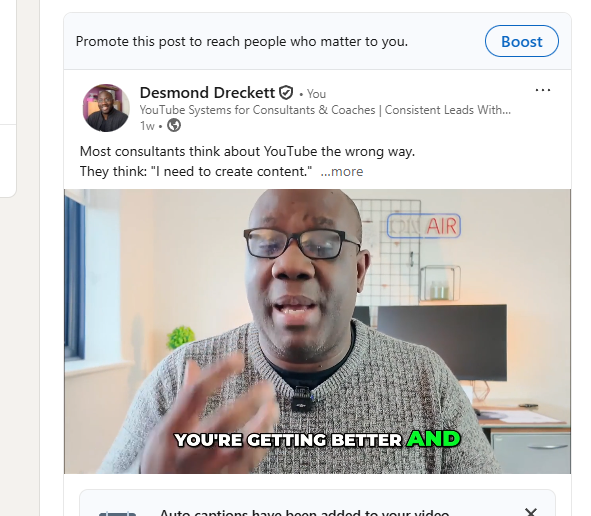
Most coaches and consultants treat their content as single-use. One video. One platform. Move on. That's not a system. That's a treadmill. Here's how I get two complete bites from the same piece of content, without recording a single extra second of footage. Step 1: Record and publish the long-form video on YouTube. This is the asset. The permanent parcel of digital real estate that earns search traffic while you sleep. Everything else flows from this. Step 2: Run the video through OpusClip. OpusClip analyses the full video and extracts the highest-value moments automatically — punchy standalone clips, already captioned, already formatted for short-form. What used to take hours of manual editing takes minutes. (I use the affiliate link here for full transparency - it's the tool in my actual workflow: https://tinyurl.com/TryOpusClip) Step 3: Take those clips straight to LinkedIn. The clips don't just live on YouTube Shorts. They go directly onto LinkedIn as native video posts. Same clip, different audience, different discovery channel. Step 4: Open the transcript from OpusClip. Every clip comes with a timestamped transcript. That transcript is your LinkedIn post — already written. Pull the core insight, restructure it as a text post, and you have a second piece of content from the same 90 seconds of footage. Step 5: Post the video clip and the written post separately, not at the same time. Two posts. Two moments of visibility. Two chances to reach coaches and consultants who engage differently — some stop for video, some stop for text. Here's an example link - Most consultants think about YouTube the wrong way. That's one YouTube video generating: → A permanent YouTube asset building long-term search authority → Short-form clips distributed across YouTube Shorts and LinkedIn → Written LinkedIn posts from the transcript — with zero additional writing
🔥
4 likes • Mar 18
I also create a LinkedIn article based on my video as another way to drive traffic.
🔥
Mar 13 •
Big news to share
I've got a meeting next week with one of the UK's largest events companies - and if it goes well, I'll be speaking at business events around the country. First time I've pursued this. Nervous and excited in equal measure. The reason I'm doing it: you don't own YouTube, LinkedIn, or Skool. Any platform can remove you without notice. Speaking is one of the few channels you actually control. Will report back after the call next week. Anyone else taken their online business offline? What worked?
🔥
3 likes • Mar 13
Yes, that's something I consider. Best of luck.
🔥
2 likes • Mar 13
@Dr. Severine Bryan Now, you’re talking!
1-10 of 11

🔥
@isabelle-lesschaeve-6005
Sensory scientist turned tasting coach, I help wine lovers hone their tasting skills with proven frameworks + training. Stop guessing, start sensing!
Active 4h ago
Joined Feb 23, 2026
Atlanta, GA