Activity
Mon
Wed
Fri
Sun
Nov
Dec
Jan
Feb
Mar
Apr
May
Jun
Jul
Aug
Sep
Oct
What is this?
Less
More
WillpowerLab
22
Free
8 contributions to WillpowerLab

Jan 13 •
🤯 knowledge pill #3
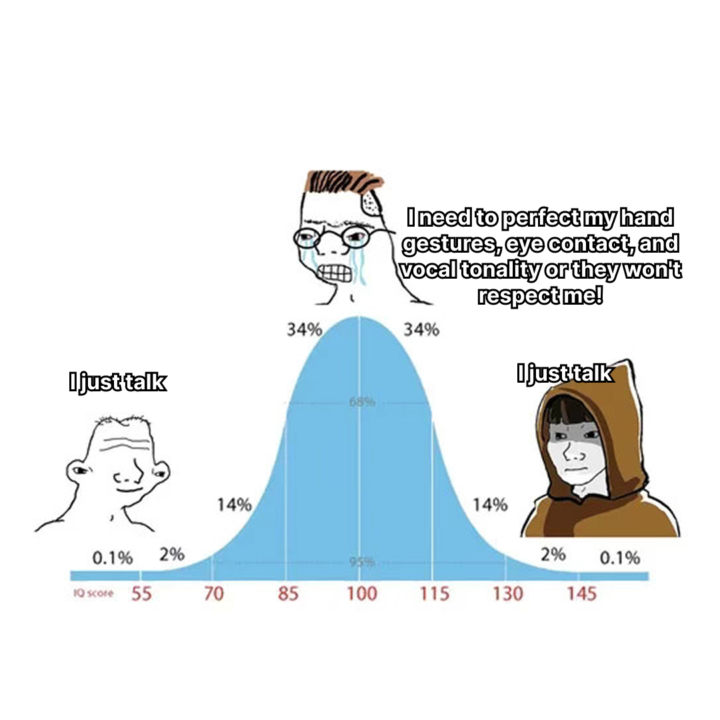
You should be concerned if people get what you say, if they understand your message and the value it brings; you should not by any means be obsessed with how you do it, because this is more yours than theirs. (Aristotle, 2007; Lucas, 2019; Savitsky & Gilovich, 2003). The merit must be there, be obsessed about the merit; let loose on how you will deliver it. You know the saying about eccentrics: “Yeah, he’s a bit weird, but he’s a genius”? Exactly, when you are really excelling at something, no one really cares if you sneeze during the speech, turn red or even green, because you delivered the value (Gilovich, Medvec, & Savitsky, 2000). Obsession over the merit. Chill over the delivery. People who have little to say sometimes try to compensate with the way they say it, and they become obsessed with their look, etc. (Lucas, 2019). *I expect some fierce debate in the comments! hahaha References Aristotle. (2007). On rhetoric: A theory of civic discourse (G. A. Kennedy, Trans., 2nd ed.). Oxford University Press. (Original work published ca. 4th century BCE) Gilovich, T., Medvec, V. H., & Savitsky, K. (2000). The spotlight effect in social judgment: An egocentric bias in estimates of the salience of one's own actions and appearance. Journal of Personality and Social Psychology, 78(2), 211–222. https://doi.org/10.1037/0022-3514.78.2.211 Lucas, S. E. (2019). The art of public speaking (13th ed.). McGraw-Hill Education. Savitsky, K., & Gilovich, T. (2003). The illusion of transparency and the alleviation of speech anxiety. Journal of Experimental Social Psychology, 39(6), 618–625. https://doi.org/10.1016/S0022-1031(03)00056-8

1 like • Aug 16
@Artur Willoński Soo that authenticity workshop finallyy took place today 🙌😎 Didn’t get through half of the presentation due to amazing discussions, messed up the recording and ended up deep diving into communication psychology for +5 additional hours by request. But a bunch of super inspired happy people and (literally) one person’s changed life trajectory later my heart is exploding from all the love and gratitude. It’s magic 😆✨ Two more groups to go
1 like • Aug 19
@Artur Willoński thank you! 😊 yeah, totally agree. It really is the absolute best and endlessly fascinating part about it ✨ I’m happy to share more if you have any specific questions? I totally messed up the recording unfortunately. So it’s nonexistent :D Sometime next week I’ll be doing the workshop again (but v2) with another group of people and have high hopes to have it successfully recorded then🤞😅
Jan 16 •
🤯 knowledge pill #4
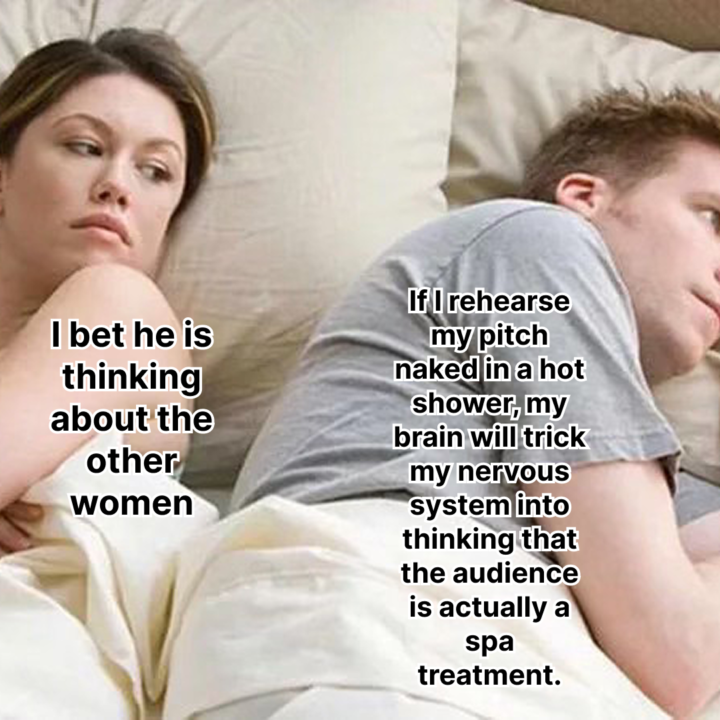
Yesterday I had this killer pres on public speaking at the Venture Cafe meeting in Warsaw, and wanted to share with you the 2 things that people particularly liked on the topic of stress management: - counter-conditioning – imagine super high stakes and mitigate the stress with full-body relaxation (e.g., a hot shower). Rehearse in the shower and condition your body to feel relaxed while rehearsing under “real” stress in front of the imagined audience. Thanks to that, when you actually present, your body remembers that even under stress it can relax. - bodily activation – we already do it here with some people, but this topic is broader than I initially thought. The science says that the more introverted you are, the less bodily activation you need to release stress. But during yesterday’s presentation I tested a super introverted-looking guy with mild activation, power activation, and super intense activation (photos soon), and he was getting less and less stressed each time - so, kind of the opposite of what the science says. - Would be awesome to hear how it works for you: do you see any patterns? Does it actually relieve your stress or not? References: Barlow, D. H. (2002). Anxiety and its disorders: The nature and treatment of anxiety and panic (2nd ed.). Guilford Press. Craske, M. G., Treanor, M., Conway, C. C., Zbozinek, T., & Vervliet, B. (2014). An inhibitory learning approach. Behaviour Research and Therapy, 58, 10–23. Deacon, B. J., Kemp, J. J., Dixon, L. J., Sy, J. T., Farrell, N. R., & Zhang, A. R. (2013). Maximizing the efficacy of interoceptive exposure by optimizing learning and dose. Behaviour Research and Therapy, 51(11), 742–750. Bodie, G. D. (2010). A racing heart, rattling knees, and ruminative thoughts: Defining, explaining, and treating public speaking anxiety. Communication Education, 59(1), 70–105.
0 likes • Jan 23
“The science says that the more introverted you are, the less bodily activation you need to release stress.” that’s interesting! And makes so much sense now. I’m an ambivert myself but predominantly introverted and I always wondered how come I mostly don’t really get the benefit of bodily activation (it can even make me feel too agitated) and usually don’t need it as well. Though, I find it depends on the stress level and biology in general. Personally, I’m always thinking of the stress responses fight, flight, freeze, fawn and imagine them as four quadrants which we can move along clockwise with an increasing stress level (fight top left, flight top right, freeze bottom right, fawn bottom left). I check in with myself where I am at and depending on that I can tell if I need bodily activation (freeze or fawn) or if would be counterproductive (fight or flight). If I’m in none of them then I don’t need it as well because I’m moderately nervous and probably even more excited. I’m not sure I got it from any literature, it could be just my own theory I developed from observing my dogs and applied it to myself (I’m a licensed animal psychologist just for fun and as mammals humans and dogs share basic biological and psychological mechanisms, so it made sense to me). But for me it works perfectly ever since, no matter the source :D Baseline blood-pressure also plays a huge role and makes a difference, as I discovered for myself. Genetically I’ve got very low blood pressure and despite being introverted or not, if I don’t move enough overall my body behaves like a lizard (cold-blooded) and I need to put in tons of effort into activating it - even more so to function in a stress situation. I generally have to workout and just move a lot to raise my baseline blood pressure and for it to match my energy levels which solves any trouble for me. But if I wouldn’t, then it’s a whole different obstacle to tackle before any presentation etc.
Jan 2 •
🌟Mastering FLOW in Public Speaking
This video came out to be quite a yap guys😂, but I post it as there’s still value to be extracted It also “counters” what Artur talks about in his most recent video, by brainwashing yourself in the present moment into thinking you are the best at speaking, which is the only beneficial mindset for performing. Doesn’t really matter how far from truth that is as long as it gets the job done, which is to get you talking. The reality is always going to kick in afterwards as it’s necessary for us to watch it back, observe, analyze and target what we have to change or improve, and what is our strength that has to be doubled down on. We do not see our minor improvements, because we get caught up in our own heads & daily life. It doesn’t mean progress it’s not there. It certainly is as long as we keep showing up. At one point it all sticks and all of a sudden you become fabulous at speaking “over night”. Let’s get it!

0 likes • Jan 9
@Olaf Wojnecki if you want to go super duper pro level with the affirmations try to record yourself speaking them and then play it while you sleep 😅 It’s supposed to be the ultimate upgrade. I haven’t read any actual science on that, I think it’s more a practice from the spiritual space. But all I know is that I don’t know. Don’t miss out on the potential, just in case :D
Jan 8 •
🤯 knowledge pill #2
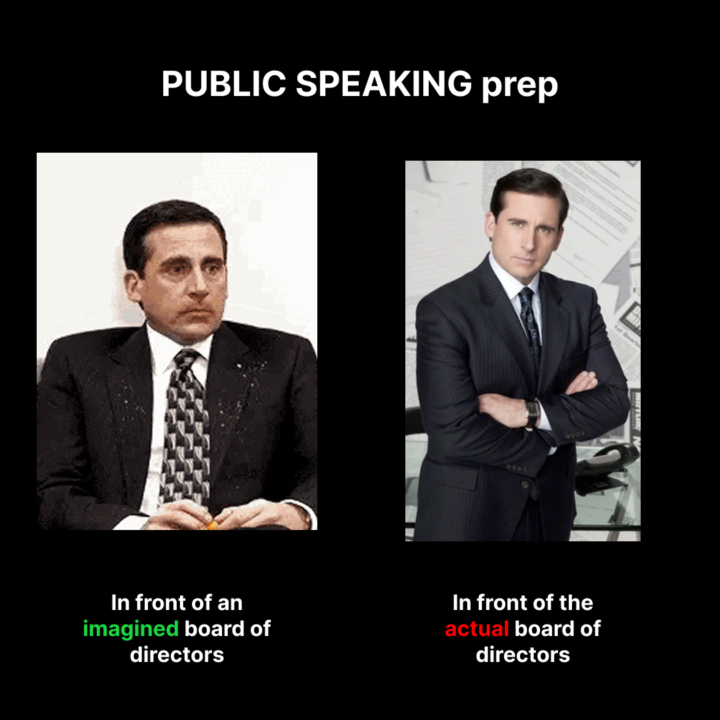
The High-Pressure / Low-Pressure Switch Here’s a powerful mental switch for public speaking. It’s a two-step process: one for practice, one for performance. Step 1: Practice Under High Pressure When you rehearse, imagine you are speaking to the highest-stake person you can think of: a major investor, your boss's boss, or a dream client. The goal is to get your mind and body accustomed to that feeling of pressure in a safe environment. Step 2: Perform Under Low Pressure When it's time for the real speech (or when you're recording your homework on camera), flip the script completely. Imagine you are talking to just one person - someone you like and feel comfortable with. Treat it as a conversation, not a performance. Why This Mental Switch Works This technique is a form of cognitive reframing, and it's backed by solid neuroscience. When you shift how you interpret a situation (from "scary performance" to "friendly chat"), you engage a part of your brain called the medial prefrontal cortex (mPFC). This area is key for self-awareness and social thinking. Activating the mPFC helps to calm down the amygdala, which is your brain's threat-detection center (Buhle et al., 2014; Denny et al., 2012). The good news is that studies also show that reappraising performance anxiety as excitement or meaningful engagement does not only make you feel better - it actually improves your performance (Brooks, 2014). Try This For Your Next Homework: 1. Practice as if the stakes are huge. 2. Talk to the camera as if you’re talking to one friendly person. Let us know how it feels! References Brooks, A. W. (2014). Get excited: Reappraising pre-performance anxiety as excitement. Journal of Experimental Psychology: General, 143(3), 1144–1158. Buhle, J. T., Silvers, J. A., Wager, T. D., Lopez, R., Onyemekwu, C., Kober, H., & Ochsner, K. N. (2014). Cognitive reappraisal of emotion: A meta-analysis of human neuroimaging studies. Cerebral Cortex, 24(11), 2981–2990.
1 like • Jan 9
I’ve been recording some videos talking to my future self about all kinds of stuff and it feels insanely comfortable in front of the camera. Huuge difference 🔥 and now the camera doesn’t feel awkward much anymore 😎
Jan 6 •
🤯 knowledge pill #1
Crack a joke at the opening… One way to do that and win over the audience right from the start is to expose a stereotype, even if it means being a little goofy about it. This is effective because it releases dopamine and immediately takes the pressure off of you. Laughter and humor trigger the release of "feel-good" chemicals like dopamine and endorphins (Dunbar et al., 2011; Mobbs et al., 2003), which boosts your mood and helps to lower levels of stress hormones like cortisol (Berk et al., 1989). If you can crack a stereotype about your domain at the very beginning, people will be interested and surprised because it’s not what they expected. And that’s exactly what you want! This sends a signal to your brain: if you can be a little teasing with people, the space is safe. You can relax and, therefore, perform better. Research shows that an appropriate level of dopamine in the brain improves cognitive performance, including memory and attention (Cools & D’Esposito, 2011; Nieoullon, 2002). It’s all about setting the tone for the audience, putting you in charge. It always works because you have the mic, and they don’t. They can only listen, and you are the star! If a heckler says something (or writes a comment), you can either deliver a witty comeback or simply ignore them and move on, because you are the main character in that moment. I am sure you can think of some stereotypes in your own domains that you can crack while talking to people in a funny way. P.S. I hope one day I will learn that Skool wants my videos to be horizontal! 🙁 References: Berk, L. S., Tan, S. A., Fry, W. F., Napier, B. J., Lee, J. W., Hubbard, R. W., Lewis, J. E., & Eby, W. C. (1989). Neuroendocrine and stress hormone changes during mirthful laughter. The American Journal of the Medical Sciences, 298(6), 390–396. Cools, R., & D’Esposito, M. (2011). Inverted-U-shaped dopamine actions on human working memory and cognitive control. Biological Psychiatry, 69(12), e113–e125. https://doi.org/10.1016/j.biopsych.2011.03.028
Poll
1 member has voted

0 likes • Jan 9
[attachment]
1-8 of 8