Activity
Mon
Wed
Fri
Sun
Jun
Jul
Aug
Sep
Oct
Nov
Dec
Jan
Feb
Mar
Apr
What is this?
Less
More
Memberships
Research Career Club
661 members • Free
30 contributions to Research Career Club

21d •
Publishing is slow. Visibility doesn’t have to be.
You don’t need a full content strategy or perfect branding to start sharing your research. You just need one clear message, one simple post, and the courage to hit “publish” even if it feels imperfect. Today, pick ONE recent output (paper, slide, figure, or review comment) and turn it into a 3‑line post: 1. What problem you tackled 2. One practical insight 3. Who this matters for (and why) Then share it on LinkedIn, ResearchGate or here in the community. You’re not “self‑promoting” — you’re making your work easier to find for the people who need it. What’s the one insight you could turn into a 3‑line post today? Drop your answer below 👇 Talk soon, Dawid P.S. If you want, paste your 3‑line draft in the comments and I’ll give you feedback.

1 like • 18d
I should turn my comment under this LinkedIn post into a post: https://www.linkedin.com/posts/eliot-higgins-955822216_when-satellite-imagery-goes-dark-new-tool-activity-7447300235669852161-ZcSX Blog Post: https://www.bellingcat.com/resources/2026/04/07/tool-damage-assessment-destruction-sentinel-satellite-imagery-iran-us-gulf/ Summary: The Bellingcat article introduces the Iran Conflict Damage Proxy Map, a new open-source tool developed by Ollie Ballinger to estimate building destruction across Iran and the wider Gulf region amidst ongoing conflict and internet blackouts. As commercial satellite providers like Planet Labs and Maxar increasingly restrict or delay high-resolution imagery in the Middle East to prevent its use for "Battle Damage Assessment," this tool utilizes publicly available, medium-resolution Sentinel-1 radar data to fill the information gap. Unlike optical imagery, which can be obscured by clouds or intentional blackouts, the radar-based approach detects physical changes in structures by comparing pre- and post-event satellite passes, providing a vital resource for journalists and researchers to verify the scale of military impacts in areas where on-the-ground reporting is restricted. **My comment**: Sentinel-1 is an excellent platform for this use case; the blast impact sites are (regrettable) quite large, so even after a 5-day revisit and clean up, the scars can still be seen. Unfortunately, this also highlights the primary shortcoming: while it can make observations under almost any atmospheric condition, the weekly frequency is a real limitation for real-time monitoring and on the ground humanitarian support.
0 likes • 17d
Hi @Dawid Hanak, I reread your post and realised I overlooked the 'problem I tackled' part. To be honest, I haven't fully solved this yet, but I'm working on it! My comment reflects a challenge I’m currently facing with the Common Space group. We’re addressing these exact gaps, but since our solution isn't operational yet, the team isn't quite ready to share the research or methods. Do you think there’s value in sharing the 'problem' stage before the 'solution' is complete, or is it better to wait until we have concrete results?
Mar 23 •
Feedback on reproducible TESSERA pipeline & observations on embedding stability thresholds
Hello Community, I am seeking feedback on the documentation and workflow implementation for the TESSERA Earth Observation Foundation Model (Cambridge, 2025). The project focuses on a reproducible Master-Worker architecture designed for resource-constrained environments (Google Colab/L4 GPUs). By applying this to a West African study site (2020–2025), I conducted an ablation-style experiment on cloud-cover thresholds. Key Finding: I observed a clear 'information ceiling' where increasing scene counts beyond a specific threshold yielded diminishing returns in improving the results. Specifically, while a strict 20% filter resulted in structural breakdown due to low scene counts, a 35% threshold achieved multi-year convergence across the 128-dimensional embeddings. I have two questions for the group: 1. Technical Review: Does the attached README clearly communicate the trade-offs between compute-heavy inference and the 'Model-as-Data' approach for independent researchers? 2. Publication Path: I am considering expanding this into a formal technical note or "Methods" paper. Given the focus on reproducibility and empirical threshold selection, which journals or open-access platforms would be most appropriate for this type of workflow validation?" Link to the draft text: https://docs.google.com/document/d/1NRdiIPcUkB8OkaEgH1cUzAbm1rQfCVVl/edit?usp=sharing&ouid=110263593530693269745&rtpof=true&sd=true
1 like • Mar 23
@Dawid Hanak - there might have been a better thread to drop this.
0 likes • Mar 26
The post is "live" https://www.linkedin.com/posts/gvddool_earthobservation-remotesensing-machinelearning-activity-7442591207559462912-bZXM
Mar 16 •
Regardless how busy you are, make time to rest
I’m spending some time in my home town this week. I haven’t travelled here for a while so decided to make the most of it. This morning sat, I down on the bench near the main square and did nothing for a good 30-40 mins. I don’t remember when was the last time I did something like this. We’re always chasing something - papers, projects, deadlines. But we’re sacrificing our health and wellbeing. I’m here to tell you that it’s fine to take time off. The world isn’t going to end!
2 likes • Mar 16
@Dawid Hanak - That was perhaps the only good thing about the lockdowns: being forced to do nothing or being limited in what you could do! I’m still baking my own bread (when I’m in a larger kitchen) as a result, and there’s nothing better than spending 30 minutes doing something completely different, away from the screen!
1 like • Mar 16
@Dawid Hanak - Whether you have a bread maker or not, there's nothing quite like home-baked bread! We don't have one, but I found an amazing recipe that's almost the same as having one: it uses warm and cold fermentations, making it super easy — you just pop it in the oven in the morning, and enjoy fresh bread for breakfast or lunch ;-) Hope "doing nothing" will become popular - yesterday I saw a short video on LinkedIn about a lizard, and the OP said the same - he watched the creature doing its thing for 30 minutes, nothing more.
Mar 4 •
Ethical use of AI + GPTZero
Good news this week - I have just been invited to join the GPTZero ambassador programme and will be running a professional development session on ethical use of AI. Would you be interested in attending? P.S. GPTZero is one of the tools that we use to identify if text was created by AI or human - it's pretty advanced to the extent it can track which elements of the document were pasted and which were written.
Poll
25 members have voted
0 likes • Mar 7
Interested in following the discussion, AI and Ethics is an important topic, and not widely, or often enough, discussed
1 like • Mar 7
On a related topic - the following dropped in my inbox: Humanity in the AI Era” Webinar – 18 March 2026 The current era of rapid AI evolution presents both promising benefits and complex risks. Global conversations increasingly recognize ethics as an essential foundation for successful AI adoption, affirming a humanity-centered approach for collective betterment. This talk explores what this means in practice, reflecting on the broader implications of responsible AI, how technological trajectories can shape societies in materially different ways, and how these ideas connect to widely shared global goals, drawing on some recent examples. Participants will also be encouraged to think through some forward-looking action steps that could help individuals and institutions to better adopt AI responsibly and harness the opportunities this moment presents. The discussion is structured to be accessible for participants across digital literacy levels. * This event will be recorded https://zoom.us/webinar/register/WN_rDoI3qaeTXmggYFpY-uMJQ#/registration
Feb 17 •
LinkedIn newsletters for academic dissemination?
If your research lives only in journal PDFs… you’re leaving impact on the table. A LinkedIn newsletter turns your expertise into a series people can subscribe to (and actually get notified about). Because when someone subscribes, LinkedIn can show them updates in-feed, and, depending on their settings, send notifications and an email when you publish. And importantly: anyone can discover, read, and share your newsletter, while members can subscribe. It works well for me. Here’s the play: 1. Pick ONE “research theme” Not your whole department. One theme you can own for 6–12 months. Example: "Decarbonisation by Prof Hanak”. 2. Turn papers into episodes Each issue = one idea. The goal isn’t to impress reviewers. It’s to help smart non-specialists apply your thinking. 3. Use the 3-line promise Hook (one line). What they’ll learn (one line). Who it’s for (one line). (Then earn the click.) 4. Write like a human Start with the problem you’re solving. Then the insight. Then the “so what”. Add the citation/link at the end for those who want the full method. 5. Make it scannable Short lines. White space. Simple headings. Your newsletter is read by busy people between meetings (and on phones). 6. Close with an invitation End with a question, or a P.S. that tells people what to do next. Example: “P.S. Want the template I use to turn a paper into a newsletter issue?” Keep a publishing rhythm you can sustain Monthly is better than weekly-that-dies-in-3-weeks. Consistency builds trust (and subscribers). If you’re an academic: what would your newsletter be called—and what’s issue number 1?
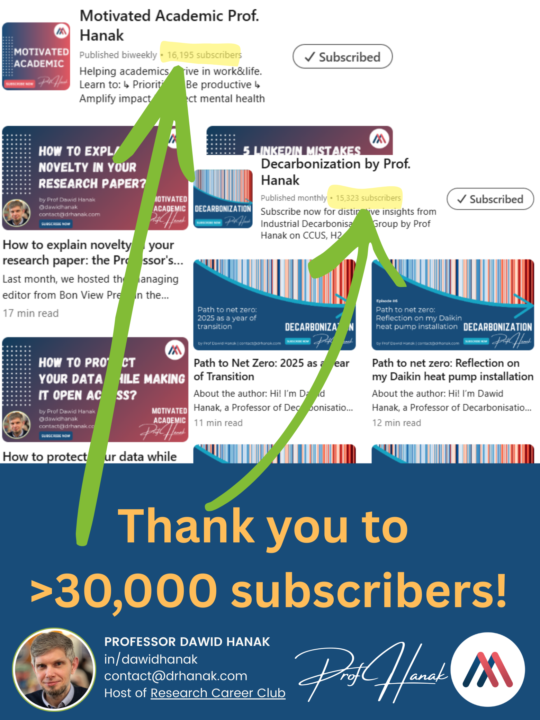
2 likes • Feb 17
It's true that consistency helps build trust and attract subscribers, but sticking to a schedule can be hard. Aiming for a weekly or bi-weekly routine over the 6-12 months might be doable. However, for me, the hardest part is finding topics I care about enough to set aside time to write 1000-5000 words each time.
1 like • Feb 18
@Dawid Hanak - every month (or so) is a nice cadence. It leaves enough time between issues to do a proper deep dive. Some of the more frequent newsletters I see on LinkedIn are either summary-style collections of articles that don’t add much insight beyond what’s already in the links, or quickly generated AI slop aimed at clickbait and self-promotion.
1-10 of 30
@gijs-van-den-dool-3402
Senior Geospatial Data Scientist / Independent Researcher / [Natural] Catastrophe Modelling / (GIScience) Specialist
Active 14d ago
Joined Nov 3, 2025
Paris, France