Activity
Mon
Wed
Fri
Sun
Jul
Aug
Sep
Oct
Nov
Dec
Jan
Feb
Mar
Apr
May
Jun
What is this?
Less
More
Memberships
The Detection Dog Lab
800 members • Free
Dog Training Community
915 members • Free
199 contributions to Dog Training Community

8d •
Shutting Down This Group
Hey Gang, This group was really damn epic at times. A lot of us made new friends I know that for sure. I really enjoyed some of the moments we had here. However as I'm sure you can tell I am not spending much time here and as a result the community has slowly began to fade away understandably. I know there will come a day where I do more online stuff but right now I'm more focused on my in-person training and I don't have the energy to commit to this also. I'll still be around on Skool in other people's groups and of course feel free to message me if you need anything. I will look to close this group soon. Thanks for the great conversations and cool hangout.

3 likes • 8d
Thanks for the effort getting it going and breathing this long. I am sure a lot of people benefited but sometimes just need to roll on to the next thing. Sure I will be seeing more content online from you in the future and appreciate the courage and effort it takes to put anything out there in an often negative and judgemental internet.
Apr 21 •
Training Chain - Chin Rest
I’ve been discovering lots of different ways to use a chin rest recently, so decided to make that the next challenge. My videos don’t want to load today, so hopefully this explanation is clear enough. Feel free to ask questions if anything doesn’t make sense. I’ll try to add videos in the comments. Step 1 - Luring I find it works best to start with a larger target, rather than your hand for 2 reasons: it’s easier for the dog to get it right and you have both hands free. My usual choice is the seat of a chair, but you may need a lower item for smaller dogs. Start by luring the dog to bring their head over the target. At first, reward them even if their chin doesn’t fully touch. I like to reward in position then release and bring them back again. Step 2 - Fading the Lure Once they are consistently performing the behaviour, start to fade out the lure. The goal is for the dog to offer the behaviour themselves. Step 3 - Introduce Verbal Cue Each time the dog offers the behaviour, give your verbal cue before rewarding. Step 4 - Transfer to Other Items Once you have a strong verbal cue, you can transfer the behaviour to other items. To start with, cue ‘chin’ and point to the object. A useful second item is a chin rest to your hand. Step 5 - Start Training Tricks! There are lots of different ways to use a chin rest, so here are a few of my favourites: 1. Retrieve: Chin rest is a great tool for building a retrieve to hand. When the dog picks up the article, cue chin so they return to a steady position. Tilt your hand upwards to gain the high head position which some sports prefer. 2. Sad/guilty: A chin rest on the floor whilst the dog is in a down makes for a cute little sad face. 3. Hide head: Once you have a solid chin rest on a chair, you can introduce a pillow for the dog to hide under. Start by holding the pillow above the chair, and gradually lower it until the dog has to lift the pillow and rest their chin on the chair underneath. 4. Cooperative care: Gradually introduce movement of objects towards the dog’s head. This can then be used for skills like eye drops or cleaning ears.
3 likes • Apr 29
When I saw this I thought would be good as meant to teach this as I did with my other dog and as she has a default freeze should not take much. Then I remembered I had showed it to her when younger to prepare for agility measurement and when teaching the retrieve. Seems she remembered it so then started on the towel. Will do some more work on putting it on a verbal and transferring to objects.
1 like • Apr 18
Annual national USAR training. 3 days mainly on rubble but she got to do a bush search. Not as keen on being loaded into a helicopter for a quick hover but handled it fine. First time being pinched into a simulation helicopter also which she was pretty relaxed about.
Apr 15 •
I Just Rescued This Dog!
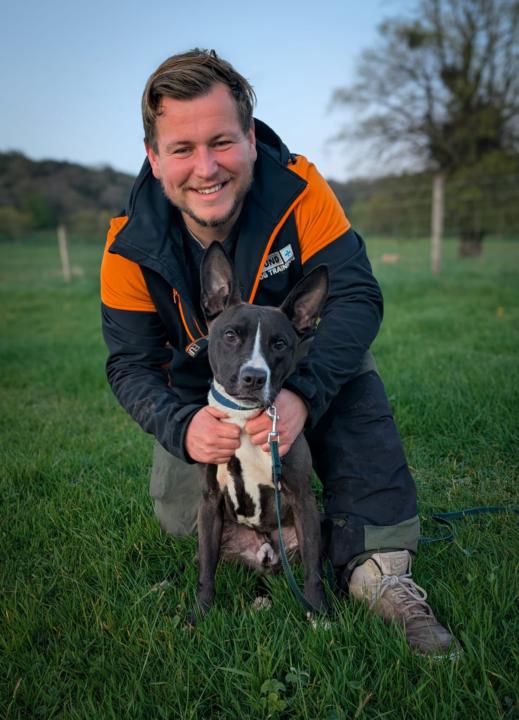
Today I rescued this dog from the pound. He has some behaviour issues that meant he was two hours from being put to sleep. I’ll be training him and sharing updates here and then eventually rehoming him. He needs a new name though. Hit me with your suggestions.
3 likes • Apr 16
with bat like ears a name like Echo, Sonar or Radar
Apr 11 •
Training Chain - Jar
I had been meaning to teach obedience style scent discrimination and retrieve so that was going to be my contribution to the challenges that @Holly Pearson threw my way. However it is a little complex and now a cyclone hitting so will just go with one prepared for something else. The exercise I call Jar is just getting the dog to run to a placed or thrown treat jar and lie down next to it. It is one I now teach first night on a puppy class as a challenge to teach before the class ends. It is like using a dish for remote reward but the closed container has some advantages. As well as teaching a down at a distance the treat jar rattle is a great attention getter in the park. Also I see this as gaining a source of focus in the park away from me I can control so one or two jars can be used for games in the park that help with off leash control by building them up on a long line first and then using the game to test off leash ears in a distracting environment. When getting new people to do it I avoid showing them the end result with a thrown jar to stop them skipping ahead - they need to be good on the waiting for the dumb human to open the jar before adding the throw or you get a dog retrieving or eating the jar.
1 like • Apr 15
@Ave Paasuke Is easy to see the dogs who have a trained freeze as that is their go to when offering. Kizmet learned the freeze as a young pup and although we stopped any scent work a year ago it is still her first choice if not sure of what I want - especially when an object is involved. You might want to try holding the container and moving it around so he does not lock into a freeze and then cue the down. As he goes down stop the container, mark it and reward before you get the freeze. Nothing wrong with the focus on the container just need to get the down first.
2 likes • Apr 15
They say if you want to get something done ask a busy person so as @Samantha Preece seems very busy will nominate her to add something to the training chain.
1-10 of 199
Active 2d ago
Joined Jan 13, 2025
Powered by