Activity
Mon
Wed
Fri
Sun
Aug
Sep
Oct
Nov
Dec
Jan
Feb
Mar
Apr
May
Jun
Jul
What is this?
Less
More
Owned by Mark
Elite biohacking community covering SARMs, SERMs, peptides, risks, rewards, and real industry insight for serious performers.
LSC Supplement Hacks: evidence-led supplement stacks, simple health wins, and optional deeper biohacking for people who want to go further.
72 contributions to Black Ops Biohacking
21h •
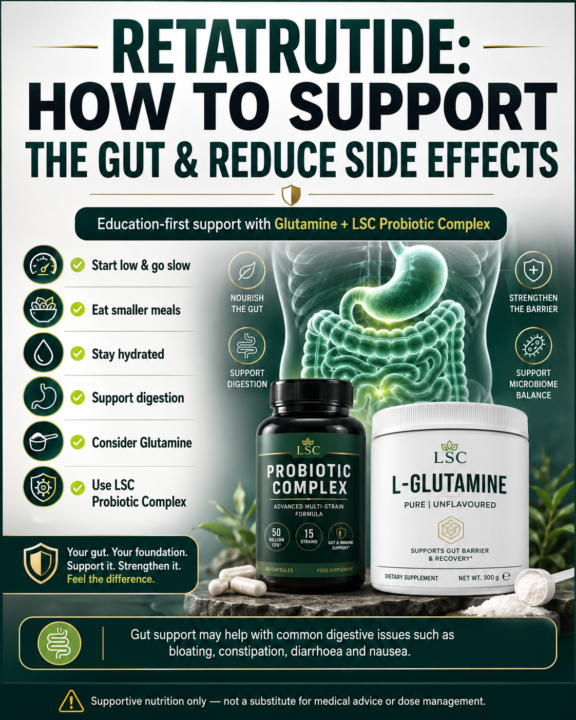
Peptide Intelligence: Retatrutide & Your Gut — Why Support Matters
Peptide Intelligence: Retatrutide & Your Gut — Why Support Matters If you're running retatrutide, you already know it's one of the most aggressive fat-loss peptides on the research scene — triple agonist action on GLP-1, GIP and glucagon receptors doesn't mess about. But that same mechanism is exactly why your gut takes the hit first. Let's talk about why the side effects happen, and more importantly, how to stop them wrecking your results. Why Your Gut Suffers GLP-1/GIP/glucagon agonists work partly by slowing gastric emptying. Food sits in your stomach longer, appetite drops — great for fat loss, less great for your digestive system. The knock-on effects are the classic complaints: - Nausea - Bloating - Constipation (sometimes swinging into diarrhoea) - Reflux - General "my gut hates me" energy None of this means you're doing something wrong. It means your gut lining and microbiome are under more pressure than usual, and they need backup. The Two-Pronged Gut Support Strategy 1. Glutamine — Rebuild the Lining L-Glutamine is the primary fuel source for enterocytes (the cells lining your gut wall). When digestion slows and gut motility changes, that lining takes more wear. Glutamine helps: - Maintain gut barrier integrity (reducing that "leaky gut" risk) - Support mucosal repair - Ease general GI irritation that comes with slowed transit Simple, cheap, and does a specific job well. Not a magic bullet, but a proper foundation stone. 2. LSC Probiotic Complex — Keep the Ecosystem Balanced Slower gastric emptying changes the environment your gut bacteria live in. Combine that with appetite suppression (meaning less fibre and food variety going in, which your microbiome needs to stay diverse), and you've got a recipe for an unhappy biome. A solid multi-strain probiotic: - Helps maintain microbial diversity when food intake drops - Supports regularity (constipation is one of the most reported retatrutide complaints) - Keeps the immune-gut axis functioning while you're in a stressed digestive state -
0
0
9d •
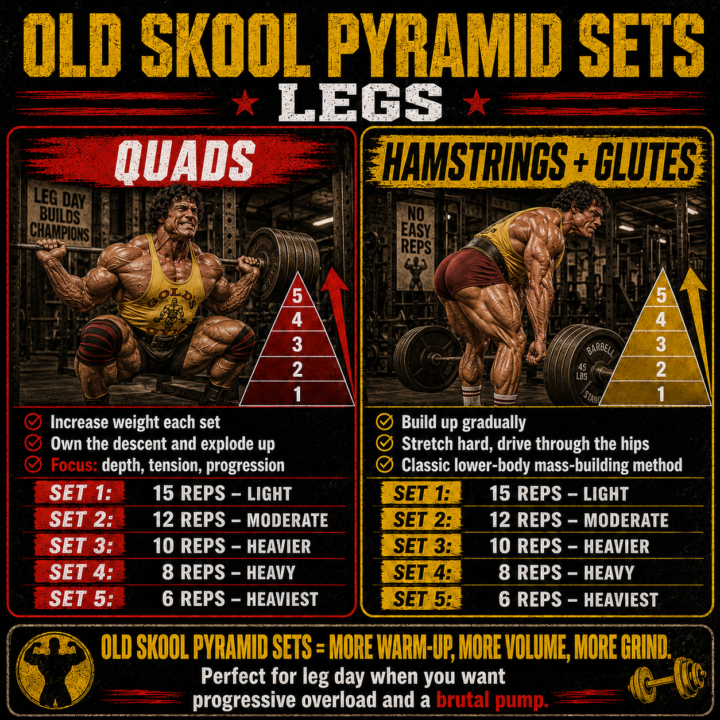
Legs Pyramid Session
1. Barbell Back Squat (true pyramid — sets the tone, just like deadlift did for back day) - Set 1: 15 reps @ ~50% 1RM - Set 2: 10 reps @ ~65% - Set 3: 6 reps @ ~75% - Set 4: 3 reps @ ~85% - Set 5: 1-2 reps @ ~90-95% (top) - Optional back-off set: 8 reps @ ~65% if your CNS can handle it — squats recover a bit better than deadlifts for most people 2. Romanian Deadlift (reverse pyramid — heaviest first, hamstrings still fresh) - Set 1: 6 reps, heaviest working weight - Set 2: 8 reps, drop ~10% - Set 3: 10-12 reps, drop another ~10% - Keep this a hip hinge, not a squat — you should feel it in the hamstrings/glutes, not the lower back 3. Leg Press (true pyramid — now you can afford to grind since spinal loading is off the table) - 20 → 15 → 12 → 8 → 6 reps, climbing weight each set - This is where you can chase real fatigue safely 4. Walking Lunges or Bulgarian Split Squat (straight sets, unilateral) - 3 x 10-12 each leg, same weight - Ironing out imbalances again, same principle as the single-arm row on back day 5. Leg Curl (true pyramid — hamstring isolation) - 15 → 12 → 10 → 8 reps, climbing weight 6. Leg Extension (reverse pyramid — quad isolation, burnout style) - Set 1: 10 reps, heaviest - Set 2: 12 reps, drop ~10% - Set 3: 15-20 reps, drop again, chase the burn 7. Standing Calf Raise (true pyramid) - 20 → 15 → 12 → 10 reps, climbing weight - Pause at full stretch each rep — calves respond to time under tension more than raw load 8. Seated Calf Raise (straight-set burnout) - 3 x 15-20, same weight - Different foot position/angle to hit soleus vs gastrocnemius from the standing version Why this order works Squat first for the same reason deadlift led back day — it's your biggest neurological demand, so it goes in while you're completely fresh. RDL next while hamstrings aren't pre-fatigued from curls. Leg press mops up more quad/glute volume once spinal loading is done, then unilateral work for balance, then isolation work for hamstrings, quads, and calves in that order — biggest muscle mass to smallest.
1
0
9d •
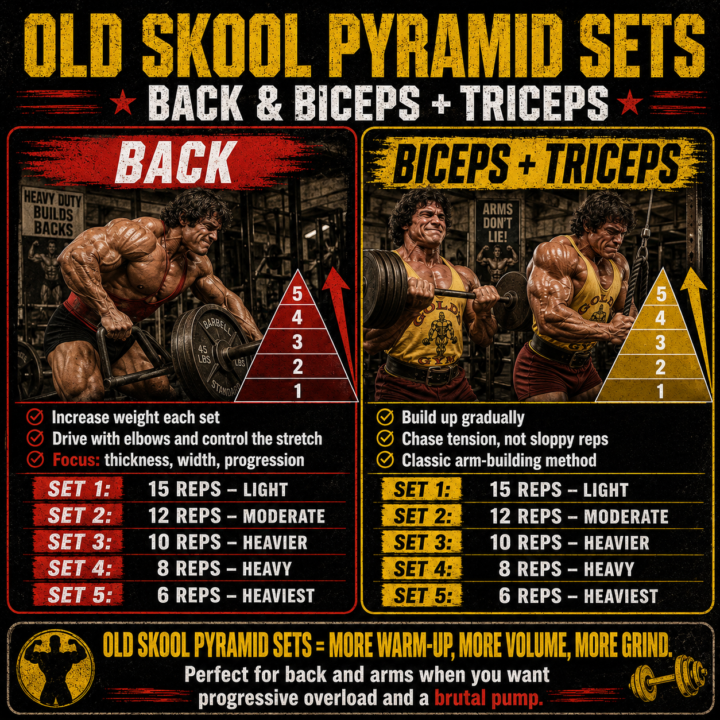
Back & Arms Pyramid Session
1. Deadlift (true pyramid — this sets the tone for the whole session) - Set 1: 12 reps @ ~50% 1RM - Set 2: 8 reps @ ~65% - Set 3: 5 reps @ ~75% - Set 4: 3 reps @ ~85% - Set 5: 1-2 reps @ ~90-95% (top) - Skip the back-off set here — deadlifts are too taxing on the CNS and lower back to add junk volume after a heavy single. 2. Weighted Pull-Ups / Lat Pulldown (true pyramid) - 15 → 12 → 8 → 6 → 4 reps, adding weight each set - If you're not strong enough for weighted yet, run it as: assisted → bodyweight → bodyweight+pause, same rep scheme. 3. Barbell Row (reverse pyramid — heaviest first while back is still fresh off pulldowns) - Set 1: 6 reps, heaviest working weight - Set 2: 8 reps, drop ~10% - Set 3: 10-12 reps, drop another ~10% 4. Single Arm Dumbbell Row (straight sets, 3 x 10-12 each side) - Unilateral work here to iron out any left-right imbalance the barbell work can mask 5. Close-Grip Bench Press or Weighted Dips (true pyramid — triceps compound) - 12 → 10 → 8 → 6 → 4 reps, climbing weight - 6. Barbell Curl (true pyramid — biceps compound) - 12 → 10 → 8 → 6 → 4 reps, climbing weight - Superset this with the close-grip bench above if you want to keep density high — arms recover fast enough to alternate. 7. Overhead Tricep Extension (reverse pyramid) - Set 1: 8 reps, heaviest - Set 2: 10-12 reps, drop ~10% - Set 3: 15 reps, drop again 8. Incline Dumbbell Curl (straight-set burnout) - 3 x 12-15, same weight, full stretch at the bottom, chase the pump 9. Face Pulls (2-3 sets, 15-20 reps) - Non-negotiable again — rear delt/rotator cuff health, and it balances out all the pressing you did on chest day. Skipping this is how shoulders start hurting six months down the line. Why this order works Deadlift first because it's the most neurologically demanding lift you'll do all week — never bury it under fatigue. Back volume work follows while you're still strong, then arms get trained as a mix of compound pyramids (close-grip, curls) and isolation burnouts once the bigger muscle groups are cooked.
1
0
9d •
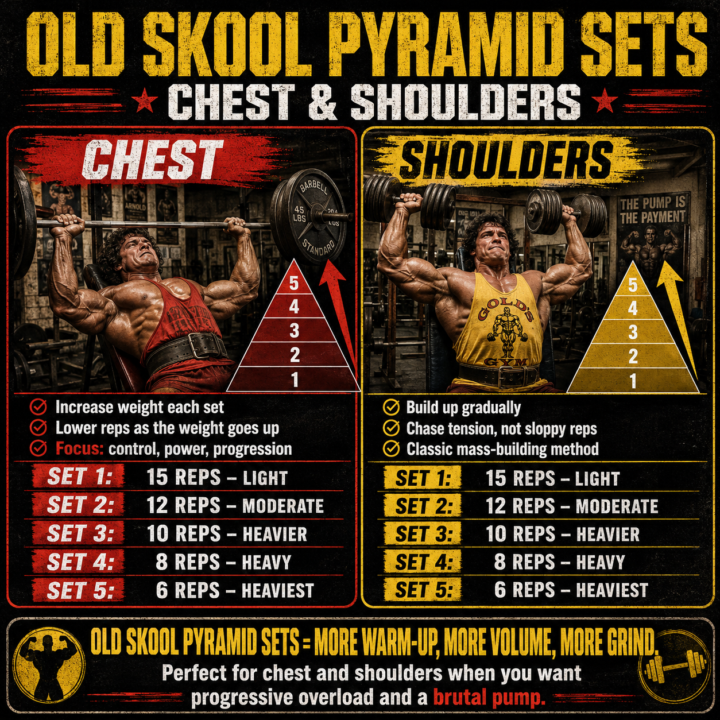
Old Skool Pyramid Sets Chest & Shoulders
Pyramid sets are brilliant for chest and shoulders because they let you hit strength, hypertrophy, and metabolic fatigue all in one session — you warm the joints up progressively (crucial for shoulders especially) while still overloading at the top end. I'll give you a true pyramid (weight up, reps down) on your big compounds, then flip into a reverse pyramid or straight-set burnout on accessories where fatigue management matters more than max loading. Chest & Shoulders Pyramid Session 1. Barbell Bench Press (true pyramid) - Set 1: 15 reps @ ~50% 1RM - Set 2: 12 reps @ ~60% - Set 3: 8 reps @ ~70% - Set 4: 5 reps @ ~80% - Set 5: 2-3 reps @ ~90% (top of pyramid) - Optional Set 6: back off, 8 reps @ ~65% - 2. Seated Overhead Press (true pyramid) - 12 → 10 → 8 → 6 → 3 reps, climbing weight each set - This is where most people get shoulder impingement issues if they skip the light ramp — don't rush the first two sets. - 3. Incline Dumbbell Press (reverse pyramid — heaviest first, since your CNS is already primed from bench) - Set 1: 6 reps, heaviest working weight - Set 2: 8 reps, drop ~10% - Set 3: 10-12 reps, drop another ~10% - 4. Lateral Raises (true pyramid, light-to-light — shoulders don't need heavy pyramiding, they need volume and control) - 20 → 15 → 12 → 12 reps, small weight jumps only - Keep strict form here, this isn't the exercise to ego lift on 5. Cable Flyes or Pec Deck (straight-set burnout finisher) - 3 sets of 12-15, same weight, chase the pump - Optional drop set on the last one - 6. Rear Delt Flyes (2-3 sets, 15 reps) - Non-negotiable — rear delts get neglected and it wrecks shoulder balance long term. Don't skip this because "it's not chest day." - Why this order works Compounds first while you're fresh and CNS is sharp, pyramid loading lets you find your true top-end strength safely (no jumping straight to a 3RM cold), then you shift to accessories where the goal changes from strength expression to volume and pump. Rear delts at the end because everyone's tempted to cut them and everyone regrets it.
1
0
9d •
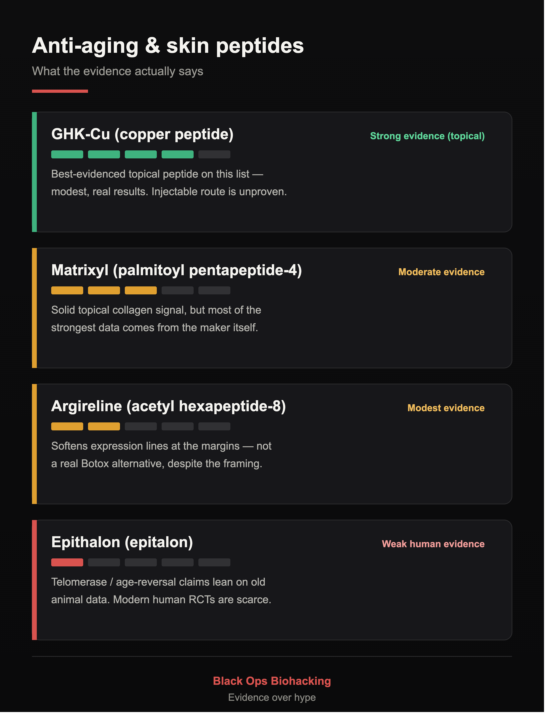
Anti-Aging & Skin Peptides: What the Evidence Actually Says
Skin peptides are having a moment. Every serum shelf and every peptide vendor site now screams "collagen-boosting," "botox alternative," "reverses ageing at the genetic level." Some of that is real. A lot of it is copy-paste marketing wearing a lab coat. Here's the honest breakdown — mechanism, evidence quality, and where the hype outruns the data. GHK-Cu (Copper Peptide / Copper Tripeptide-1) This is the one with the most genuine research behind it, and also the one most aggressively oversold right now. What it is: A naturally occurring copper-binding tripeptide, present in human plasma, saliva and urine from birth. Levels fall off a cliff with age — by some estimates over 60% between age 20 and 60 — which is the entire premise for topping it back up. What it does: Copper is a cofactor for the enzymes that clean up damaged tissue and build new collagen, elastin and blood vessels. GHK-Cu essentially chaperones copper to where it's needed for tissue remodelling, and there's decent evidence it upregulates genes involved in collagen and antioxidant defence while calming inflammatory signalling. The evidence, honestly assessed: - Multiple small RCTs (topical, 8–12 weeks, n=48–60) show measurable wrinkle reduction and collagen density increases versus placebo — genuinely respectable results for a cosmetic actives study. - A recent meta-analysis pooling several RCTs found a statistically significant effect on wrinkle reduction, though with high heterogeneity between studies — translation: the effect is real but the size varies a lot depending on formulation, concentration, and who ran the trial. - Head-to-head comparisons against vitamin C and retinoic acid for collagen stimulation favour GHK-Cu in some studies — worth knowing, but these are still small, industry-adjacent trials, not the kind of scale you'd want before making a hard comparative claim in marketing copy. - Safety data is genuinely reassuring for topical use at low concentrations — this is one of the cleaner-tolerated actives on the market, with low rates of irritation.
0
0
1-10 of 72

@mark-hamilton-7500
No-fluff health & supplement masterclasses. Learn what works, avoid expensive wee, and get Practitioner-style Q&As. Join free while it lasts.
Active 20h ago
Joined Jul 31, 2025