Activity
Mon
Wed
Fri
Sun
Nov
Dec
Jan
Feb
Mar
Apr
May
Jun
Jul
Aug
Sep
Oct
What is this?
Less
More
AI Vibe Tribe
55
$29/m
75 contributions to Black Ops Biohacking

Jul 28 •
MOT-c Support Stack
⚡ TAKING MOTS-c? CONSIDER SUPPORTING YOUR CELLULAR ENERGY SYSTEMS ⚡ MOTS-c is often discussed as a mitochondrial peptide because of its potential relationship with energy metabolism, glucose utilisation and physical performance. However, MOTS-c remains an experimental peptide, with much of the exciting research still coming from laboratory and animal studies rather than large human clinical trials. It is not an approved treatment, so quality, safety and medical supervision genuinely matter. In my latest video, I explain three supplements people interested in mitochondrial health, training performance and cellular energy may want to consider: ⚡ CoQ10: 200 mg CoQ10 plays an important role within the mitochondrial energy-production system and also acts as an antioxidant. Supplementation has been researched for its potential to support energy metabolism, reduce oxidative stress and assist exercise recovery. Research in athletes has used a wide range of approximately 30–300 mg daily, although results vary between individuals. 💪 Micronised Creatine: 10 g Creatine is not only for building bigger muscles. It helps replenish ATP, the body’s immediate energy currency, and can support strength, training performance, recovery and the preservation of lean muscle. Ten grams may be appropriate for larger, highly active individuals, although many people achieve excellent results using 3–5 g daily. More powder does not automatically create more mitochondria, despite what the aggressively veined man on Instagram may suggest. 🧬 NMN + Resveratrol NMN is a precursor used by the body to produce NAD+, a molecule involved in cellular energy metabolism and numerous repair processes. Human studies show that NMN can raise NAD+ availability, but claims surrounding dramatic anti-ageing, fat-loss or performance benefits remain ahead of the available human evidence. Resveratrol is often combined with NMN because of its relationship with cellular stress-response pathways. Research suggesting that it may improve the distribution or effects of NMN is currently largely preclinical, so this should be viewed as promising nutritional support rather than a proven longevity miracle.
0
0

Jul 23 •
The Wolverine Recovery Stack: BPC-157 & TB-500 (Plus Dosing Protocols) 🩹🧬
Welcome back to the group! We’ve talked a lot about fat-loss stacks, but today we are diving into the most popular peptide combination for injury rehabilitation, tissue repair, and joint health: the BPC-157 and TB-500 stack. If you've been dealing with nagging joint pain, tendonitis, or are recovering from a surgery, these are the compounds you will hear about the most in biohacking and fitness circles. Here is a breakdown of what they are and the most commonly discussed dosages. The Compounds 1. BPC-157 (Body Protection Compound 157) BPC-157 is a synthetic peptide derived from a protein naturally found in human gastric juices. Its superpower is its ability to stimulate angiogenesis, which is the formation of new blood vessels. By increasing blood flow to damaged areas, it rushes oxygen and nutrients to injured muscles, tendons, ligaments, and even nerves to accelerate recovery. It also possesses anti-inflammatory properties that help reduce swelling and pain. 2. TB-500 (Thymosin Beta-4) Often paired directly with BPC-157 for a synergistic effect, TB-500 is a piece of the Thymosin Beta-4 peptide. It is widely used to regulate wound healing, decrease inflammation, and reduce oxidative damage. How Are They Dosed? Because these peptides are not FDA-approved for human use, there is no universally prescribed medical dosage. However, based on clinical observations and popular online protocols, here is how they are typically administered: - Frequency and Duration: Dr. Kyle Gillett, an expert in peptide therapy, notes that most dosing regimens for BPC-157 are administered subcutaneously (injected just under the skin) two to three times a week for a period of two to six weeks. - The Dosages: Common protocols advertised in the peptide community suggest a range of 1 mg to 20 mg per week via subcutaneous (SQ) or intramuscular (IM) injections, divided into 2-3 doses throughout the week. - Maintenance Phase: After an initial 1-2 week "loading" phase, it is common for the dose to be lowered to a maintenance level of approximately half the original weekly dose, administered just once a week thereafter. -
0
0

Jul 23 •
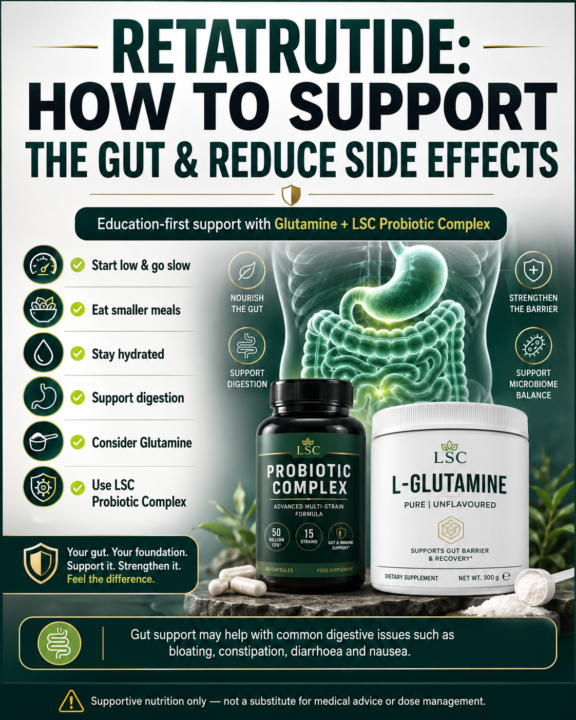
Retatrutide - Possible side effects and what to do to avoid them
If you’re using retatrutide for weight management, you may have noticed changes in your digestion. Slower gastric emptying, constipation and general gut discomfort are common experiences, and understanding how to support your gut during this process is key. In this short video, we break down a simple, practical approach to maintaining gut health while using retatrutide. Here’s what we cover: • Why retatrutide can impact digestion and gut comfort • How supporting your gut microbiome can help maintain balance • The role of L-glutamine in supporting the intestinal lining • How magnesium citrate can assist with bowel regularity • A simple three-part support strategy using the LSC Gut Support Trio This is not about overcomplicating things. It’s about giving your body the support it needs so you can stay consistent with your routine and feel better day to day. If you’re experiencing digestive changes or want to stay ahead of them, this video will give you a clear starting point. https://littlesupplementcompany.co.uk/
0
0

Jul 17 •
Peptide Intelligence: Retatrutide & Your Gut — Why Support Matters
Peptide Intelligence: Retatrutide & Your Gut — Why Support Matters If you're running retatrutide, you already know it's one of the most aggressive fat-loss peptides on the research scene — triple agonist action on GLP-1, GIP and glucagon receptors doesn't mess about. But that same mechanism is exactly why your gut takes the hit first. Let's talk about why the side effects happen, and more importantly, how to stop them wrecking your results. Why Your Gut Suffers GLP-1/GIP/glucagon agonists work partly by slowing gastric emptying. Food sits in your stomach longer, appetite drops — great for fat loss, less great for your digestive system. The knock-on effects are the classic complaints: - Nausea - Bloating - Constipation (sometimes swinging into diarrhoea) - Reflux - General "my gut hates me" energy None of this means you're doing something wrong. It means your gut lining and microbiome are under more pressure than usual, and they need backup. The Two-Pronged Gut Support Strategy 1. Glutamine — Rebuild the Lining L-Glutamine is the primary fuel source for enterocytes (the cells lining your gut wall). When digestion slows and gut motility changes, that lining takes more wear. Glutamine helps: - Maintain gut barrier integrity (reducing that "leaky gut" risk) - Support mucosal repair - Ease general GI irritation that comes with slowed transit Simple, cheap, and does a specific job well. Not a magic bullet, but a proper foundation stone. 2. LSC Probiotic Complex — Keep the Ecosystem Balanced Slower gastric emptying changes the environment your gut bacteria live in. Combine that with appetite suppression (meaning less fibre and food variety going in, which your microbiome needs to stay diverse), and you've got a recipe for an unhappy biome. A solid multi-strain probiotic: - Helps maintain microbial diversity when food intake drops - Supports regularity (constipation is one of the most reported retatrutide complaints) - Keeps the immune-gut axis functioning while you're in a stressed digestive state -
0
0
Jul 9 •
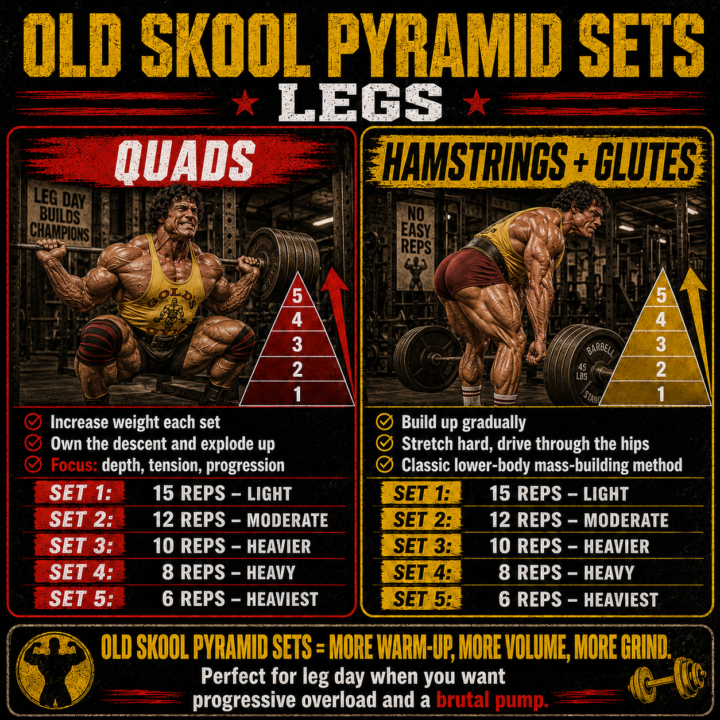
Legs Pyramid Session
1. Barbell Back Squat (true pyramid — sets the tone, just like deadlift did for back day) - Set 1: 15 reps @ ~50% 1RM - Set 2: 10 reps @ ~65% - Set 3: 6 reps @ ~75% - Set 4: 3 reps @ ~85% - Set 5: 1-2 reps @ ~90-95% (top) - Optional back-off set: 8 reps @ ~65% if your CNS can handle it — squats recover a bit better than deadlifts for most people 2. Romanian Deadlift (reverse pyramid — heaviest first, hamstrings still fresh) - Set 1: 6 reps, heaviest working weight - Set 2: 8 reps, drop ~10% - Set 3: 10-12 reps, drop another ~10% - Keep this a hip hinge, not a squat — you should feel it in the hamstrings/glutes, not the lower back 3. Leg Press (true pyramid — now you can afford to grind since spinal loading is off the table) - 20 → 15 → 12 → 8 → 6 reps, climbing weight each set - This is where you can chase real fatigue safely 4. Walking Lunges or Bulgarian Split Squat (straight sets, unilateral) - 3 x 10-12 each leg, same weight - Ironing out imbalances again, same principle as the single-arm row on back day 5. Leg Curl (true pyramid — hamstring isolation) - 15 → 12 → 10 → 8 reps, climbing weight 6. Leg Extension (reverse pyramid — quad isolation, burnout style) - Set 1: 10 reps, heaviest - Set 2: 12 reps, drop ~10% - Set 3: 15-20 reps, drop again, chase the burn 7. Standing Calf Raise (true pyramid) - 20 → 15 → 12 → 10 reps, climbing weight - Pause at full stretch each rep — calves respond to time under tension more than raw load 8. Seated Calf Raise (straight-set burnout) - 3 x 15-20, same weight - Different foot position/angle to hit soleus vs gastrocnemius from the standing version Why this order works Squat first for the same reason deadlift led back day — it's your biggest neurological demand, so it goes in while you're completely fresh. RDL next while hamstrings aren't pre-fatigued from curls. Leg press mops up more quad/glute volume once spinal loading is done, then unilateral work for balance, then isolation work for hamstrings, quads, and calves in that order — biggest muscle mass to smallest.
1
0
1-10 of 75

@mark-hamilton-7500
No-fluff health & supplement masterclasses. Learn what works, avoid expensive wee, and get Practitioner-style Q&As. Join free while it lasts.
Active 11d ago
Joined Jul 31, 2025