Activity
Mon
Wed
Fri
Sun
Jun
Jul
Aug
Sep
Oct
Nov
Dec
Jan
Feb
Mar
Apr
May
What is this?
Less
More
Memberships
The Iron Forge Brotherhood
24.7k members • Free
BioOptimization Collective
261 members • Free
Agency Vault
8k members • Free
Cleaning specialist training
14 members • Free
Commercial Cleaning Program
970 members • Free
Automated Cleaning Business
1.9k members • Free
Commercial Cleaning Owners™
835 members • Free
1 contribution to BioOptimization Collective

14d •
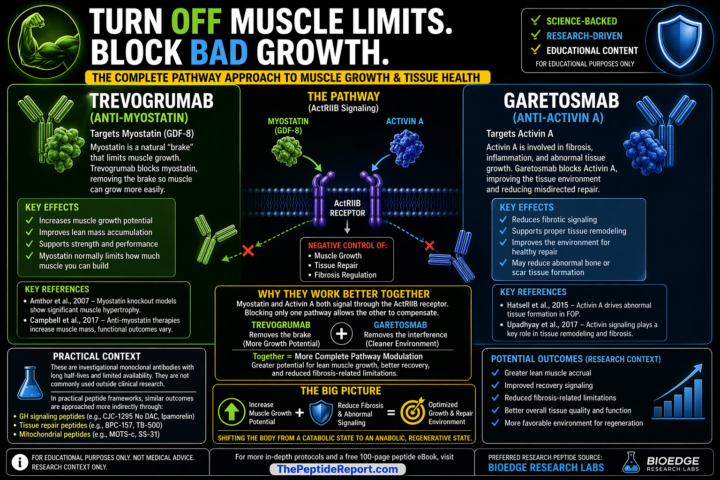
Turned OFF Muscle Limits AND Blocked Bad Growth… This Is What's Coming
Trevogrumab + Garetosmab — Clean Breakdown (Research Context) Trevogrumab and Garetosmab both target the same overall control system in the body: the myostatin/activin pathway, which regulates how muscle grows and how tissue repairs. Trevogrumab (anti-myostatin):This removes the body’s built-in “brake” on muscle growth. Myostatin normally limits how much muscle you can build. When you block it, muscle size can increase more easily.That said, studies show this effect is often incomplete on its own because the body compensates through other signals. - Amthor et al., 2007 — Myostatin knockout models show significant hypertrophy - Campbell et al., 2017 — Anti-myostatin therapies increase mass, but functional outcomes vary Garetosmab (anti-Activin A):This targets Activin A, which is more tied to fibrosis, inflammation, and misdirected tissue growth. Blocking it helps clean up the signaling environment so tissue repair happens more correctly. - Hatsell et al., 2015 — Activin A drives abnormal tissue formation in FOP - Upadhyay et al., 2017 — Activin signaling plays a key role in tissue remodeling and fibrosis Why they matter together: Myostatin and Activin A both signal through the ActRIIB receptor. If you only block myostatin, Activin can still limit results. So the idea is simple: - Trevogrumab → increases muscle growth potential - Garetosmab → reduces negative / fibrotic signaling Together, you’re not just pushing growth you’re also removing interference. Big picture: This is a more complete way to shift the body out of a catabolic (breakdown-limited) state and into a more favorable growth and repair environment. Still experimental, but mechanistically very relevant. In practical peptide frameworks, similar outcomes are approached more indirectly through GH signaling, repair peptides, and mitochondrial support just without directly blocking these pathways.

1 like • 7d
If I’m 33, 234lbs and about 15-16.5% bf and been a trainer/fitness coach for the last 15 years, who’s trains HARD 5 days a week and does a minimum of 3 miles of cardio per day, along with proper nutrition and a goal of lean muscle while burning fat. Is this a stack that would help me? I’m debating going full blown aas which I’ve done before with great results or dabble with peptides like this, what would you recommend
1-1 of 1
@erik-kuusisto-9756
Residential Cleaning Business Owner Looking to take my business over $50,000 Per/Mo. in the next 12 months.
Active 7d ago
Joined Apr 3, 2026
Powered by